
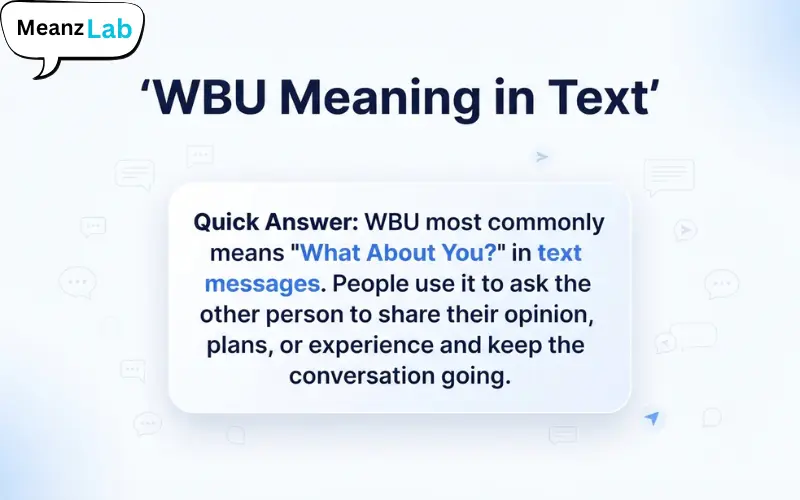
The WBU meaning in text is “What About You?” It is a common texting abbreviation used to return a question to the other person. Instead of typing the entire phrase, people simply write WBU in text messages, social media chats, gaming conversations, and messaging apps.
Example:
Friend: “I’m watching a movie tonight. WBU?”
Here, WBU simply means “What About You?”
Text messaging has changed the way people communicate. Instead of writing long sentences, people often rely on abbreviations that make conversations quicker and easier. Acronyms like LOL, IDK, TBH, IMO, BRB, and SMH have become part of everyday online communication.
One abbreviation that appears in millions of conversations every day is WBU. If you’ve recently received a message ending with “WBU,” you might wonder what it means and how you should respond. Many people search what does WBU mean in text, what does WBU stand for, or simply what does WBU mean after seeing the abbreviation in a chat.
Unlike some internet slang that has several unrelated meanings, WBU is simple and straightforward. It helps keep conversations flowing naturally by inviting the other person to share their opinion, experience, or plans. Instead of asking the same question twice, the speaker answers first and then writes WBU to continue the discussion.
Whether you’re chatting with friends, messaging classmates, talking with coworkers, or commenting on social media, you’ll likely encounter WBU sooner or later. Once you know what it means, you’ll notice how often people use it in everyday conversations.
This guide explains the meaning of WBU, where it is commonly used, why people prefer it over the full phrase, and how to reply naturally in different situations.
What Does WBU Mean in Text?
If you’re asking what does WBU mean in text, the answer is simple:
WBU = What About You?
People use WBU after answering a question themselves. It invites the other person to share the same information.
For example, if someone asks how your weekend is going, you might reply:
“I’m just relaxing today. WBU?”
Instead of writing “What about you?”, the abbreviation keeps the conversation short and casual.
WBU is not limited to one specific topic. It can be used when discussing hobbies, work, school, relationships, travel plans, food, movies, sports, or almost anything else.
Here are some natural examples:
- “I’m working from home today. WBU?”
- “I already finished the assignment. WBU?”
- “My favorite season is winter. WBU?”
- “I’m thinking about ordering pizza tonight. WBU?”
- “I usually wake up early on weekends. WBU?”
Each example invites the other person to continue the conversation by sharing their own experience or opinion.
Quick Meaning
| Abbreviation | Meaning | Common Use |
| WBU | What About You? | Text messages |
| WBU | What About You? | WhatsApp chats |
| WBU | What About You? | Snapchat conversations |
| WBU | What About You? | Social media messaging |
In nearly every casual conversation, WBU simply means “What About You?”
Why Do People Use WBU?
One reason WBU has remained popular is because it makes conversations feel balanced. Instead of talking only about themselves, people invite others to participate by asking for their thoughts.
Imagine typing the complete phrase every time:
- What about you?
- How about you?
- And you?
- What do you think?
- What’s your opinion?
Using WBU communicates the same idea with only three letters.
Another reason people like WBU is that it keeps conversations moving naturally. After answering a question, the speaker immediately encourages the other person to respond.
For example:
“I’ve already seen that movie. WBU?”
This feels much more conversational than ending the message after giving your own answer.
Common Situations Where WBU Is Used
Because WBU simply asks for another person’s opinion or experience, it fits almost every casual conversation.
Daily Life Conversations
Friends often use WBU while discussing everyday activities.
Examples:
- “I’m making coffee before work. WBU?”
- “I spent the afternoon reading. WBU?”
- “I’m staying home tonight. WBU?”
- “I finally cleaned my room. WBU?”
- “I’m going shopping later. WBU?”
These messages encourage the other person to talk about their own plans.
School and College Chats
Students frequently use WBU when discussing homework, classes, and exams.
Examples:
- “I finished the math assignment yesterday. WBU?”
- “My science project is almost done. WBU?”
- “I’m studying for tomorrow’s exam. WBU?”
- “I chose history as my elective. WBU?”
- “I’m joining the debate club. WBU?”
The abbreviation helps keep conversations quick while inviting classmates to share their own progress.
Work Conversations
Coworkers sometimes use WBU during casual workplace chats.
Examples:
- “I’m working remotely today. WBU?”
- “I already submitted the report. WBU?”
- “My meeting starts at 10. WBU?”
- “I’m taking Friday off. WBU?”
- “I’ve completed today’s tasks. WBU?”
Although WBU is acceptable in informal workplace messaging, writing the full phrase is usually better in formal business emails.
Talking About Personal Preferences
People also use WBU when comparing opinions or favorites.
Examples:
- “My favorite singer is Taylor Swift. WBU?”
- “I prefer tea over coffee. WBU?”
- “Summer is my favorite season. WBU?”
- “I enjoy action movies. WBU?”
- “Blue has always been my favorite color. WBU?”
These conversations help people learn more about each other’s interests.
WBU on Snapchat, Instagram, TikTok, and Other Apps
Because WBU is short and easy to type, it appears across nearly every messaging platform.
You’ll commonly see WBU on:
- Snapchat
- Instagram Direct Messages
- TikTok comments
- Discord
- Facebook Messenger
- Telegram
- X (formerly Twitter)
No matter which platform you’re using, the meaning stays the same.
Here are some realistic examples:
- “Just got home from work. WBU?”
- “I’m obsessed with this new song. WBU?”
- “Heading to the gym now. WBU?”
- “I finally watched that series. WBU?”
- “I’m planning a vacation this summer. WBU?”
Unlike many abbreviations that change meaning depending on the app, WBU almost always means “What About You?”
Real Conversation Examples
Seeing WBU in complete conversations makes it much easier to remember.
Conversation 1
Emma: “I’m spending the weekend at my grandparents’ house. WBU?”
Lucas: “I’m going camping with my cousins.”
Conversation 2
Olivia: “I’ve already eaten lunch. WBU?”
Noah: “Not yet, I’m ordering food now.”
Conversation 3
Sophia: “I love mystery novels. WBU?”
James: “I’m more into science fiction.”
Conversation 4
Ava: “I’m thinking of learning Spanish. WBU?”
Ethan: “I’m taking online photography classes.”
Conversation 5
Mia: “I’ve been listening to podcasts lately. WBU?”
Daniel: “I’ve started audiobooks instead.”
These examples show that WBU works naturally in almost any conversation where someone wants to invite another person to share their own thoughts, experiences, or preferences.
WBU in Different Contexts
Although WBU almost always means “What About You?”, the topic of the conversation changes how it’s used.
| Context | Meaning | Example |
| Text Messages | What About You? | “I’m free tonight. WBU?” |
| School Chats | Asking about progress | “I finished my homework. WBU?” |
| Social Media | Asking for opinions | “I love this trend. WBU?” |
| Workplace Messaging | Asking for updates | “My report is done. WBU?” |
The abbreviation remains consistent across these situations. It simply encourages the other person to continue the conversation by sharing their own answer.
Other Meanings of WBU
Although WBU almost always means “What About You?” in text messages, abbreviations can occasionally have different meanings depending on the community or industry. These alternative meanings are much less common, but knowing them helps prevent confusion.
For example, if you’re reading a technical document, a company report, or a niche online forum, WBU may stand for something entirely different. However, in everyday texting, social media conversations, and messaging apps, people almost always use it to ask the other person the same question they have just answered.
Here are a few alternative meanings you might encounter:
- What About You? – Text messages and social media
- World Blind Union – International organization
- Western Business Unit – Internal business communication
- Women’s Bowling Union – Sports organizations (less common)
Examples:
- “I’m heading out now. WBU?”
- “The WBU conference starts next month.”
- “Our WBU exceeded its sales target.”
- “Have you heard about the World Blind Union?”
In almost every casual online conversation, “What About You?” is the correct interpretation.
WBU Compared With Similar Texting Abbreviations
WBU belongs to a group of abbreviations that help keep conversations flowing naturally. While each abbreviation has its own purpose, they are often used together during casual chats.
| Abbreviation | Meaning | Purpose |
| WBU | What About You? | Return a question |
| HBU | How About You? | Ask for someone’s opinion |
| IDK | I Don’t Know | Express uncertainty |
| TBH | To Be Honest | Give an honest opinion |
| IMO | In My Opinion | Share a personal view |
| WYD | What Are You Doing? | Ask about current activity |
Although WBU and HBU are very similar, there is a slight difference.
- WBU usually follows your own answer.
- HBU often introduces a new question or asks about preferences in a broader way.
Examples:
- “I’m staying home tonight. WBU?”
- “I enjoy traveling. HBU?”
- “IDK what time they’re arriving.”
- “TBH, I liked the first movie better.”
- “IMO, this restaurant has the best pizza.”
Learning these abbreviations makes online conversations much easier to follow.
Common Mistakes People Make
Because WBU is simple, people rarely misunderstand it. However, there are still a few common mistakes worth avoiding.
Thinking WBU Has Many Slang Meanings
Unlike abbreviations such as ATP or PDA, WBU rarely changes meaning. In texting, it almost always stands for “What About You?”
Using WBU in Formal Writing
WBU works perfectly in casual conversations but looks unprofessional in business emails, reports, or academic writing.
Instead of writing:
“WBU?”
Write:
“What about you?”
Using WBU Without Context
WBU works best after you’ve answered a question yourself.
For example:
✔ “I’m going hiking this weekend. WBU?”
Instead of:
❌ “WBU?”
without any context.
Confusing WBU With HBU
Although both abbreviations are similar, many people use them interchangeably. While this usually doesn’t cause problems, WBU traditionally means “What About You?”, whereas HBU stands for “How About You?”
When Should You Use WBU?
WBU is appropriate whenever you’re having an informal conversation and want the other person to share their opinion, experience, or plans.
Good situations include:
- Text messages
- WhatsApp chats
- Snapchat conversations
- Instagram DMs
- Discord servers
- Gaming chats
- Family group chats
- Conversations with friends
Examples:
- “I’m cooking dinner tonight. WBU?”
- “I’ve already watched that series. WBU?”
- “I love rainy weather. WBU?”
- “I’m planning a road trip this summer. WBU?”
- “I’ve finished today’s work. WBU?”
These examples feel natural because WBU invites the other person to keep the conversation going.
When Should You Avoid WBU?
Although WBU is widely understood online, it isn’t suitable for every situation.
Avoid using WBU in:
- Business emails
- Cover letters
- Academic essays
- Research papers
- Official correspondence
Instead, write the complete phrase:
“What about you?”
This makes your writing clearer and more professional, especially when communicating with people who may not recognize texting abbreviations.
Formal vs Informal Usage
| Situation | Use WBU? | Better Choice |
| Texting friends | ✅ Yes | WBU |
| WhatsApp chats | ✅ Yes | WBU |
| Snapchat | ✅ Yes | WBU |
| Workplace email | ❌ No | What about you? |
| Academic writing | ❌ No | What about you? |
Choosing the right style ensures your message matches the situation.
Interesting Fact About WBU
One reason WBU has remained popular for so many years is that it encourages two-way conversations. Unlike abbreviations that simply express an emotion, WBU actively invites the other person to respond.
You’ll often notice that conversations become longer and more engaging when someone ends a message with WBU. It shows genuine interest in the other person’s thoughts instead of focusing only on your own answer.
For example:
- “I just started reading a new mystery novel. WBU?”
- “I’ve switched to working remotely this month. WBU?”
- “I finally learned how to bake bread. WBU?”
- “I’m thinking about adopting a dog. WBU?”
- “I’ve been exercising every morning. WBU?”
A simple three-letter abbreviation can turn a one-sided message into an ongoing conversation.
See Also:
- PDA Meaning in Text
- LCR Meaning in Text
- GBTS Meaning in Text
- TV Meaning in Text
- LOML Meaning in Text
FAQs
What does WBU mean in text?
The most common WBU meaning in text is “What About You?” People use it after answering a question to ask the other person for their thoughts, opinions, or experiences. It keeps conversations friendly and encourages both people to participate.
What does WBU stand for?
If you’re wondering what does WBU stand for, it usually stands for “What About You?” in text messages and social media. Although the abbreviation has a few specialized meanings in other fields, this is the definition you’ll encounter most often in everyday conversations.
Is WBU the same as HBU?
WBU and HBU are very similar because both invite another person to respond. WBU means “What About You?”, while HBU means “How About You?” Most people use them interchangeably in casual chats, and both are widely understood.
Can I use WBU in professional emails?
It’s better to avoid WBU in formal communication. Business emails, job applications, and official documents should use the complete phrase “What about you?” instead of the abbreviation. This keeps your writing clear and professional.
Is WBU still popular?
Yes. WBU continues to be widely used across WhatsApp, Snapchat, Instagram, Discord, Messenger, and other messaging platforms. Because it’s short, easy to type, and encourages conversation, it remains one of the most useful texting abbreviations.
Conclusion
The WBU meaning in text is “What About You?” It is one of the most common abbreviations used in messaging apps, social media platforms, and everyday online conversations. People use it after sharing their own answer to encourage the other person to respond with their opinion, experience, or plans.
Whether you’re chatting with friends, classmates, coworkers, or family members, WBU helps create natural, balanced conversations. While the abbreviation has a few uncommon meanings in specialized fields, “What About You?” is almost always the intended definition in casual texting.
The next time someone sends WBU, you’ll know they’re simply inviting you to continue the conversation by sharing your own answer.