
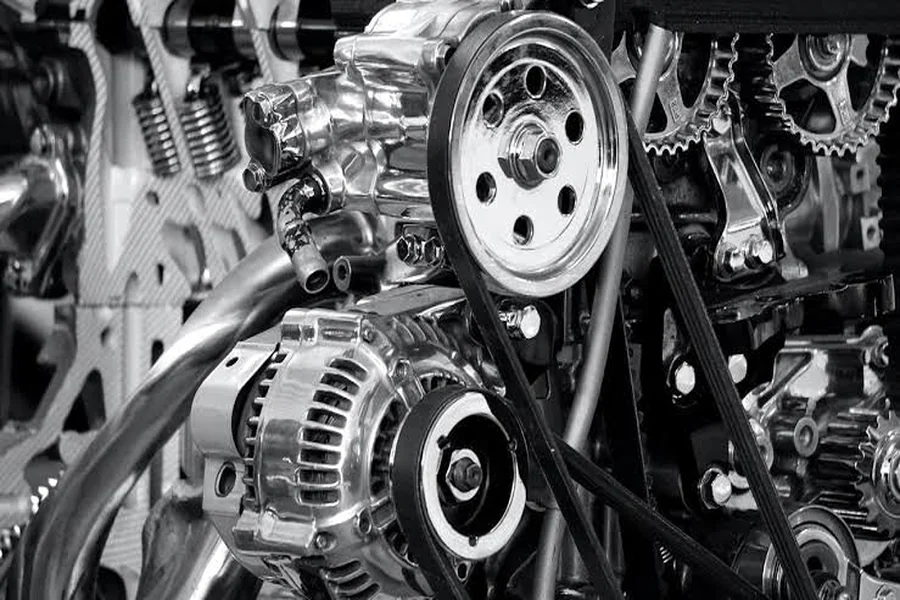
When you turn the ignition key or push the engine start button, a remarkable sequence of mechanical events springs to life beneath the hood. The car engine, often referred to as the heart of the vehicle, transforms chemical energy from fuel into the kinetic mechanical power that drives your wheels. Most passenger vehicles depend on four-stroke internal combustion engines, where controlled mini-explosions occur thousands of times every minute inside sealed combustion chambers.
While modern automotive engines consist of hundreds of specialized components, a core set of primary parts carries out the critical heavy lifting. Understanding how these main parts operate and interact provides driver confidence and builds a better appreciation for essential vehicle maintenance.
The Engine Block: The Structural Core
At the core of every internal combustion engine is the engine block. Manufactured from durable cast iron or lightweight aluminum alloy, the block acts as the heavy-duty framework holding all major engine components in alignment.
The engine block contains the cylindrical bores where combustion takes place. It also features intricate internal passages designed to route engine oil for lubrication and coolant liquid for temperature regulation. During manufacturing, high-precision metalworking techniques like vertical milling are utilized to flatten mating surfaces and carve precise channels, ensuring airtight seals when the block is bolted to the cylinder head assembly.
Pistons and Connecting Rods: Converting Pressure into Force
Pistons are cylindrical metal components engineered to fit snugly inside each cylinder bore. As the fuel system delivers a vaporized mixture of fuel and air into the chamber, spark plugs ignite the compressed charge. The violent expansion of hot combustion gas drives the piston downward with tremendous force.
Each piston connects to the main crankshaft below using a rigid connecting rod. The connecting rod acts as a mechanical linkage that captures the piston’s linear up-and-down motion. Because pistons endure intense combustion pressures and high friction, high-performance engines often employ forged aluminum alloy pistons to endure stress while minimizing moving mass.
The Crankshaft: Turning Linear Motion into Rotation
The linear force generated by descending pistons must be transformed into rotational motion before it can spin your car’s wheels. This conversion happens at the crankshaft, a heavy, precision-machined shaft mounted along the bottom section of the engine block.
As connecting rods push down against offset crank journals, the crankshaft spins. This spinning torque is transferred through the flywheel to the transmission, ultimately powering the vehicle’s drivetrain. Counterweights are strategically integrated along the crankshaft to dampen harsh engine vibrations and balance kinetic forces during acceleration.
The Camshaft and Valvetrain: Managing Engine Breathing
To sustain the internal combustion process, an engine must continually pull in fresh air and expel spent exhaust gases. The camshaft orchestrates this ventilation cycle by controlling the opening and closing times of the intake and exhaust valves.
- Intake Valves: Open to allow the precise mixture of fresh air and fuel into the cylinder.
- Exhaust Valves: Open following combustion to discharge spent exhaust gases into the manifold.
The camshaft features shaped egg-like lobes that press against valve stems as the shaft rotates. The timing belt or timing chain connects the camshaft directly to the crankshaft, ensuring that valve movement stays perfectly synchronized with piston location to prevent physical collisions inside the cylinders.
The Cylinder Head: Sealing the Combustion Chamber
Mounted directly onto top of the engine block, the cylinder head acts as the ceiling for the combustion chambers. Sealed firmly by a head gasket to retain internal pressures, the cylinder head houses critical ignition and fuel delivery hardware, including spark plugs, fuel injectors, and the valvetrain. Intricately shaped intake and exhaust runners inside the head direct incoming airflow and outgoing exhaust gases efficiently.
Conclusion: Powering Your Drive
A car engine functions through the harmonious coordination of mechanical linkages, controlled combustion, and precise timing. From the foundational engine block to the synchronized rotation of the crankshaft and camshaft, each component plays an indispensable role in converting fuel into dependable motion. Staying mindful of routine oil changes, coolant service, and timing belt inspections helps keep this complex mechanical assembly operating smoothly for many miles ahead.