
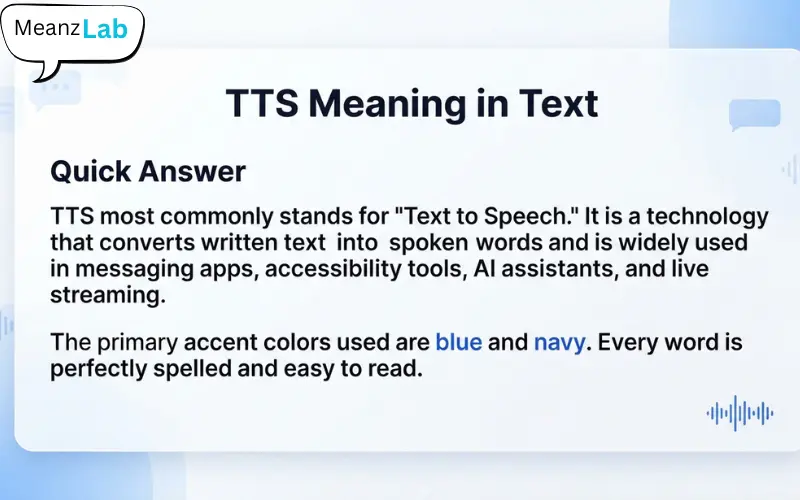
The TTS meaning in text is “Text to Speech.” It refers to technology that converts written words into spoken audio. You’ll commonly see TTS in messaging apps, accessibility tools, live streaming platforms, gaming communities, and AI-powered applications. In streaming culture, TTS also refers to messages or donations that are automatically read aloud during a live broadcast.
Example
Viewer: “I sent a TTS donation.”
Streamer: “I heard your message immediately!”
Here, TTS means the donation message was converted into speech and played during the stream.
If you’ve ever browsed social media, watched a live stream, or explored the settings on your smartphone, you’ve probably seen the abbreviation TTS. Although it consists of only three letters, its meaning is important because it appears in many different areas of technology. Some people encounter it while using accessibility features, while others first hear about it through Twitch, YouTube Live, TikTok, or Discord.
Many users search for tts meaning in text, what does tts mean, what does tts mean in slang, or what does tts stand for because the abbreviation appears in different situations. The good news is that the meaning is usually easy to identify once you understand the context.
In most conversations, TTS stands for Text to Speech. This technology converts written text into spoken words using a computer-generated voice. Millions of people use it every day, often without realizing it. Your phone reading a text message aloud, your GPS giving driving directions, or a virtual assistant answering a question are all examples of Text-to-Speech technology in action.
This guide explains every common meaning of TTS, where it is used, how it works, and why it has become such an important part of modern communication.
What Does TTS Mean in Text?
When people ask, “What does TTS mean in text?”, the answer is almost always Text to Speech.
Text-to-Speech is a digital technology that converts written text into spoken audio. Instead of reading words on a screen, users can listen to them through a computer-generated voice.
This feature is built into many smartphones, tablets, computers, websites, and mobile applications.
Here are a few everyday examples:
- “My phone uses TTS to read incoming messages.”
- “The reading app supports TTS for long articles.”
- “Turn on TTS so you can listen while driving.”
- “This eBook has a built-in TTS feature.”
- “The accessibility menu lets you enable TTS.”
These examples all describe software converting text into speech rather than someone reading the words aloud.
What Does TTS Stand For?
If you’re wondering what does TTS stand for, the answer is straightforward.
TTS = Text to Speech
Each letter represents one word:
- T = Text
- T = To
- S = Speech
The name accurately describes what the technology does—it changes written text into spoken language.
Unlike many internet abbreviations that have several unrelated meanings, TTS has remained consistent for years. Whether you’re discussing smartphones, accessibility, AI, or streaming platforms, Text to Speech is almost always the intended definition.
Common Uses of TTS
| Meaning | Where It’s Used | Example |
| Text to Speech | Phones, computers, apps | “Enable TTS for notifications.” |
| Stream Message Playback | Twitch, YouTube Live | “The donation used TTS.” |
| Accessibility Feature | Screen readers | “TTS reads the document aloud.” |
| AI Voice Technology | Virtual assistants | “The assistant answered using TTS.” |
Although the situations differ, they all involve converting written text into spoken audio.
How Does Text-to-Speech Work?
Text-to-Speech may sound advanced, but the basic process is surprisingly simple.
First, you type or display text on a screen. The software analyzes each word, sentence, and punctuation mark. It then generates spoken audio using a digital voice.
Modern TTS systems also adjust pronunciation, pauses, and sentence flow to make the speech sound more natural.
For example:
- Text: “Good morning! How are you?”
- TTS Output: A digital voice speaks the sentence naturally.
More examples include:
- “The navigation system reads every street name.”
- “My tablet reads PDF files aloud.”
- “The app converted the article into speech.”
- “The AI assistant answered my question using TTS.”
- “The software pronounced difficult words correctly.”
Today’s systems are far more realistic than older robotic voices, making listening much more comfortable.
TTS Meaning in Slang
People also search for what does TTS mean in slang, especially after watching gaming videos or live streams.
In online slang, TTS still refers to Text to Speech, but the focus shifts to live interactions.
Many streamers allow viewers to pay for messages that are automatically read aloud using a computer-generated voice. These are commonly called TTS donations or TTS messages.
Examples include:
- “My TTS donation made everyone laugh.”
- “The streamer enabled TTS during today’s broadcast.”
- “I sent a funny message through TTS.”
- “TTS alerts keep viewers entertained.”
- “His live stream uses TTS for every donation.”
In these cases, TTS isn’t a different definition—it simply describes how the message is delivered.
Where Is TTS Used Every Day?
Many people think TTS only belongs to technology experts, but it’s actually part of everyday life. Millions of people rely on it without even noticing.
Common places where you’ll find TTS include:
- Smartphones
- GPS navigation systems
- Smart speakers
- Virtual assistants
- eBook readers
- Accessibility software
- Educational apps
- Banking apps
- Customer service systems
- Language-learning platforms
Here are five everyday examples:
- “Google Maps uses TTS to announce directions.”
- “My smart speaker reads today’s weather aloud.”
- “The audiobook app generated narration using TTS.”
- “My phone reads incoming notifications while I’m driving.”
- “The language app pronounces every new vocabulary word.”
These examples show that Text-to-Speech has become an essential part of modern digital experiences.
TTS in Live Streaming
One of the most popular uses of Text-to-Speech (TTS) is in live streaming. Platforms such as Twitch, YouTube Live, and Kick allow streamers to connect with viewers in real time. Many creators enable TTS so that donation messages or selected chat comments are read aloud by an AI-generated voice.
This feature makes streams more interactive because viewers can hear their own messages without waiting for the streamer to read them manually. Some creators even customize the voice, speed, or language to match the style of their content.
Here are a few examples:
- “The streamer laughed after hearing my TTS donation.”
- “I sent a message through TTS during the live broadcast.”
- “Today’s stream has TTS enabled for every donation.”
- “The AI voice read my comment instantly.”
- “TTS keeps the audience engaged throughout the stream.”
Although TTS is often associated with streaming slang, it still refers to the same technology—converting written text into spoken words.
TTS in Accessibility
One of the most valuable applications of TTS is improving accessibility. People with visual impairments, reading disabilities, or learning differences can listen to written content instead of reading it on a screen.
Screen readers and accessibility tools rely heavily on Text-to-Speech technology. This allows users to browse websites, read emails, and interact with digital devices independently.
Examples include:
- “The screen reader used TTS to read every menu.”
- “My grandmother listens to news articles using TTS.”
- “The accessibility app reads text messages aloud.”
- “Students with reading difficulties often benefit from TTS.”
- “The website supports TTS for visually impaired visitors.”
Because of these practical benefits, TTS has become an essential feature in many operating systems and mobile devices.
TTS in Education
Teachers, students, and lifelong learners also use Text-to-Speech every day. Listening to written material can improve concentration, pronunciation, and comprehension, especially for lengthy documents.
Educational software often includes TTS so students can hear textbooks, assignments, and study materials while following the written text on the screen.
Examples:
- “I listened to my history chapter using TTS.”
- “The language-learning app pronounced every sentence through TTS.”
- “Students used TTS to review difficult vocabulary.”
- “The online course supports TTS narration.”
- “Listening while reading helped me remember the lesson.”
For many learners, hearing information and reading it at the same time creates a more engaging learning experience.
AI Has Made TTS Sound More Natural
Earlier Text-to-Speech systems often sounded robotic, with unnatural pauses and limited pronunciation. Modern AI has changed that dramatically.
Today’s TTS engines use advanced language models and neural voice synthesis to produce speech that closely resembles a real human voice. They can adjust tone, pacing, pronunciation, and even emotional expression.
Examples:
- “The AI voice sounded almost identical to a human.”
- “I couldn’t tell the narration was generated by TTS.”
- “The assistant changed its speaking speed automatically.”
- “Modern TTS handles names much better than older software.”
- “The audiobook uses AI-powered TTS with natural expression.”
As artificial intelligence continues to improve, the gap between synthetic and human speech becomes smaller every year.
TTS vs. STT
| Feature | TTS (Text to Speech) | STT (Speech to Text) |
| Input | Written text | Spoken voice |
| Output | Audio speech | Written text |
| Main Purpose | Reads text aloud | Converts speech into text |
| Common Uses | GPS, screen readers, audiobooks | Voice typing, captions, dictation |
| Example | Phone reads a message aloud | Phone types what you say |
Although the abbreviations look similar, they perform opposite tasks.
Common Mistakes About TTS
People sometimes misunderstand TTS because they see it used in different online communities. Knowing these common mistakes can help you interpret the abbreviation correctly.
One mistake is believing TTS is only internet slang. In reality, it is primarily a technology term used worldwide.
Another mistake is confusing TTS with STT. While TTS speaks written text, STT listens to spoken words and converts them into writing.
Some users also assume TTS is used only by streamers. However, smartphones, navigation systems, smart assistants, and educational tools all rely on Text-to-Speech technology.
Examples:
- “I thought TTS only existed on Twitch.”
- “My phone uses TTS every day without me noticing.”
- “GPS directions are another example of TTS.”
- “The audiobook app generates narration through TTS.”
- “Screen readers depend on TTS technology.”
Why TTS Is Becoming More Popular
The popularity of Text-to-Speech continues to grow because digital devices are becoming smarter and more accessible.
People use TTS while driving, exercising, cooking, studying, or multitasking. Instead of stopping to read a screen, they can simply listen.
Businesses also use TTS for customer support systems, automated announcements, and virtual assistants. Content creators use it for narration, while educators use it to make learning more accessible.
As AI voices become increasingly realistic, TTS is expected to play an even bigger role in daily communication.
See Also:
- HYB Meaning in Text
- NC Meaning in Text
- FYP Meaning in Text
- GTFO Meaning in Text
- BBW Meaning in Text
- WWA Meaning in Text
FAQs
What does TTS mean in text?
The TTS meaning in text is Text to Speech. It describes technology that converts written words into spoken audio using a computer-generated voice. This feature is commonly found in smartphones, accessibility tools, and many modern applications.
What does TTS mean in slang?
In online slang, especially on streaming platforms, TTS refers to text that is automatically read aloud during live broadcasts. Viewers often send TTS donations or messages that play through an AI voice. Although the setting is different, the meaning still comes from Text to Speech.
What does TTS stand for?
TTS stands for Text to Speech. The abbreviation has been widely used in technology for many years and remains the standard term across different industries. It is one of the most recognized abbreviations in accessibility and voice technology.
Where is Text-to-Speech used?
Text-to-Speech is used in smartphones, GPS navigation, virtual assistants, audiobooks, educational software, accessibility tools, customer support systems, and live streaming platforms. Millions of people use TTS every day, often without realizing it. It helps make digital content easier to access and consume.
What is the difference between TTS and STT?
TTS converts written text into spoken audio, while STT converts spoken words into written text. They are opposite technologies that often work together in modern devices. For example, voice typing uses STT, while a phone reading your messages aloud uses TTS.
Conclusion
The TTS meaning in text is Text to Speech, a technology that converts written words into spoken audio. While many people first encounter TTS through live streams or online chats, it is also an important part of smartphones, accessibility tools, GPS navigation, educational software, virtual assistants, and AI-powered applications.
Whether you’re reading a text message aloud, listening to an article while driving, or hearing a donation message during a livestream, you’re experiencing Text-to-Speech technology in action. Although the abbreviation may appear in different contexts, its core meaning remains the same.
The next time someone asks what does TTS mean, you’ll know that it usually refers to technology that transforms written text into clear, spoken language.