
If you are wondering whether you should write to early or too early, here is the quick and clear answer:
👉 “Too early” is correct.
👉 “To early” is always wrong.
Why?
Because “too” means more than needed, and when we talk about time that is earlier than expected, earlier than comfortable, or earlier than necessary — we use too early.
This tiny rule fixes a very common English mistake and makes your writing look more fluent, more natural, and more professional.
But let’s not stop at the basic rule.
Let’s understand this in a fun, simple, and unforgettable way.
The Real Reason This Mistake Happens
The confusion between to early vs too early happens because both words sound the same when we speak.
Your ears hear:
👂 too early
👂 to early
Same sound.
But grammar is not based on sound.
Grammar is based on meaning and function.
That’s where the magic happens.
What Does “Too Early” Actually Mean?
The phrase too early means:
- earlier than necessary
- earlier than expected
- earlier than comfortable
- more early than it should be
It shows excess.
Just like:
- too big
- too fast
- too hot
- too expensive
It means more than needed.
Real-Life Examples
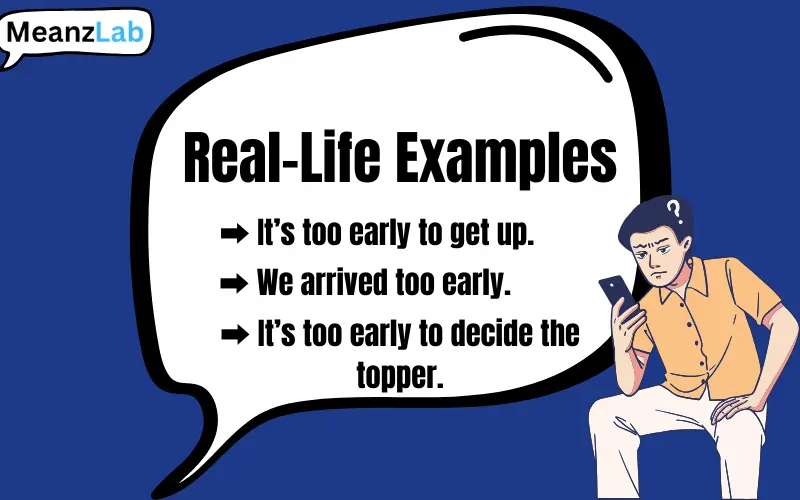
You wake up at 4 AM and say:
➡ It’s too early to get up.
You reach the wedding hall before everyone:
➡ We arrived too early.
Teacher announces results in one day:
➡ It’s too early to decide the topper.
In all these sentences, the time is not wrong, but it is more early than required.
Why “To Early” Is Grammatically Incorrect
Let’s understand this like a small story.
The word to has a job.
It is used for:
- showing direction → go to school
- showing purpose → to learn
- joining with verbs → to eat, to sleep
But early is not a place
and early is not a verb
So to early has no job in the sentence.
That’s why it is always incorrect.
To Early vs Too Early (The Ultimate Comparison Table)
| Form | Correct? | Reason | Example |
| to early | ❌ No | “To” cannot describe time | I woke up to early |
| too early | ✅ Yes | “Too” means excessively | I woke up too early |
The Golden Memory Trick 🧠✨
This trick is loved by beginners and advanced learners.
Think:
Too = Extra
And look at the spelling:
too → has an extra O → extra meaning
So when the time feels extra early, write:
✅ too early
You will never forget this again.
Too Early in Daily Life Situations
This phrase is everywhere in real English.
Morning Life
Your alarm rings at 5 AM.
You say:
😴 It’s too early…
School Life
Your exam preparation starts in January for December exams.
📚 It’s too early to study this chapter.
Office Life
Boss schedules a meeting at 7 AM.
☕ This is too early for a meeting.
Eid Shopping
Markets open one month before.
🛍 It’s too early to buy clothes.
See?
You already use this phrase in your life — now you just use it correctly.
Too Early + To + Verb (Very Important Structure)
This structure is extremely common in spoken and written English.
too early to decide
too early to leave
too early to announce
too early to celebrate
Examples
- It’s too early to make a final judgment.
- It’s too early to predict the winner.
- It’s too early to talk about results.
This structure helps your writing sound natural and fluent.
Too Early vs Very Early (BIG Difference)
Many learners think these are the same.
They are not.
| Phrase | Meaning | Feeling |
| very early | early but okay | normal |
| too early | earlier than acceptable | problem |
Example
✔ I woke up very early to pray. → good
❌ I woke up too early for the meeting. → uncomfortable
Too Early in Questions
You can use it in questions naturally.
- Is it too early to sleep?
- Is it too early to call him?
- Is it too early for lunch?
- Is it too early to start preparation?
This makes your English sound conversational and fluent.
Common Mistakes Related to This Topic
Students who write to early also write:
❌ to late
❌ to big
❌ to small
❌ to fast
All of these should be:
✅ too late
✅ too big
✅ too small
✅ too fast
So when you fix to early or too early, you fix many grammar mistakes at once.
Advanced Usage in Real English
With Nouns
- It’s too early for dinner.
- It’s too early for the announcement.
With Time Expressions
- 6 AM is too early for me.
- January is too early for summer planning.
In Formal Writing
- It is too early to draw conclusions.
- It would be too early to comment on the results.
Synonyms of Too Early
You can use these for variation in content:
- prematurely
- earlier than expected
- ahead of time
- excessively early
Example:
The decision was made prematurely.
Opposite of Too Early
The direct opposite is:
👉 too late
Example:
We arrived too late to enter the hall.
A Fun Story So You Never Forget 😄
Ahmed set an alarm for his cricket match.
Alarm rang at 3 AM.
He opened one eye and said:
“It’s too early.”
He opened the second eye.
Even the sun was sleeping.
Even the birds were sleeping.
Even the street dogs were sleeping.
He turned off the alarm and slept again.
That is too early 😄
Quick Practice Section
Fill the blanks:
- I reached the airport ___ early.
- It’s ___ early to announce the winner.
- We came ___ early for the movie.
Correct answers:
- too early
- too early
- too early
Final Rule That Fixes Everything
Whenever you write about time that is more early than needed, always choose:
✨ too early
Never write to early.
This one small correction makes your English:
✔ clearer
✔ more natural
✔ more fluent
✔ more professional
We have more interesting free grammar guides. Check here:
- To cute or Too cute? Learn the Correct Word in Simple English
- Ran or Run? Learn the Correct Word in Simple English
- Flew or Flown? Learn the Correct Word in Simple English
- Glueing or Gluing? Learn the Correct Word in Simple English
FAQs
Which is correct, to early or too early?
Too early is correct. It means earlier than needed or earlier than expected.
To early is wrong because “to” cannot describe time.
What does too early mean in English?
Too early means something happens before the right time or before it is suitable to happen.
Why do people write to early instead of too early?
People make this mistake because to and too sound the same in speech, but their meanings are different in grammar.
Can I say too early in a sentence?
Yes, you can use it like this:
It is too early to sleep.
We arrived too early for the event.
What is the difference between very early and too early?
Very early means early but okay.
Too early means earlier than comfortable or earlier than necessary.
Is too early grammatically correct?
Yes, too early is 100% grammatically correct and commonly used in both speaking and writing.
Conclusion
The confusion between to early or too early is common, but the solution is beautifully simple.
If the meaning is extra early, the correct phrase is:
✅ too early
And once you remember that too means extra, this mistake disappears from your writing forever.