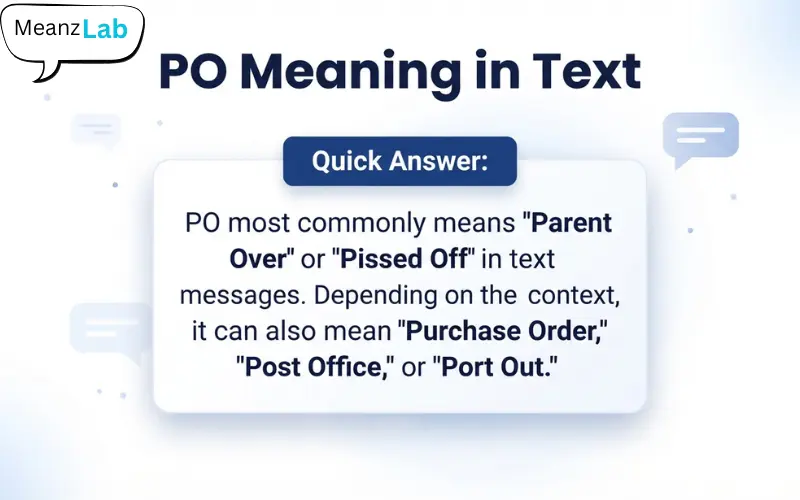
The PO meaning in text depends on the conversation, but the two most common meanings are “Parent Over” and “Pissed Off.” Teenagers often use PO to let friends know that a parent is nearby, while others use it to express anger or frustration. Outside texting, PO can also stand for Purchase Order, Post Office, Port Out, or Pet Owner.
Text messaging has changed the way people communicate. Instead of typing long sentences, people often rely on abbreviations that save time while keeping conversations quick and natural. Acronyms such as LOL, IDK, TBH, and BRB have become a normal part of everyday communication, and new abbreviations continue to appear across social media, gaming platforms, and messaging apps.
One abbreviation that often confuses people is PO. Unlike many internet acronyms that have only one widely accepted definition, PO can represent several completely different phrases. The intended meaning depends on who is using it, where it appears, and what the conversation is about. A teenager chatting with friends may use PO differently from someone discussing business documents or shipping information.
This is why many people search for what does PO mean in text, PO meaning, what does PO mean, or what does PO mean in slang after seeing the abbreviation in a text message, Snapchat conversation, Instagram comment, or workplace email.
The good news is that you rarely have to guess. By paying attention to the surrounding conversation, you can usually identify the correct meaning within seconds. This guide explains the most common definitions of PO, where each one is used, and how to recognize the right meaning with practical examples.
What Does PO Mean in Text?
When people ask “What does PO mean in text?”, they are usually referring to casual conversations on messaging apps or social media.
The abbreviation has several accepted meanings, but these are the ones you’re most likely to encounter:
- Parent Over
- Pissed Off
- Purchase Order
- Post Office
- Port Out
- Pet Owner
Although every meaning is correct in the right situation, Parent Over and Pissed Off are the definitions most commonly seen in texting.
The reason PO can be confusing is that it consists of only two letters. Short abbreviations are often adopted by different communities, each giving them a different meaning. As a result, context becomes much more important than the letters themselves.
Common Meanings of PO
| PO Meaning | Where It’s Commonly Used | Example |
| Parent Over | Texting, Snapchat, chats | “PO, talk later.” |
| Pissed Off | Casual conversations | “I’m still PO.” |
| Purchase Order | Business and finance | “Please approve the PO.” |
| Post Office | Shipping and mail | “The package is at the PO.” |
| Port Out | Mobile networks | “Your number is ready for PO.” |
| Pet Owner | Online communities | “PO looking for advice.” |
This table shows why the surrounding conversation matters so much. The exact same abbreviation can represent completely different ideas.
PO as “Parent Over”
Among teenagers and younger users, Parent Over is one of the most popular meanings of PO.
This abbreviation acts as a quick warning. Instead of typing, “My mom is standing behind me,” or “My dad can see my phone,” users simply send PO to let their friends know they should avoid discussing anything private.
The message is short, discreet, and immediately understood by people who are familiar with the abbreviation.
Examples
- Friend: “Did you tell your parents about the surprise?”
You: “PO.” - Friend: “Can we gossip now?”
You: “Not yet, PO.” - “PO, I’ll text you after dinner.”
- “Delete that message. PO just walked in.”
- “Can’t explain right now. PO.”
In every example, PO serves as a warning rather than part of the main conversation. It tells the other person to change the subject or wait until it’s safe to continue.
PO as “Pissed Off”
Another common answer to what does PO mean in slang is Pissed Off.
This meaning is used when someone feels annoyed, disappointed, frustrated, or angry. Instead of writing an entire sentence describing their emotions, they simply type PO.
Because it’s short and easy to understand, it appears regularly in text messages, online chats, and social media conversations.
Examples
- “I’m PO after today’s meeting.”
- “He’s still PO about losing the game.”
- “That customer was really PO.”
- “My flight got canceled, so I’m PO.”
- “She sounded PO after reading the comments.”
Unlike the Parent Over meaning, this definition describes an emotional state. Looking at the conversation quickly tells you which interpretation fits.
Why Does PO Have So Many Meanings?
Many internet abbreviations develop naturally rather than through official rules. When an abbreviation is very short, different groups often begin using it for completely different phrases.
For example, students may use PO to mean Parent Over, office workers use it for Purchase Order, postal employees think of Post Office, and mobile service providers recognize it as Port Out.
None of these meanings are incorrect. They simply belong to different situations.
Imagine reading these messages:
- “Please sign the PO before noon.”
- “PO is watching.”
- “The package reached the PO.”
- “I’m really PO today.”
Although each message contains the same abbreviation, the surrounding words completely change its meaning.
This is why experienced internet users rarely focus on the abbreviation alone. Instead, they consider the topic of the conversation before deciding what PO represents.
PO in Social Media Conversations
Social media platforms encourage fast communication, making abbreviations more popular than ever. Whether people are commenting on photos, replying to stories, or chatting through direct messages, short acronyms help them communicate quickly.
PO appears regularly on platforms such as:
- Snapchat
- TikTok
- Discord
- Facebook Messenger
- X (formerly Twitter)
The meaning usually changes depending on the discussion.
Examples
- “Everyone in the comments is PO.”
- “PO, message you later.”
- “Don’t send that picture. PO.”
- “Why is everyone so PO after today’s announcement?”
- “PO right now, can’t explain.”
The first and fourth examples most likely mean Pissed Off, while the second, third, and fifth examples usually mean Parent Over. Simply reading the surrounding conversation makes the difference clear.
PO in Business and Professional Communication
Outside texting and social media, PO most commonly stands for Purchase Order. This is a formal business document used to request goods or services from a supplier. It includes details such as product descriptions, quantities, prices, delivery dates, and payment terms.
If you work in accounting, procurement, logistics, or inventory management, you’ll probably see PO almost every day. In this context, it has nothing to do with texting slang.
Examples
- “Please send me the approved PO before placing the order.”
- “The supplier hasn’t received our PO yet.”
- “Accounting needs the PO number for payment.”
- “The warehouse can’t ship the products without a valid PO.”
- “I’ll update the PO after confirming the pricing.”
When discussing business documents, Purchase Order is almost always the correct interpretation.
PO as “Post Office”
Another widely recognized meaning of PO is Post Office. This definition is common in conversations about mail, shipping, parcels, and deliveries.
People often shorten “Post Office” to PO because it’s faster to type, especially in text messages.
Examples
- “Your package is waiting at the PO.”
- “I’m stopping by the PO after work.”
- “The letter was returned to the PO.”
- “The PO closes at 5 p.m.”
- “Can you pick up the parcel from the PO tomorrow?”
In each example, the discussion revolves around mail or deliveries, making the meaning easy to identify.
PO in Telecommunications
In the mobile phone industry, PO may stand for Port Out. This refers to transferring a phone number from one mobile carrier to another.
Although this meaning isn’t as common in everyday texting, customers may encounter it while switching service providers.
Examples
- “Your PO request has been approved.”
- “The number transfer is still in the PO process.”
- “Please wait until the PO is complete.”
- “Customer support confirmed the PO yesterday.”
- “Your service will end once the PO finishes.”
If the conversation involves phone numbers or network providers, Port Out is usually the intended meaning.
How to Identify the Correct Meaning of PO
Because PO has several definitions, learning to read the context is more important than memorizing every possible meaning.
Ask yourself a few simple questions:
- Are people talking about family or texting?
- Is someone expressing an emotion?
- Does the conversation involve business documents?
- Are shipping or packages being discussed?
- Is the topic related to mobile phone services?
The answers usually reveal the correct definition immediately.
For example:
Message: “PO is here.”
Meaning: Parent Over
Message: “I’m PO after today’s meeting.”
Meaning: Pissed Off
Message: “Email me the PO.”
Meaning: Purchase Order
Message: “The package arrived at the PO.”
Meaning: Post Office
These examples demonstrate why context matters far more than the abbreviation itself.
Common Mistakes People Make
One of the biggest mistakes is assuming that PO always means Pissed Off because that’s the definition they learned first. While this interpretation is common, it doesn’t fit every conversation.
Another mistake is using PO in formal writing without considering the audience. In casual text messages, abbreviations are perfectly acceptable. However, in reports, academic assignments, or professional emails, writing the complete phrase often improves clarity.
People also confuse Parent Over with Parenting Over or other similar expressions. In texting slang, Parent Over specifically means that a parent is nearby and may be able to see the conversation.
When Should You Use PO?
PO works best in informal communication where everyone understands the abbreviation. Friends, classmates, gaming partners, and family members often use it because it saves time and keeps conversations moving quickly.
It is also appropriate in industries where Purchase Order or Post Office is a well-known abbreviation.
You should avoid using PO in situations where readers may not recognize its meaning.
Good situations include:
- Casual text messages
- Group chats
- Social media conversations
- Gaming discussions
- Internal workplace messages
Less suitable situations include:
- Academic essays
- Legal documents
- Formal business letters
- Professional reports
- Official presentations
Writing the complete phrase removes any possibility of misunderstanding.
PO Compared with Other Texting Abbreviations
Learning PO becomes easier when you compare it with other abbreviations that appear regularly in online conversations.
| Abbreviation | Meaning | Typical Use |
| LOL | Laughing Out Loud | Showing laughter |
| BRB | Be Right Back | Taking a short break |
| IDK | I Don’t Know | Expressing uncertainty |
| TBH | To Be Honest | Sharing an honest opinion |
| SMH | Shaking My Head | Showing disappointment |
| IMO | In My Opinion | Giving a personal view |
| PO | Parent Over / Pissed Off / Purchase Order / Post Office | Depends on context |
Although most abbreviations have one primary meaning, PO stands out because it is used in several completely different fields.
See Also:
- OMY Meaning in Text
- GL Meaning in Text
- GPI Meaning
- MB Meaning in Text
- MS Meaning in Text
- MK Meaning in Text
FAQs
What does PO mean in text?
The most common PO meaning in text is Parent Over or Pissed Off. Teenagers often use it to let friends know that a parent is nearby, while others use it to express frustration or anger. The correct meaning depends entirely on the conversation.
What does PO mean in slang?
In internet slang, PO usually means Parent Over or Pissed Off. These two meanings appear frequently in text messages, Snapchat chats, Discord servers, and social media conversations. Reading the surrounding messages will help you determine which one is intended.
Can PO mean something other than texting slang?
Yes. Outside casual conversations, PO commonly stands for Purchase Order, Post Office, Port Out, or Pet Owner. These meanings are widely used in business, shipping, telecommunications, and online communities.
Is PO appropriate in professional writing?
That depends on the meaning. Purchase Order is a standard business abbreviation and is perfectly acceptable in workplace documents. However, slang meanings such as Parent Over or Pissed Off should generally be avoided in formal writing.
How can I tell which PO meaning is correct?
The easiest method is to look at the topic of the conversation. Discussions about emotions usually point to Pissed Off, while messages about parents suggest Parent Over. Business, shipping, or telecommunications conversations typically indicate one of the professional meanings of PO.
Conclusion
The PO meaning in text isn’t limited to a single definition. In casual conversations, it most commonly means Parent Over or Pissed Off, while in professional settings it often refers to a Purchase Order. Other accepted meanings include Post Office, Port Out, and Pet Owner, depending on the situation.
Instead of guessing, always read the surrounding conversation before deciding what PO represents. A message about homework, business, shipping, or emotions provides valuable clues that help identify the correct meaning.
Once you become familiar with these common uses, you’ll find it much easier to understand PO in text messages, social media posts, workplace conversations, and online communities.