IGL Meaning in Text: What Does IGL Mean in Gaming?
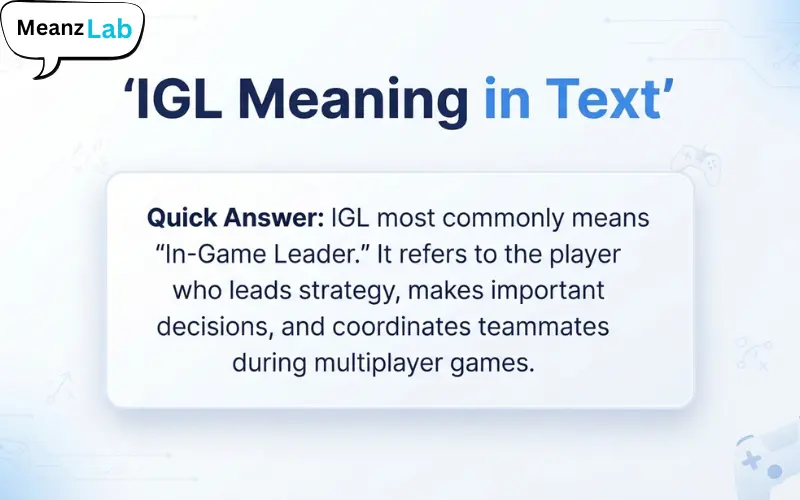
The IGL meaning in text is most commonly “In-Game Leader.” It refers to the player responsible for leading a team during multiplayer games by making strategic decisions, coordinating teammates, and calling important plays. You’ll often see IGL used in competitive games like Valorant, Counter-Strike 2 (CS2), PUBG, Fortnite, and Call of Duty.
Example
Player 1: “Who’s making the calls this match?”
Player 2: “I’m the IGL.”
In this conversation, IGL means In-Game Leader, the player responsible for guiding the team’s strategy.
Gaming has developed its own language over the years. Whether you’re playing casually with friends or competing in professional tournaments, you’ll come across abbreviations that make communication faster and more efficient. Terms like GG, AFK, DPS, MVP, and IGL have become a regular part of conversations in gaming communities.
One abbreviation that often confuses new players is IGL. Unlike common texting shortcuts such as LOL or IDK, IGL is closely connected to multiplayer and esports games. If you’ve seen someone mention an IGL during a match or read the term in a gaming forum, you may have wondered what it actually means.
Many people search online for IGL meaning in text, what does IGL mean in text, IGL meaning, or what does IGL mean in slang after hearing commentators mention it during esports tournaments or seeing players discuss it in chat. Although the abbreviation may seem technical at first, its meaning is actually quite simple.
An IGL is much more than just another teammate. This player serves as the tactical brain of the squad, helping everyone stay organized during fast-paced matches. Instead of every player making independent decisions, the IGL creates a clear strategy, communicates important information, and adapts to changing situations throughout the game.
Whether you’re new to competitive gaming or simply curious about gaming terminology, learning what IGL means will help you better understand team-based games and online discussions.
What Does IGL Mean in Text?
If you’re wondering what does IGL mean in text, the answer is usually:
IGL = In-Game Leader
An In-Game Leader is the player responsible for making strategic decisions while the match is in progress. Rather than focusing only on personal performance, the IGL keeps track of the entire team’s position, objectives, and enemy movements.
Think of an IGL as the coach on the battlefield. While everyone contributes by aiming, defending, or attacking, the IGL decides when, where, and how those actions should happen.
For example, during a tactical shooter, the IGL might instruct teammates to attack one bomb site before quickly rotating to another. In a battle royale game, they may decide where the team should land, when to fight, and when to avoid unnecessary battles.
Here are some original examples:
- “Our IGL wants everyone to defend the left side.”
- “The IGL called a quick rotation after spotting enemies.”
- “Without a strong IGL, our team kept making random decisions.”
- “He became our IGL because he has the best game sense.”
- “Listen to the IGL before pushing the objective.”
Each example highlights the leadership role rather than individual gameplay.
Quick Comparison Table
| Abbreviation | Meaning | Common Use |
| IGL | In-Game Leader | Competitive gaming |
| GG | Good Game | End of a match |
| AFK | Away From Keyboard | Temporary absence |
| DPS | Damage Per Second | Character role |
| MVP | Most Valuable Player | Best-performing player |
Among these gaming abbreviations, IGL is unique because it refers to a leadership role instead of an action or reaction.
Why Is an IGL Important?
In team-based games, having skilled players isn’t always enough to win. A team with excellent communication and organization often defeats a group of individually talented players who fail to work together.
This is where an IGL becomes essential.
Instead of allowing everyone to make separate decisions, the IGL keeps the team focused on one strategy. This reduces confusion, improves teamwork, and helps players react quickly when situations change.
A good IGL helps the team by:
- Planning attack and defense strategies.
- Making decisions during intense moments.
- Coordinating teammates’ movements.
- Choosing when to fight or retreat.
- Adjusting tactics after reading the opponent’s strategy.
Without clear leadership, teammates may rush different objectives, waste resources, or miss important opportunities.
Main Responsibilities of an IGL
Being an IGL involves much more than simply giving instructions. The role requires constant attention, communication, and decision-making throughout the entire match.
Here are some of the key responsibilities.
Creating a Strategy
Before a match even begins, the IGL usually develops a plan based on the team’s strengths and the game’s objectives.
Examples include:
- Choosing the safest landing spot in PUBG.
- Planning an opening attack in Valorant.
- Assigning defensive positions in CS2.
- Selecting the first objective in Call of Duty.
- Deciding how aggressively the team should play.
A strong opening strategy often gives the team an early advantage.
Making Mid-Game Decisions
No strategy survives unchanged throughout an entire match. Opponents constantly adapt, so the IGL must adjust accordingly.
Examples include:
- Calling a retreat after spotting too many enemies.
- Rotating to another objective.
- Changing defensive positions.
- Switching from aggressive to defensive play.
- Saving resources for later rounds.
These quick decisions often determine whether a team wins or loses.
Coordinating Team Communication
Communication is one of the most valuable skills an IGL can have.
Instead of everyone talking at once, teammates listen for clear instructions from the IGL.
Examples:
- “Rotate to B.”
- “Hold your position.”
- “Don’t peek yet.”
- “Push together in three seconds.”
- “Cover the left entrance.”
Short, precise commands help teammates react immediately without confusion.
Reading the Opponent
Experienced IGLs don’t simply react—they predict.
By observing enemy behavior, they can identify patterns and adjust the team’s strategy before problems occur.
Examples:
- Predicting another attack on the same objective.
- Expecting an enemy flank.
- Recognizing repeated strategies.
- Changing defensive setups.
- Taking advantage of predictable rotations.
This ability often separates average IGLs from exceptional ones.
Real Conversation Examples
Seeing IGL used naturally makes the abbreviation much easier to remember.
Conversation 1
Player: “Who’s calling today’s strategy?”
Teammate: “Alex is our IGL.”
Conversation 2
Friend: “Why did everyone rotate so quickly?”
Player: “The IGL made the call.”
Conversation 3
Teammate: “Should we attack now?”
IGL: “Wait five seconds, then push together.”
Conversation 4
Player: “Our IGL changed the plan after spotting two enemies.”
Friend: “Good decision.”
Conversation 5
Commentator: “The IGL’s smart rotation completely changed the match.”
These conversations demonstrate how the IGL serves as the decision-maker who keeps the entire team organized during competitive gameplay.
IGL in Popular Games
The term IGL is most closely associated with competitive multiplayer games where teamwork is essential. While every player contributes through aiming, movement, or supporting teammates, the IGL focuses on the bigger picture by making decisions that benefit the entire squad.
Different games require different leadership styles, but the core responsibility remains the same—guiding the team toward victory through communication and strategy.
Valorant
In Valorant, the IGL decides how the team approaches each round. They determine whether the team should attack aggressively, play defensively, fake a site push, or rotate after gathering information.
Examples:
- “Our IGL wants to execute on B Site.”
- “Wait for the IGL’s signal before using your ultimate.”
- “The IGL called a late rotation.”
- “Listen to the IGL during eco rounds.”
- “Our IGL changed the strategy after spotting two defenders.”
Counter-Strike 2
In CS2, the IGL has one of the most demanding roles on the team. They monitor the economy, call bomb site executions, organize defensive setups, and decide when to save weapons for future rounds.
Examples:
- “The IGL called a fast A push.”
- “We’ll save this round because of the IGL’s decision.”
- “Our IGL predicted their rotation.”
- “Everyone followed the IGL perfectly.”
- “The IGL adjusted our strategy after halftime.”
PUBG
Battle royale games also rely heavily on strong leadership.
An IGL decides:
- Where to land.
- When to rotate into the safe zone.
- Which fights to take.
- When to avoid unnecessary battles.
- How to position the squad during the final circles.
Examples:
- “The IGL marked a safe landing spot.”
- “Follow the IGL to the next zone.”
- “Our IGL wants to avoid this fight.”
- “The IGL spotted another squad.”
- “Trust the IGL during the final circle.”
Fortnite and Call of Duty
Even though these games move at a faster pace, communication remains important.
The IGL may decide:
- Which objectives to capture.
- Where teammates should rotate.
- When to build or defend.
- Which enemy team to challenge.
- How to coordinate pushes.
Strong leadership often separates winning teams from average ones.
IGL vs Other Gaming Roles
An IGL is only one part of a successful team. Other players specialize in different responsibilities while the IGL keeps everyone working together.
| Role | Main Responsibility |
| IGL | Creates strategy and leads the team |
| Entry Fragger | Starts fights and creates openings |
| Support | Helps teammates with utilities and resources |
| Lurker | Flanks opponents and gathers information |
| Sniper / AWPer | Eliminates enemies from long range |
Each role is important, but the IGL connects them by making sure everyone follows the same plan.
IGL vs Team Captain
Many people assume an IGL and a team captain are always the same person, but that isn’t necessarily true.
A captain often manages the team outside the game by organizing practice sessions, discussing schedules, and representing the team in tournaments. An IGL, however, focuses on decisions made during live matches.
| Feature | IGL | Team Captain |
| Main Focus | Match strategy | Team management |
| Makes live decisions | Yes | Sometimes |
| Organizes practice | Occasionally | Usually |
| Leads during gameplay | Yes | Not always |
| Represents the team | Sometimes | Usually |
In some professional esports teams, one player performs both roles. In others, they are handled by different people.
Skills Every Great IGL Needs
Being an IGL requires much more than mechanical skill. The best leaders combine game knowledge with strong communication and decision-making abilities.
Important qualities include:
- Excellent map awareness.
- Calm decision-making under pressure.
- Clear communication.
- Leadership confidence.
- Quick adaptation to changing situations.
Examples:
- A good IGL remains calm after losing an early fight.
- They quickly change strategies if opponents adjust.
- They encourage teammates after mistakes.
- They recognize patterns in enemy gameplay.
- They make decisions that benefit the entire squad instead of chasing personal statistics.
These qualities often matter more than raw aiming ability.
Common Mistakes New IGLs Make
Leading a team isn’t easy, and many new IGLs make similar mistakes while learning.
Some common errors include:
- Giving too many complicated instructions.
- Changing strategies too frequently.
- Ignoring teammates’ suggestions.
- Panicking after losing one round.
- Speaking unclearly during important moments.
For example:
- Calling two different strategies at the same time confuses teammates.
- Constantly changing plans makes players hesitate.
- Talking over teammates can hide important information.
- Becoming frustrated often hurts team morale.
- Rushing decisions without gathering information can lead to unnecessary losses.
Experienced IGLs learn to stay calm, communicate clearly, and trust their teammates.
When Should You Use IGL?
Although IGL is common in gaming communities, it isn’t a general internet abbreviation like LOL or BRB.
You should use it when discussing:
- Competitive gaming.
- Esports tournaments.
- Multiplayer team games.
- Gaming strategy.
- Team leadership.
Examples:
- “Who’s our IGL for tonight’s tournament?”
- “Our IGL made the perfect rotation.”
- “Listen to the IGL before pushing.”
- “Every successful team needs a strong IGL.”
- “He’s becoming an excellent IGL.”
Outside gaming conversations, many people won’t recognize the abbreviation, so writing In-Game Leader may be clearer.
See Also:
- NDA Meaning in Text
- OTOE Meaning in Text
- NTY Meaning in Text
- ELO Meaning in Text
- HWY Meaning in Text
- GPI Meaning in Text
FAQs
What does IGL mean in text?
The IGL meaning in text is “In-Game Leader.” It describes the player responsible for making strategic decisions and guiding teammates during multiplayer games. The abbreviation is widely used in competitive gaming and esports.
What does IGL mean in slang?
In gaming slang, IGL refers to the leader who calls strategies and coordinates the team during matches. Unlike general internet slang, it has a specific meaning within competitive gaming communities. Most players immediately recognize IGL as In-Game Leader.
Which games commonly use the term IGL?
You’ll frequently hear IGL in games such as Valorant, Counter-Strike 2 (CS2), PUBG, Fortnite, Call of Duty, Rainbow Six Siege, and other team-based multiplayer titles. These games rely on teamwork, making leadership an important part of success. Professional esports teams also use the term regularly.
Can anyone become an IGL?
Yes. Any player can become an IGL with enough game knowledge, communication skills, and leadership experience. The role requires practice because the IGL must make quick decisions while keeping the team organized under pressure.
Is an IGL the same as a team captain?
Not always. An IGL focuses on making tactical decisions during matches, while a team captain often handles leadership responsibilities outside the game, such as organizing practice sessions and representing the team. In some teams, one player performs both roles, while in others, the responsibilities are shared.
Conclusion
The IGL meaning in text is most commonly “In-Game Leader.” It refers to the player responsible for creating strategies, coordinating teammates, and making important decisions during competitive matches. Whether you’re playing Valorant, CS2, PUBG, Fortnite, or another team-based game, the IGL helps keep everyone focused and organized.
If you’ve searched for what does IGL mean in text, IGL meaning, or what does IGL mean in slang, you’ll now know that it is a gaming term rather than a general texting abbreviation. A skilled IGL combines leadership, communication, and game knowledge to help the entire team perform at its best.