
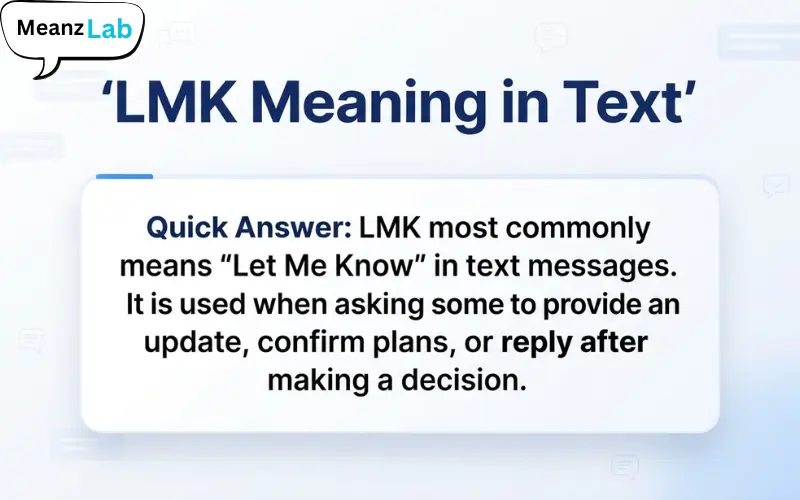
The LMK meaning in text is “Let Me Know.” People use it when they want someone to provide an update, share an opinion, confirm plans, or reply after making a decision. It’s one of the most common texting abbreviations used in everyday conversations across messaging apps and social media.
Example
Friend: “I’m free after 6 PM.”
You: “LMK if you still want to grab dinner.”
Here, LMK means “Let Me Know.”
Text messaging has changed the way people communicate. Instead of typing complete sentences, many people use abbreviations that save time while keeping conversations quick and natural. Expressions like LOL, IDK, TBH, BRB, and SMH appear every day in text messages, group chats, and social media conversations.
Among these popular abbreviations, LMK is one of the easiest to recognize because it has a simple and practical purpose. Rather than expressing an emotion, LMK is used to request information or ask someone to respond later. Whether you’re making plans with friends, waiting for an answer, or asking someone to confirm something, LMK helps keep the conversation brief without changing the meaning.
Many people search what does LMK mean in text, what does LMK stand for, or simply what does LMK mean after seeing the abbreviation in a message. Fortunately, the meaning is straightforward in most situations.
Unlike internet slang that can have several definitions, LMK almost always means “Let Me Know.” The phrase politely asks another person to send an update once they have more information or have made a decision.
This guide explains what LMK means, why it has become one of the most frequently used texting abbreviations, where you’ll commonly see it, and how to use it naturally in conversations.
What Does LMK Mean in Text?
If you’re wondering what does LMK mean in text, the answer is simple:
LMK = Let Me Know
People use this abbreviation whenever they want someone to provide information later. Instead of asking for an immediate answer, LMK gives the other person time to think, check their schedule, or gather the information before replying.
For example, if you’re planning a weekend trip with friends, you might send:
“LMK if you’re coming.”
This tells your friend that you don’t need an instant response, but you would like them to update you once they’ve decided.
Similarly, if you’re waiting for confirmation about an appointment, you could write:
“LMK when the meeting is confirmed.”
The abbreviation works in nearly every casual conversation because everyone occasionally needs updates from other people.
Here are several original examples:
- “LMK when you get home safely.”
- “LMK if you need any help.”
- “LMK what time the movie starts.”
- “LMK after you’ve talked to your manager.”
- “LMK whether you’re free this weekend.”
Each example politely asks someone to respond later with new information.
Quick Meanings of LMK
| Abbreviation | Meaning | Common Situation |
| LMK | Let Me Know | Text messages |
| LMK | Let Me Know | WhatsApp chats |
| LMK | Let Me Know | Snapchat conversations |
| LMK | Let Me Know | Social media messages |
Although some abbreviations have multiple meanings, LMK almost always stands for “Let Me Know” in online conversations.
Why Do People Use LMK?
People prefer LMK because it saves time while sounding friendly and polite. Instead of writing long requests every time they need an update, they can simply type three letters.
Rather than writing:
- Let me know what you decide.
- Let me know when you’re finished.
- Let me know if you’re available.
- Let me know after you arrive.
- Let me know if anything changes.
Most people simply type:
LMK
The meaning stays exactly the same, but the message becomes shorter and quicker to send.
Another reason LMK is popular is that it doesn’t pressure the other person into responding immediately. It simply requests a future update whenever they have the answer.
Common Situations Where LMK Is Used
LMK appears in many different conversations because people frequently ask each other for updates.
Making Plans
Friends often use LMK while organizing trips, parties, dinners, or weekend activities.
Examples:
- “LMK if you’re joining us.”
- “LMK when you’ve booked your ticket.”
- “LMK which restaurant you choose.”
- “LMK if the plans change.”
- “LMK what time you’ll arrive.”
These messages help people coordinate plans without requiring an immediate reply.
School and College Conversations
Students regularly exchange updates about assignments, exams, and group projects.
Examples:
- “LMK when you’ve finished the presentation.”
- “LMK if the professor changes the deadline.”
- “LMK after you submit the assignment.”
- “LMK which topic you’re choosing.”
- “LMK if you need help studying.”
LMK keeps classmates connected without creating unnecessary pressure.
Workplace Communication
Although abbreviations are less common in formal emails, LMK frequently appears in workplace messaging apps like Slack or Microsoft Teams.
Examples:
- “LMK when the report is ready.”
- “LMK if the client responds.”
- “LMK once the meeting is confirmed.”
- “LMK if there are any changes.”
- “LMK after you’ve spoken with the manager.”
Because coworkers often exchange quick updates throughout the day, LMK fits naturally into business chats.
Family Conversations
Family members also use LMK when checking on travel, appointments, or everyday activities.
Examples:
- “LMK when you get home.”
- “LMK if Grandma needs anything.”
- “LMK once you’ve reached the airport.”
- “LMK how the appointment goes.”
- “LMK when dinner is ready.”
These short messages help families stay connected without lengthy conversations.
LMK on Snapchat, Instagram, TikTok, and WhatsApp
LMK appears across almost every messaging platform because it works in nearly every type of conversation.
You’ll regularly see it on:
- Snapchat
- Instagram Direct Messages
- TikTok messages
- Facebook Messenger
- Discord
- Telegram
- iMessage
Examples include:
- “LMK if you like the video.”
- “LMK when you’re online.”
- “LMK your thoughts.”
- “LMK if you’re interested.”
- “LMK when you’re free.”
Because social media conversations are often fast-paced, abbreviations like LMK make communication quicker without losing clarity.
Real Conversation Examples
Seeing LMK in complete conversations makes its meaning easy to remember.
Conversation 1
Friend: “I’m waiting to hear back from work.”
You: “LMK what they say.”
Conversation 2
Sibling: “I might visit this weekend.”
You: “LMK once your plans are final.”
Conversation 3
Coworker: “I’ll review the document this afternoon.”
You: “Great. LMK if you find any issues.”
Conversation 4
Friend: “I’m looking for concert tickets.”
You: “LMK if you find good seats.”
Conversation 5
Classmate: “I’ll ask the teacher tomorrow.”
You: “Perfect. LMK what the answer is.”
Each of these conversations demonstrates the same idea: LMK politely asks another person to provide an update once they know more or have made a decision.
LMK in Different Contexts
Although Let Me Know is the primary definition, the abbreviation is flexible because it can be used in many different situations.
| Context | LMK Meaning | Example |
| Text Messages | Let Me Know | “LMK when you’re home.” |
| Friend Chats | Let Me Know | “LMK if you’re coming.” |
| Workplace Chats | Let Me Know | “LMK after the meeting.” |
| Family Messages | Let Me Know | “LMK when you arrive.” |
No matter where it appears, the purpose remains the same: asking someone to share information later without sounding demanding or impatient.
Other Meanings of LMK
Although LMK almost always means “Let Me Know” in text messages, abbreviations can have different meanings in specialized communities. That’s why context always matters. If you’re chatting with friends or family, LMK nearly always carries its common texting definition. In technical documents or niche online communities, however, the letters may represent something completely unrelated.
For example, a software developer, engineer, or someone discussing a company acronym might use LMK differently. These uses are much less common than the texting version, but they still exist.
Here are a few meanings you may encounter:
- Let Me Know – Texting and online chats
- Local Master Key – Security or engineering contexts
- Last Minute Knowledge – Occasionally used within organizations
- Company-specific abbreviations – Internal business communication
Examples:
- “LMK if you’re available tonight.”
- “LMK after you’ve checked the schedule.”
- “The engineer updated the LMK settings.”
- “LMK once you’ve finished reviewing it.”
- “I’ll wait, just LMK.”
In everyday conversations, you can safely assume LMK means “Let Me Know.”
LMK Compared With Similar Texting Abbreviations
LMK belongs to a group of abbreviations that make conversations faster. While many internet shortcuts look similar, each one has a different purpose.
| Abbreviation | Meaning | When It’s Used |
| LMK | Let Me Know | Asking for an update |
| IDK | I Don’t Know | Expressing uncertainty |
| FYI | For Your Information | Sharing information |
| TBH | To Be Honest | Giving an honest opinion |
| BRB | Be Right Back | Leaving temporarily |
| IMO | In My Opinion | Sharing a personal view |
Here are some examples:
- “LMK when you’re ready.”
- “IDK where everyone went.”
- “FYI, the meeting moved to Friday.”
- “TBH, I liked the first version better.”
- “BRB, someone’s at the door.”
Although these abbreviations are all common in online communication, LMK is specifically used when you expect a future response.
Common Mistakes People Make
Even though LMK is one of the easiest abbreviations to understand, people sometimes misuse it.
One common mistake is expecting an immediate answer after saying LMK. The phrase actually suggests that the other person should reply whenever they have the information, not necessarily right away.
Another mistake is using LMK in highly formal communication. While it feels natural in text messages and chat apps, writing the complete phrase is usually more appropriate in business emails or official documents.
Some users also mistake LMK for abbreviations like IDK or NVM, even though each serves a completely different purpose.
Common mistakes include:
- Thinking LMK means “tell me immediately.”
- Using LMK in formal reports.
- Confusing LMK with IDK.
- Assuming everyone recognizes the abbreviation.
- Forgetting to provide context when asking for updates.
Keeping these points in mind makes conversations clearer and avoids misunderstandings.
Interesting Facts About LMK
LMK has remained popular for years because it solves a simple communication problem. Instead of asking someone to remember a long sentence, three letters accomplish the same task.
Unlike many internet slang terms that become outdated after a few years, LMK continues to appear across nearly every messaging platform. Its meaning hasn’t changed, making it one of the most reliable abbreviations in digital communication.
Another interesting fact is that LMK works equally well in personal and professional messaging. While you might avoid it in formal emails, it’s widely accepted in workplace chat platforms like Slack, Microsoft Teams, and Google Chat.
You’ll often notice LMK in conversations involving:
- Travel planning
- School assignments
- Group projects
- Event invitations
- Family updates
- Online shopping
- Customer support chats
- Gaming communities
Because asking for updates is such a common part of daily life, LMK remains useful regardless of age or platform.
When Should You Use LMK?
LMK works best whenever you’re waiting for someone to make a decision or gather information.
Good situations include:
- Text messages
- WhatsApp conversations
- Snapchat
- Instagram DMs
- Discord chats
- Facebook Messenger
- Group chats
- Workplace messaging apps
Examples:
- “LMK if you change your mind.”
- “LMK when you’ve landed.”
- “LMK what the doctor says.”
- “LMK if you need anything.”
- “LMK after you finish work.”
In each example, LMK politely asks for a future response.
When Should You Avoid LMK?
Although LMK is widely accepted online, it isn’t always the best choice.
Avoid using it in:
- Job applications
- Academic papers
- Formal business emails
- Legal documents
- Official announcements
Instead of writing:
“LMK your decision.”
Write:
“Please let me know your decision when convenient.”
Using the complete phrase sounds clearer and more professional.
Formal vs Informal Usage
| Situation | Use LMK? | Better Choice |
| Texting friends | ✅ Yes | LMK |
| Family chat | ✅ Yes | LMK |
| ✅ Yes | LMK | |
| Slack or Teams | ✅ Usually | LMK |
| Business email | ❌ No | Please let me know |
| Academic writing | ❌ No | Let me know |
Choosing the right style helps your message match the situation.
See Also:
- TBH Meaning in Text
- WBU Meaning in Text
- PDA Meaning in Text
- LCR Meaning in Text
- GBTS Meaning in Text
FAQs
What does LMK mean in text?
LMK most commonly stands for “Let Me Know.” People use it when they want someone to update them, confirm plans, or provide information later. It is one of the most frequently used abbreviations in texting and online messaging.
What does LMK stand for?
If you’re wondering what does LMK stand for, the answer is “Let Me Know.” The phrase is commonly used in conversations where a person expects a future response rather than an immediate reply. It keeps messages short while remaining polite.
Is LMK considered slang?
LMK is generally considered a texting abbreviation rather than traditional slang. It has become part of everyday digital communication because it saves time and is easy to understand. You’ll regularly see it in text messages, WhatsApp, Snapchat, Instagram, and workplace chat apps.
Can I use LMK in professional communication?
LMK is acceptable in casual workplace messaging platforms like Slack or Microsoft Teams. However, in formal emails, reports, or official correspondence, it’s usually better to write the complete phrase “Please let me know.” Doing so ensures clarity and maintains a professional tone.
Is LMK the same as IDK?
No. Although both abbreviations are common in texting, they have completely different meanings. LMK asks someone to provide information later, while IDK means “I Don’t Know” and expresses uncertainty rather than requesting an update.
Conclusion
The LMK meaning in text is “Let Me Know.” It is one of the most widely used abbreviations in digital communication because it politely asks someone to provide an update, share information, or respond after making a decision. Whether you’re arranging plans with friends, waiting for work updates, or checking in with family members, LMK makes conversations shorter without losing clarity.
If you’ve searched what does LMK mean in text, what does LMK stand for, or what does LMK mean, the answer is almost always the same. While the abbreviation may have rare technical meanings, the texting definition is by far the most common.
The next time someone writes LMK, you’ll know they’re simply asking you to reply once you have the information they’re waiting for.