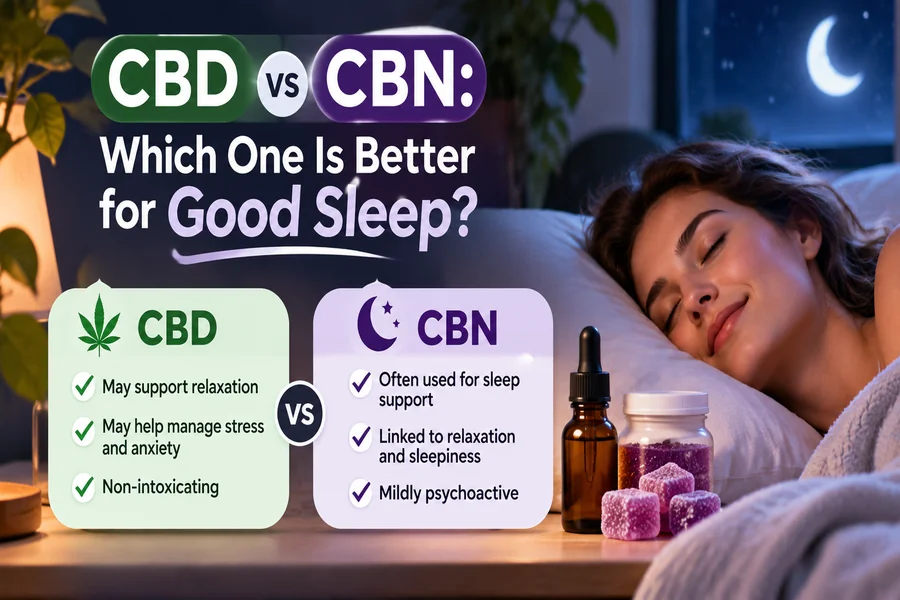
Getting a good night’s sleep is essential for physical health, mental clarity, and overall well-being. However, millions of people struggle with falling asleep, staying asleep, or waking up feeling refreshed. As interest in plant-based wellness products continues to grow, cannabinoids such as CBD (cannabidiol) and CBN (cannabinol) have attracted attention for their potential role in supporting better sleep.
Both CBD and CBN are naturally occurring compounds found in the cannabis plant. Although they share some similarities, they interact with the body’s endocannabinoid system differently and have distinct properties that researchers are still exploring.
This has led to a common question: CBD vs CBN, which one is better for sleep?
The answer depends on what you want to address. CBD is primarily researched for its potential effects on anxiety, stress, and relaxation, while CBN is often marketed as a sleep-focused cannabinoid. However, scientific evidence supporting either compound as an effective sleep treatment remains limited.
In this guide, we’ll explore the differences between CBD and CBN, their potential effects on sleep, how they work, and what to consider when choosing between them.
What Is CBD?
CBD, short for cannabidiol, is one of the most widely studied cannabinoids found in the cannabis plant. Unlike THC (tetrahydrocannabinol), CBD is non-intoxicating, meaning it does not produce the traditional cannabis high.
CBD interacts with several biological systems, including the endocannabinoid system (ECS), which plays a role in regulating various physiological processes.
The endocannabinoid system consists of receptors, enzymes, and naturally produced compounds called endocannabinoids. It is involved in processes such as mood regulation, stress response, pain perception, and sleep-wake cycles.
CBD does not simply activate CB1 and CB2 receptors in the same way as THC. Instead, it influences several signaling pathways involved in maintaining physiological balance.
How Does CBD Potentially Support Sleep?
CBD is not traditionally considered a sedative. Instead, researchers are investigating whether it may support sleep indirectly by influencing factors that can interfere with healthy sleep patterns.
Some potential areas of interest include:
- Supporting relaxation
Stress and an overactive mind can make it difficult to fall asleep. CBD is being studied for its potential interaction with serotonin-related pathways, particularly the 5-HT1A receptor, which is associated with mood and anxiety regulation.
- Managing everyday stress
Stress can interfere with the body’s natural sleep-wake cycle. By potentially influencing stress-related pathways, CBD may help some individuals feel more relaxed before bedtime.
- Supporting physical comfort
Discomfort and occasional pain can interrupt sleep. CBD has demonstrated anti-inflammatory and pain-modulating potential in preclinical research, although evidence for these effects in humans remains limited.
- Influencing sleep-related processes
Researchers are exploring how CBD interacts with biological pathways involved in sleep regulation. However, findings from human studies are mixed, and more clinical research is needed to understand its effectiveness.
Overall, CBD may be worth researching for people whose sleep difficulties are associated with stress, anxiety, or physical discomfort. However, it should not be considered a proven treatment for insomnia.
What Is CBN?
CBN, or cannabinol, is another naturally occurring cannabinoid found in the cannabis plant.
Unlike CBD, CBN is generally produced through the degradation and oxidation of THC over time. When THC is exposed to oxygen, heat, and light, it can gradually break down into other compounds, including CBN.
CBN is mildly psychoactive, but it is significantly less intoxicating than THC at commonly discussed concentrations.
In the wellness industry, CBN has gained popularity as a sleep-focused cannabinoid. It is frequently included in nighttime formulations, including oils, capsules, and CBN gummies for sleep, which are designed for consumers exploring cannabinoid-based nighttime wellness products.
However, its reputation as a sleep cannabinoid is ahead of the available scientific evidence.
How Does CBN Potentially Support Sleep?
CBN interacts with the endocannabinoid system, including CB1 and CB2 receptors. Its interaction with CB1 receptors is generally weaker than THC’s, which may explain its comparatively mild intoxicating effects.
Researchers are investigating several possible ways CBN could influence sleep.
- Potential sleep-promoting properties
CBN is frequently associated with relaxation and sleepiness. However, human research has not yet established that CBN independently improves sleep quality or reduces the time it takes to fall asleep.
- Interaction with the endocannabinoid system
The endocannabinoid system contributes to several processes associated with sleep regulation. CBN’s interaction with cannabinoid receptors makes it an interesting subject for further sleep research.
- Potential role in physical relaxation
Some early research has investigated the anti-inflammatory and pain-related properties of CBN. These findings are preliminary, and there is not enough human evidence to conclude that CBN improves sleep by reducing discomfort.
- Combination with other cannabinoids
Some sleep products combine CBN with CBD and small amounts of THC. Researchers are interested in whether combinations of cannabinoids produce different effects from individual compounds.
However, the idea that CBD and CBN automatically work better together, sometimes described as the entourage effect, has not been conclusively established for sleep.
CBD vs CBN: Key Differences at a Glance
Although both cannabinoids come from the cannabis plant, they differ in their chemical origins, biological interactions, and current research applications.
| Feature | CBD | CBN |
| Full name | Cannabidiol | Cannabinol |
| Origin | Naturally occurring cannabinoid | Formed partly through THC degradation |
| Intoxicating effects | Non-intoxicating | Mildly psychoactive |
| Research focus | Anxiety, pain, inflammation, and other conditions | Potential sleep-related and other biological effects |
| Sleep research | Limited and mixed human evidence | Very limited human evidence |
| Sedative properties | Not established as a sedative | Commonly marketed for sleep, but not clinically established |
| Product formats | Oils, gummies, capsules, and creams | Oils, gummies, capsules, and sleep blends |
| Regulatory status | Varies by country and product | Varies by country and product |
The biggest difference is that CBD has a considerably larger body of scientific research behind it, while CBN has received growing commercial attention for its potential sleep-related properties.
CBD vs CBN for Sleep: Which One Works Better?
There is no definitive scientific answer to whether CBD or CBN works better for sleep. Both compounds are being investigated, but the available human evidence is not strong enough to establish either as an effective sleep aid.
Still, understanding their different research profiles can help explain why consumers consider them for different purposes.
CBD for Stress-Related Sleep Difficulties
If stress, anxious thoughts, or difficulty relaxing are contributing to your sleep problems, CBD may be an interesting cannabinoid to research.
CBD has been studied for its potential effects on anxiety-related pathways. Some preliminary human research has reported improvements in anxiety symptoms, although study designs, doses, and outcomes vary.
Since stress and anxiety can affect sleep quality, researchers are interested in whether CBD could indirectly support healthier sleep patterns.
However, CBD does not consistently produce sleepiness, and some people may experience no noticeable sleep-related benefits.
CBN for Sleep-Focused Wellness
CBN is often selected by consumers looking for cannabinoid products specifically formulated for nighttime use.
Its growing popularity comes from early research and consumer interest in its potential sleep-promoting properties.
However, one important distinction needs to be understood: marketing a cannabinoid as a sleep aid does not establish that it improves sleep.
A small 2024 randomized clinical trial investigated CBN in adults with poor sleep quality. It reported improvements in certain sleep-related measures, including nighttime awakenings, but did not establish consistent improvements across all sleep outcomes.
This is an encouraging area for further investigation, not definitive proof that CBN treats insomnia.
CBD and CBN Together
Some nighttime formulations combine CBD and CBN to bring together the different properties of both cannabinoids.
The idea is that CBD may support relaxation while CBN may contribute to the product’s intended nighttime experience.
However, there is currently insufficient clinical evidence to establish that combining CBD and CBN produces better sleep outcomes than using either compound individually.
The effectiveness of a combination product may also depend on its formulation, cannabinoid concentrations, additional ingredients, and individual response.
CBD vs CBN Sleep Gummies: What Is the Difference?
CBD and CBN are available in different product formats, but gummies have become a popular option among people exploring cannabinoid-based wellness products.
Both CBD and CBN gummies are designed for oral consumption. However, their formulations and intended uses can differ.
CBD Sleep Gummies
CBD sleep gummies contain cannabidiol as their primary cannabinoid.
Some formulations also include ingredients such as:
- Melatonin
- L-theanine
- Chamomile
- Magnesium
- Other botanical extracts
These additional ingredients may influence the overall formulation, so it is important to evaluate the complete ingredient list rather than focusing only on CBD.
CBN Sleep Gummies
CBN sleep gummies are generally marketed for nighttime relaxation and sleep support.
Depending on the product, they may contain:
- CBN as the primary cannabinoid
- CBD and CBN combinations
- Melatonin
- Botanical ingredients
- Other cannabinoids, including THC where legally permitted
The presence of additional cannabinoids and sleep-related ingredients can change the product’s effects and potential risks.
Which Type of Gummies Should You Choose?
Neither CBD nor CBN gummies have been established as a reliable treatment for sleep disorders.
When evaluating a product, consider its cannabinoid content, ingredient transparency, third-party testing, and compliance with local regulations.
Avoid assuming that a higher cannabinoid concentration automatically means better results.
How Long Do CBD and CBN Take to Work?
The time it takes to experience the effects of CBD or CBN depends on several factors, including the product format, formulation, individual metabolism, and whether it is consumed with food.
Here is a general comparison of different delivery methods:
| Product format | General onset considerations |
| Gummies | Effects may take longer because they must pass through the digestive system |
| Capsules | Similar to other orally consumed products; onset varies |
| Oils (under the tongue) | Absorption may begin before swallowing, but timing varies |
| Inhaled products | Effects can occur more quickly, but inhalation carries additional respiratory risks |
These are general pharmacological considerations, not guaranteed timelines for CBD or CBN.
For oral products, food intake and individual differences can significantly influence absorption.
It is also important to remember that experiencing an effect does not necessarily mean sleep quality has improved.
Are CBD and CBN Safe for Sleep?
CBD and CBN are not automatically risk-free simply because they are derived from cannabis.
Both compounds require further safety research, particularly when used regularly or alongside other medications.
Frequently Asked Questions (FAQs)
1. Is CBD or CBN better for sleep?
Neither has been conclusively proven to be better for sleep. CBD has more extensive research overall, particularly concerning anxiety-related pathways, while CBN is being investigated for its potential sleep-promoting properties. More high-quality human clinical trials are needed.
2. Does CBN make you sleepier than CBD?
CBN is commonly marketed as a sleep-focused cannabinoid, but there is insufficient clinical evidence to establish that it causes greater sleepiness than CBD. Individual responses can also vary.
3. Can you take CBD and CBN together?
Some products combine CBD and CBN in a single formulation. However, there is not enough clinical evidence to establish that combining them improves sleep more than using either compound alone. Consult a healthcare professional before combining cannabinoid products with medications or other sleep aids.
4. Is CBN the same as THC?
No. CBN and THC are different cannabinoids. CBN can form when THC degrades over time, but CBN is generally much less intoxicating than THC.
5. Does CBD help you stay asleep throughout the night?
Research has not established that CBD reliably prevents nighttime awakenings. Some studies have investigated its potential effects on sleep, but results remain mixed.
6. Are CBD and CBN non-addictive?
CBD is not generally considered intoxicating or associated with the same dependence potential as THC. However, long-term safety data for cannabinoid products remain incomplete. CBN also requires more research to establish its long-term safety and dependence profile.
7. Can CBD or CBN replace melatonin?
CBD and CBN should not automatically be considered replacements for melatonin. They work through different biological pathways, and there is insufficient evidence to establish either cannabinoid as an equivalent alternative to melatonin.
8. Are CBD and CBN sleep gummies legal?
Legality depends on the country, cannabinoid source, THC concentration, product classification, and applicable regulations. Always verify local laws before purchasing or using cannabinoid products.
Final Verdict: CBD vs CBN – Which One Should You Choose?
CBD and CBN are two interesting cannabinoids attracting attention in the sleep and wellness industry. However, their scientific evidence and potential applications are not identical.
CBD has a broader research foundation, particularly around anxiety, stress-related pathways, and other biological processes that may indirectly influence sleep.
CBN, on the other hand, has gained recognition as a sleep-focused cannabinoid. Early research is promising in some areas, but larger and more rigorous human studies are needed to establish its effectiveness.
The bottom line: There is currently no scientific consensus that CBD or CBN is the better option for good sleep. The right approach is to understand the differences, evaluate product quality, consider potential interactions, and avoid treating either cannabinoid as a proven insomnia remedy.
Most importantly, healthy sleep starts with consistent sleep habits, a comfortable sleeping environment, and addressing the underlying causes of sleep disturbances. Cannabinoid products, where legally available and medically appropriate, should be considered only with a clear understanding of their potential benefits and limitations.