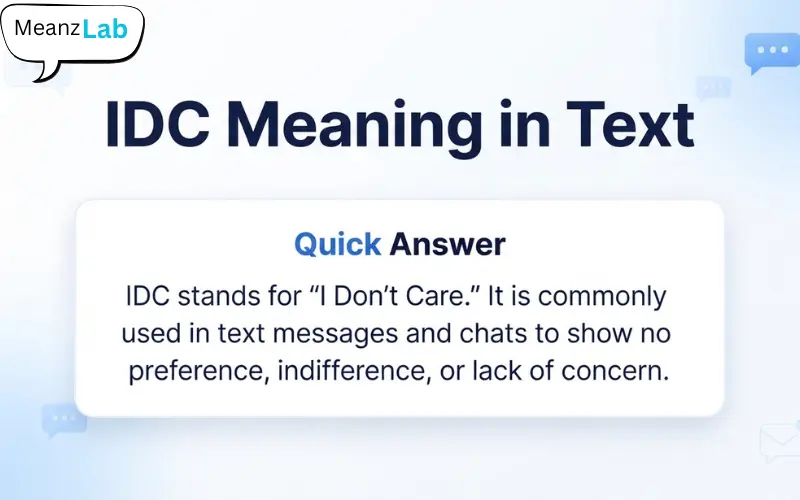
The IDC meaning in text is “I Don’t Care.” People use this abbreviation to show that they have no strong preference, are indifferent to a decision, or don’t feel concerned about a topic. Depending on the conversation, IDC can sound relaxed, neutral, frustrated, or emotionally distant, so the context is important when interpreting its tone.
Example:
Friend: “Should we order pizza or burgers?”
You: “IDC.”
In this conversation, IDC means “Either option is fine with me.”
Text messaging has changed the way people communicate. Instead of typing long sentences, many people rely on abbreviations to express their thoughts quickly. Terms like LOL, BRB, IDK, and TBH have become part of everyday online conversations. Another abbreviation that appears frequently in chats is IDC.
If you’ve recently received this abbreviation, you may be searching for the IDC meaning in text or wondering what does IDC mean in text. Although the letters are simple, the message behind them isn’t always the same. While IDC almost always stands for “I Don’t Care,” the speaker’s attitude can vary from being completely relaxed to sounding annoyed or emotionally distant.
For example, replying “IDC” when choosing a restaurant usually means you’re happy with any option. However, using the same reply during an argument can make it sound dismissive or hurtful. Because written messages don’t include facial expressions or voice tone, it’s easy to misunderstand what someone really means.
This guide explains the meaning of IDC, how it’s used in different conversations, why tone matters, and how to tell whether it’s being used casually or emotionally. You’ll also find practical examples that make it easy to recognize the correct meaning whenever you see IDC in a text message, social media comment, or online chat.
What Does IDC Mean in Text?
The answer is simple.
IDC stands for “I Don’t Care.”
People use it when they don’t have a strong opinion, don’t mind which option is chosen, or don’t feel interested in continuing a discussion. Instead of typing the full phrase, they shorten it to three letters to save time.
Although the words remain the same, the intention behind them can be very different.
Here are some common situations where people use IDC:
- They genuinely have no preference.
- They’re letting someone else make the decision.
- They’re showing that the topic isn’t important to them.
- They’re feeling frustrated or emotionally tired.
- They want to end the conversation quickly.
Because the meaning depends on the situation, it’s always helpful to read the surrounding messages before deciding how IDC is being used.
Common Uses of IDC
| Situation | Meaning of IDC | Typical Tone |
| Choosing between options | I have no preference | Neutral |
| Making weekend plans | Either choice works | Relaxed |
| During an argument | I no longer care | Frustrated |
| Social media debate | Others’ opinions don’t matter | Confident |
| Group decision | I’m happy with any option | Flexible |
The wording never changes, but the emotional tone often does.
IDC as “I Don’t Care”
The most common use of IDC is simply to express a lack of preference.
Many people assume that saying “I don’t care” is rude, but that isn’t always true. In everyday conversations, it often means that you’re comfortable letting someone else decide.
For instance, imagine two friends discussing dinner plans. One person asks where they should eat, and the other replies with IDC. Rather than showing disrespect, they’re simply saying that every option sounds good.
Here are several original examples:
- “IDC which movie we watch tonight.”
- “IDC where we meet after work.”
- “IDC if we leave now or later.”
- “IDC what color you choose for the room.”
- “IDC whether we order online or cook at home.”
Each example shows flexibility rather than negativity. The speaker trusts the other person to make the choice.
Why Context Changes the Meaning
Although IDC always expands to “I Don’t Care,” the surrounding conversation changes how readers interpret it.
Suppose someone asks, “Which shirt should I wear?” Responding with IDC usually means that either shirt looks fine.
Now imagine someone says, “I’m really upset about what happened today,” and the reply is simply “IDC.” That response sounds much colder because it dismisses another person’s feelings.
Context influences whether IDC feels:
- Friendly
- Neutral
- Casual
- Annoyed
- Hurtful
This is why reading only one message can sometimes lead to misunderstandings.
Consider these examples:
- “IDC which seat we get.” (Flexible)
- “IDC what time we leave.” (Relaxed)
- “IDC about winning today.” (Indifferent)
- “IDC anymore.” (Emotionally exhausted)
- “IDC what people think.” (Confident)
Even though every sentence contains the same abbreviation, each one creates a different impression.
IDC Meaning in Chat Conversations
If you’re searching for IDC meaning in chat, you’ll find that the abbreviation works much the same way across different messaging platforms.
Whether you’re using WhatsApp, Messenger, Discord, Telegram, Snapchat, or Instagram, IDC almost always means “I Don’t Care.” The difference comes from the topic being discussed rather than the app itself.
For example, friends chatting about weekend plans may use IDC to show flexibility. Coworkers discussing lunch might use it to indicate they have no preference. In a gaming chat, a player could use IDC to show that any map or character is acceptable.
Here are five examples:
- “IDC which café we visit after class.”
- “IDC if we start the meeting five minutes later.”
- “IDC which playlist you choose for the road trip.”
- “IDC what game mode we play tonight.”
- “IDC who sits in the front seat.”
These examples demonstrate that IDC often keeps conversations moving because it lets someone else make the final decision.
Why People Prefer Using IDC
Typing three letters is much faster than writing an entire sentence.
Instead of saying:
“I’m fine with whichever option you prefer because I don’t have a strong opinion.”
Most people simply write:
IDC.
The abbreviation is popular because it’s:
- Quick to type
- Easy to recognize
- Common across messaging apps
- Suitable for casual conversations
- Flexible enough to fit many situations
Its simplicity has made IDC one of the most widely used abbreviations in digital communication.
IDC in Everyday Text Messages
Most people first encounter IDC while texting friends or family members. In these conversations, the abbreviation is usually harmless and simply means that the sender has no particular preference.
Imagine you’re organizing plans with a group of friends. One person asks where everyone wants to meet. Instead of suggesting a place, someone replies with IDC because every option sounds equally good.
Examples include:
- “IDC if we meet at the mall or the park.”
- “IDC what time the movie starts.”
- “IDC whether we travel by bus or train.”
- “IDC if we eat before or after shopping.”
- “IDC which route we take.”
In each situation, the abbreviation helps keep the conversation short while making it clear that the speaker is happy to go along with the group’s decision.
IDC on Social Media
Social media platforms encourage short, fast communication, so abbreviations like IDC appear frequently in comments, captions, and replies. While the meaning still remains “I Don’t Care,” the tone often reflects the user’s attitude toward a topic, trend, or public opinion.
For example, someone responding to criticism may use IDC to show confidence rather than disrespect. Another person might use it humorously to indicate they aren’t bothered by a minor issue. Because social media conversations often lack vocal tone, readers should avoid assuming the worst without considering the surrounding posts.
Here are five original examples:
- “IDC if this trend goes out of style—I still like it.”
- “IDC what strangers think about my hobbies.”
- “IDC how many people disagree with my opinion.”
- “IDC if this post gets only ten likes.”
- “IDC about online drama anymore.”
In these situations, IDC expresses independence or personal confidence rather than hostility.
IDC in Friendships
Among friends, IDC is usually interpreted in a positive or neutral way. It often means, “I’m happy with whatever you decide,” especially when discussing everyday plans.
However, close friends also recognize that tone matters. If someone repeatedly responds with IDC during serious conversations, it may sound like they’re uninterested or emotionally distant. Good communication involves knowing when a short abbreviation is appropriate and when a more thoughtful response is needed.
Examples:
- “IDC where we hang out this weekend.”
- “IDC which game we play after dinner.”
- “IDC if we watch an action movie or a comedy.”
- “IDC who drives today.”
- “IDC what restaurant we choose.”
These examples show flexibility and trust rather than a lack of respect.
IDC in Relationships
Relationships add another layer of meaning to IDC because emotions are often involved. A simple “IDC” can either mean “I’m okay with anything” or “I don’t want to discuss this anymore.”
For example, if one partner asks where to eat dinner and the other replies with IDC, the message is usually harmless. But during an argument, the same response may suggest frustration, disappointment, or emotional exhaustion.
Examples include:
- “IDC where we celebrate our anniversary.”
- “IDC which movie we watch tonight.”
- “IDC anymore. I’m too tired to argue.”
- “IDC if we stay home or go out.”
- “IDC what color we paint the bedroom.”
If the topic is emotionally important, it’s often better to write a complete sentence instead of using an abbreviation.
When Can IDC Sound Rude?
Although IDC isn’t automatically impolite, it can appear dismissive when someone is sharing their feelings or asking for emotional support.
Imagine that a friend proudly tells you about an achievement they’ve worked hard to accomplish. Replying with “IDC” may make them feel ignored, even if that wasn’t your intention. In these situations, the problem isn’t the abbreviation itself but the lack of empathy.
Compare these responses:
Less thoughtful:
- “IDC.”
More considerate:
- “I’m glad it worked out for you.”
- “That sounds exciting.”
- “Tell me more about it.”
Choosing a warmer response can strengthen relationships and prevent unnecessary misunderstandings.
Better Alternatives to IDC
If you want to sound polite while still expressing flexibility, there are several alternatives that feel more natural in conversation.
Instead of typing IDC, you could say:
- “Either option works for me.”
- “I’m happy with whatever you choose.”
- “I don’t mind.”
- “You can decide.”
- “Both choices sound good.”
These alternatives communicate the same basic idea while sounding friendlier, especially in conversations with coworkers, family members, or people you don’t know well.
IDC vs. IDK
Many people accidentally confuse IDC with IDK because both abbreviations begin with the letters “ID.” However, their meanings are completely different.
| Abbreviation | Full Form | Meaning | Example |
| IDC | I Don’t Care | No preference or concern | “IDC where we eat.” |
| IDK | I Don’t Know | Lack of information | “IDK where the restaurant is.” |
Notice the difference:
IDC: “IDC which laptop you buy.”
This means every option is acceptable.
IDK: “IDK which laptop is better.”
This means the speaker doesn’t know the answer.
Remembering this distinction helps avoid confusion during online conversations.
Common Mistakes People Make
Many misunderstandings happen because readers assume IDC always carries a negative tone. In reality, the abbreviation often expresses simple flexibility rather than annoyance.
Here are a few common mistakes:
Mistake 1: Assuming IDC Always Means Anger
Reality: Most of the time, it simply means the speaker has no preference.
Mistake 2: Thinking IDC Is Always Rude
Reality: It depends on the situation. Choosing a restaurant is very different from discussing someone’s feelings.
Mistake 3: Confusing IDC with IDK
Reality: IDC means I Don’t Care, while IDK means I Don’t Know.
Mistake 4: Ignoring Context
Reality: The conversation around the abbreviation determines its emotional tone.
Understanding these differences helps you interpret messages more accurately.
How Should You Respond to IDC?
The best response depends on why the other person used the abbreviation.
If they have no preference, simply make the decision.
If they seem frustrated, ask whether something is bothering them.
If they appear emotionally distant, consider responding with kindness instead of continuing the disagreement.
Examples:
- “Okay, I’ll choose the restaurant.”
- “No problem. I’ll make the reservation.”
- “Are you sure everything’s okay?”
- “We can talk about it later if you’d like.”
- “Thanks, I’ll decide then.”
A thoughtful response often prevents small misunderstandings from becoming larger problems.
See Also:
- HMMM Meaning in Text
- WTH Meaning in Text
- DM Meaning in Text
- PP Meaning in Text
- UT Meaning in Text
- BTS Meaning in Text
FAQs
What does IDC mean in text?
The IDC meaning in text is “I Don’t Care.” People use it to show they have no strong opinion or preference about a decision or topic. Depending on the conversation, it can sound neutral, relaxed, or emotionally distant.
What does IDC mean in chat?
In online chats, IDC almost always means “I Don’t Care.” Friends often use it when they’re happy with any choice, while others may use it to express frustration during disagreements. The surrounding conversation determines the intended tone.
Is IDC considered rude?
Not necessarily. When discussing simple decisions, IDC usually sounds harmless and flexible. However, replying with IDC when someone shares personal feelings or important news may come across as dismissive or insensitive.
What is the difference between IDC and IDK?
IDC means “I Don’t Care,” while IDK means “I Don’t Know.” The first expresses a lack of preference, whereas the second indicates a lack of knowledge. Although the abbreviations look similar, they communicate completely different ideas.
Should I use IDC in professional conversations?
It’s generally better to avoid IDC in formal workplace communication. Writing complete phrases such as “Either option works for me” or “I don’t have a preference” sounds more professional and courteous. Reserve IDC for casual conversations with friends or informal group chats.
Conclusion
The IDC meaning in text is almost always “I Don’t Care.” While the abbreviation itself is simple, its emotional tone depends entirely on the conversation. In casual situations, IDC usually means the sender has no preference and is happy with any option. In more emotional discussions, however, the same abbreviation can sound frustrated, detached, or dismissive.
Whether you’re texting friends, chatting on social media, participating in online gaming, or messaging coworkers, paying attention to context is the best way to interpret IDC correctly. Looking at the surrounding messages helps you decide whether the sender is being relaxed, confident, indifferent, or emotionally tired.
By recognizing how IDC is used in different situations, you’ll communicate more effectively and avoid common misunderstandings in digital conversations.