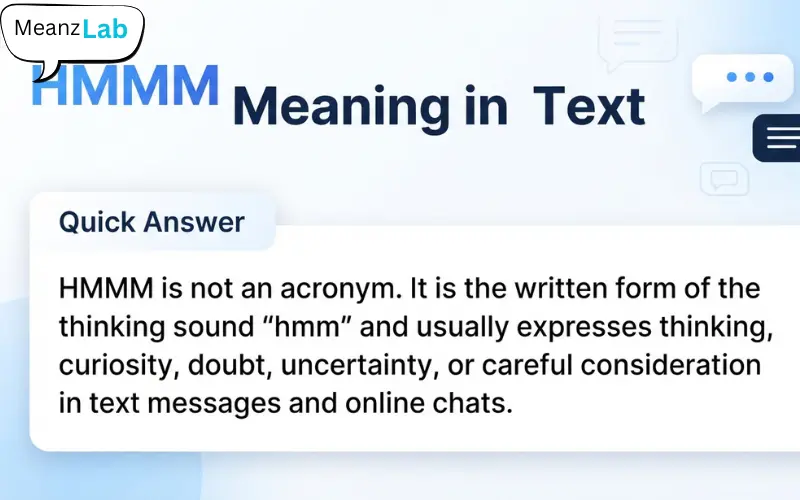
The HMMM meaning in text is usually a sign that someone is thinking, unsure, curious, doubtful, or carefully considering what to say next. Unlike abbreviations such as LOL or BRB, HMMM is not an acronym. Instead, it is the written version of the thoughtful sound people naturally make when they pause to think.
Example
Friend: “I’m thinking about quitting my job to travel the world.”
You: “Hmmm…”
In this conversation, HMMM shows that you’re thinking carefully before giving your opinion.
Text messages don’t include facial expressions, body language, or tone of voice. Because of this, people often rely on simple expressions to show emotions that would normally be obvious during face-to-face conversations. One of the most common expressions is HMMM.
You have probably seen someone reply with “Hmmm…” after hearing surprising news, reading an unexpected message, or considering an important question. At first glance, the response may seem confusing because it doesn’t provide a direct answer. However, that’s exactly its purpose. HMMM communicates that the person is processing information before responding.
Many people search for hmmm meaning in text or what does hmmm mean in text because the expression can represent several emotions. Sometimes it shows curiosity. Other times it suggests doubt, hesitation, reflection, or even mild suspicion. The surrounding conversation determines the exact meaning.
Unlike many internet abbreviations, HMMM has existed long before texting became popular. People have always made the “hmm” sound while thinking. Digital communication simply transformed that natural sound into written form, making it one of the most recognizable expressions in online conversations today.
This guide explains the different meanings of HMMM, when people use it, how to interpret it correctly, and how context changes its emotional tone.
What Does HMMM Mean in Text?
When people ask “What does HMMM mean in text?”, they’re usually looking for a single definition. The reality is slightly different because HMMM expresses a feeling rather than a fixed phrase.
Most commonly, HMMM indicates that someone is:
- Thinking carefully.
- Considering an idea.
- Unsure about something.
- Curious to hear more.
- Taking a moment before replying.
Instead of immediately giving an opinion, the sender uses HMMM to signal that they’re processing the information.
Consider these examples:
- “Hmmm… that’s an interesting idea.”
- “Hmmm, I need a little more information.”
- “Hmmm, are you certain about that?”
- “Hmmm… let me think for a minute.”
- “Hmmm, I wasn’t expecting that answer.”
Each sentence communicates thoughtful consideration rather than an immediate reaction.
Is HMMM an Acronym?
One of the biggest misconceptions is that HMMM stands for a hidden phrase.
The answer is simple:
No. HMMM is not an acronym.
Unlike abbreviations such as:
- LOL = Laughing Out Loud
- BRB = Be Right Back
- IDK = I Don’t Know
- IMO = In My Opinion
HMMM doesn’t represent separate words.
Instead, it is a written version of the sound people naturally make while thinking.
When someone pauses during a conversation, they might quietly say:
“Hmmm…”
Texting simply converts that sound into written language.
HMMM vs Common Texting Abbreviations
| Expression | Meaning | Acronym? |
| HMMM | Thinking sound | No |
| LOL | Laughing Out Loud | Yes |
| BRB | Be Right Back | Yes |
| IDK | I Don’t Know | Yes |
| TBH | To Be Honest | Yes |
This comparison highlights why HMMM feels different from traditional internet abbreviations.
Why Do People Type HMMM?
Since text messages don’t include voice or facial expressions, people often use reaction words to replace those missing emotional cues.
HMMM fills that role perfectly.
Instead of writing a long explanation like:
“I’m thinking about what you said and I’m not ready to answer yet.”
Someone simply types:
“Hmmm…”
The message immediately communicates thoughtfulness without requiring extra words.
People also use HMMM because it:
- Creates a natural pause.
- Shows genuine interest.
- Softens disagreement.
- Signals curiosity.
- Makes conversations feel more human.
Because of these qualities, HMMM has remained popular across nearly every messaging platform.
Different Emotions Behind HMMM
Although the spelling stays the same, the emotional meaning changes depending on the situation.
Sometimes HMMM expresses curiosity.
Other times it reflects doubt or careful evaluation.
Here are several common emotional meanings.
Thinking
Someone is processing information before responding.
Examples:
- “Hmmm… I’ll think about your suggestion.”
- “Hmmm, that’s a difficult question.”
- “Hmmm, I haven’t decided yet.”
- “Hmmm… give me a minute.”
- “Hmmm, there are several possibilities.”
Curiosity
The sender wants to learn more.
Examples:
- “Hmmm? Tell me what happened.”
- “Hmmm, that sounds interesting.”
- “Hmmm… how did that happen?”
- “Hmmm, I’d like to hear the rest.”
- “Hmmm, now you’ve got my attention.”
Doubt
The sender isn’t completely convinced.
Examples:
- “Hmmm… are you sure?”
- “Hmmm, that doesn’t sound right.”
- “Hmmm… I don’t know if I believe that.”
- “Hmmm, something feels unusual.”
- “Hmmm, I’d like to see proof.”
The exact meaning depends entirely on the conversation rather than the expression itself.
HMMM Between Friends
Friends often use HMMM playfully because they feel comfortable expressing curiosity or teasing one another.
A single HMMM may invite someone to explain their story in greater detail, question an unbelievable claim, or simply show interest.
Here are some everyday conversations:
- “I won free concert tickets.” — “Hmmm, seriously?”
- “I’m moving to another country.” — “Hmmm, that’s exciting.”
- “I met my favorite actor yesterday.” — “Hmmm… lucky you!”
- “I started learning Japanese.” — “Hmmm, that’s impressive.”
- “I baked my first cake.” — “Hmmm, save me a slice.”
Notice that none of these replies are rude. Instead, they encourage the conversation to continue naturally.
HMMM in Romantic Conversations
HMMM often carries extra meaning in dating and relationships because people pay closer attention to each other’s responses.
Someone might use HMMM while flirting, considering an invitation, or reacting to an emotional message.
Examples include:
- “Would you like to have dinner together?” — “Hmmm… I’d love that.”
- “I think you’re really funny.” — “Hmmm 😊 Thank you.”
- “Can we talk later tonight?” — “Hmmm, sure.”
- “I have something important to tell you.” — “Hmmm? I’m listening.”
- “Guess who was thinking about you?” — “Hmmm… now I’m curious.”
In romantic conversations, emojis and punctuation often influence the emotional tone even more than the word itself.
Emotional Meanings of HMMM
| Situation | Possible Meaning |
| Receiving surprising news | Thinking |
| Hearing an unusual story | Curiosity |
| Questioning a claim | Doubt |
| Considering an invitation | Reflection |
| Learning new information | Interest |
| Solving a problem | Careful thinking |
HMMM on Social Media
You’ll often see HMMM in comments, replies, captions, and direct messages across platforms like Instagram, TikTok, Facebook, X, Reddit, and Discord. Unlike a simple “OK” or “Cool,” HMMM shows that someone is reacting thoughtfully instead of giving an instant opinion.
Sometimes users type HMMM after seeing unexpected news, a surprising photo, or a controversial opinion. In other cases, they use it humorously to build suspense before replying.
Here are some natural examples:
- “Hmmm… I didn’t expect that ending.”
- “Hmmm, this theory actually makes sense.”
- “Hmmm, something feels different here.”
- “Hmmm… that’s a bold opinion.”
- “Hmmm, now I’m curious to learn more.”
The expression encourages further discussion because it leaves room for additional conversation.
HMMM in Online Discussions
People frequently use HMMM in forums, community groups, and discussion boards when they are evaluating ideas instead of immediately agreeing or disagreeing.
Unlike a direct response such as “You’re wrong,” HMMM creates a softer tone. It suggests that the person is still thinking and may want more evidence before forming an opinion.
Examples include:
- “Hmmm, I’d like to read more about that.”
- “Hmmm, your explanation is interesting.”
- “Hmmm, I’m not fully convinced yet.”
- “Hmmm, that’s one possible solution.”
- “Hmmm, let’s compare both options first.”
Using HMMM this way helps keep conversations respectful while encouraging thoughtful discussion.
HMMM vs. Hmm vs. Hmmmm
Many people wonder whether adding extra M’s changes the meaning.
The basic meaning remains the same, but the number of letters often changes the intensity or length of the pause.
For example:
Hmm
Usually shows a brief moment of thought.
Hmmm
Suggests a slightly longer pause and deeper consideration.
Hmmmm
Often indicates stronger curiosity, greater uncertainty, or more careful thinking.
Examples:
- “Hmm… maybe.”
- “Hmmm… that’s interesting.”
- “Hmmmm… I need more time to think.”
- “Hmm… I understand your point.”
- “Hmmmm… I’m not completely sure.”
Although there are no strict grammar rules, longer spellings generally imply a longer pause.
HMMM vs. Umm
People sometimes confuse HMMM with Umm, but they communicate different ideas.
HMMM usually appears after someone has received information and is thinking about it.
Umm often appears before someone speaks because they’re trying to find the right words.
Compare these examples:
HMMM
- “Hmmm… that’s an interesting suggestion.”
- “Hmmm, I’ll think about it.”
Umm
- “Umm… I’m not sure how to explain it.”
- “Umm… could you repeat the question?”
Although both expressions involve hesitation, HMMM feels more reflective, while Umm often signals uncertainty during speech.
HMMM Compared with Similar Expressions
| Expression | Primary Meaning | Typical Situation |
| Hmm | Brief thought | Quick reaction |
| Hmmm | Careful thinking | Considering information |
| Hmmmm | Longer reflection | Deep thought or doubt |
| Umm | Speech hesitation | Searching for words |
| Oh | Surprise | Immediate reaction |
This comparison makes it easier to recognize the emotional difference between these commonly used expressions.
Should You Use HMMM in Professional Communication?
In most professional settings, HMMM is not the best choice. Business emails, workplace chats with clients, and formal documents usually require clear language instead of reaction words.
For example, instead of writing:
❌ “Hmmm… I’m not sure about this proposal.”
You could write:
✔ “I’d like some time to review this proposal before making a decision.”
Similarly:
❌ “Hmmm… I don’t think this will work.”
Better:
✔ “I have a few concerns about this approach.”
Choosing complete sentences makes your communication more professional and leaves less room for misunderstanding.
Common Mistakes People Make
One common mistake is assuming HMMM always expresses disagreement. In reality, many people use it simply because they’re thinking before responding.
Another mistake is believing HMMM is an acronym like LOL or IDK. Unlike those abbreviations, HMMM doesn’t stand for separate words. It’s simply the written version of a natural thinking sound.
Some readers also interpret every HMMM as something negative. However, context changes everything. The same expression can communicate excitement, curiosity, reflection, uncertainty, or skepticism depending on the conversation.
Common Misunderstandings About HMMM
| Misunderstanding | Correct Explanation |
| HMMM always means disagreement. | It often simply means the person is thinking. |
| HMMM is an acronym. | It is a written thinking sound, not an abbreviation. |
| HMMM is always negative. | It can be positive, neutral, or negative depending on context. |
| HMMM is rude. | Most of the time, it is simply thoughtful or curious. |
How Should You Respond to HMMM?
The best response depends on why the other person used it.
If they seem curious, provide more information.
If they appear uncertain, answer their questions.
If they seem doubtful, explain your point more clearly.
If they’re simply thinking, give them a little time before expecting a reply.
Examples:
- “Let me explain what I meant.”
- “Would you like more details?”
- “Take your time.”
- “I can answer any questions you have.”
- “Here’s why I think it’s a good idea.”
Responding to the emotion behind HMMM usually keeps the conversation moving smoothly.
See Also:
- WTH Meaning in Text
- DM Meaning in Text
- DW Meaning in Text
- IDC Meaning in Text
- PP Meaning in Text
- UT Meaning in Text
FAQs
What does HMMM mean in text?
The most common HMMM meaning in text is that someone is thinking carefully before responding. It can also express curiosity, uncertainty, doubt, or reflection. The exact meaning depends on the context of the conversation.
Does HMMM stand for anything?
No. HMMM is not an acronym and does not represent a hidden phrase. It is simply the written version of the thoughtful sound people naturally make when they pause to think.
Is HMMM positive or negative?
HMMM can be positive, neutral, or negative depending on the situation. Someone might use it while considering exciting news, questioning a surprising claim, or reflecting on an important decision. Reading the surrounding messages helps determine the intended tone.
Is there a difference between Hmm and HMMM?
Yes, although they express the same basic idea. Hmm often represents a brief moment of thought, while HMMM usually suggests a longer or deeper pause. Many people also add extra “M’s” to emphasize stronger reflection.
Should I use HMMM in professional emails?
Generally, no. Professional communication is clearer when you express your thoughts in complete sentences instead of using reaction words like HMMM. Saving HMMM for casual conversations with friends and family is usually the better choice.
Conclusion
The HMMM meaning in text isn’t tied to one fixed definition. Instead, it reflects a person’s thoughts and emotions at a particular moment. Most often, HMMM shows that someone is thinking, curious, uncertain, reflective, or carefully considering what they’ve just read.
Unlike common internet abbreviations, HMMM isn’t an acronym. It’s simply the written form of a natural sound people make when they pause to think. That makes it one of the most flexible expressions in digital communication.
Whenever you receive HMMM in a text message, don’t focus only on the word itself. Look at the surrounding conversation, the relationship with the sender, and the overall tone. Those clues will help you understand exactly what they mean.