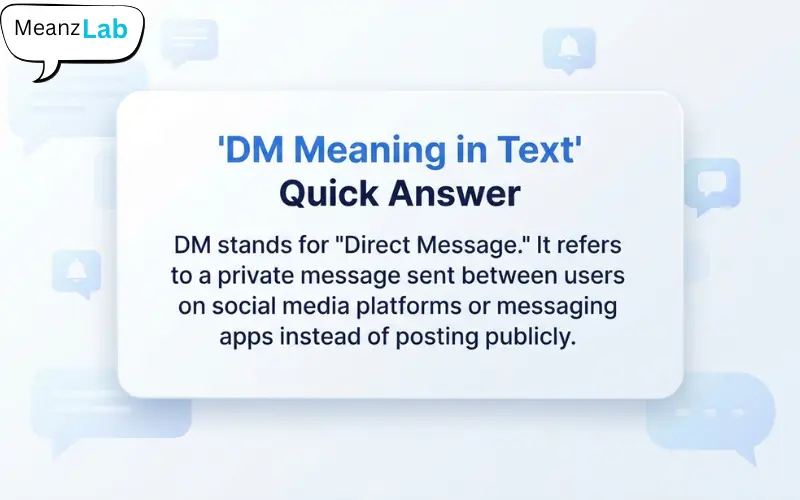
The DM meaning in text is Direct Message. A direct message is a private conversation between two or more users on a social media platform or messaging service. Instead of replying publicly in a comment section, people use DMs to continue the conversation privately.
Example
Person A: “Can you send me the event details?”
Person B: “Sure, I’ll DM you.”
Here, DM means “I’ll send you a private message.”
If you’ve spent any time on Instagram, Facebook, TikTok, X (formerly Twitter), Discord, Reddit, or LinkedIn, you’ve probably come across the abbreviation DM. People use it in comments, captions, private chats, and even business posts. Phrases like “DM me,” “Check your DMs,” and “I’ll send you a DM” have become a normal part of online communication.
Many people search for DM meaning in text, what does DM mean in text, or what does DM stand for because they aren’t sure whether the abbreviation refers to texting, social media, or something else. Although DM can have different meanings in specific industries or hobbies, its most common meaning in online conversations is Direct Message.
A direct message allows users to communicate privately instead of discussing something in front of everyone. Whether you’re sharing personal information, asking a question, discussing business, or simply chatting with a friend, DMs provide a secure and convenient way to keep the conversation between the people involved.
This guide explains what DM means, where it’s used, how it differs from public comments, common expressions involving DMs, and when you should use direct messages instead of posting publicly.
What Does DM Mean in Text?
When people ask “What does DM mean in text?”, they’re usually referring to conversations on social media or messaging platforms.
In this context, DM stands for Direct Message.
A direct message is simply a private message sent from one user to another. Unlike comments, which anyone can read, DMs are visible only to the participants in the conversation.
For example:
- “DM me your phone number.”
- “I’ll send the address through DM.”
- “Can you check your DMs?”
- “Let’s continue this conversation in DM.”
- “I already sent you a DM.”
Each sentence involves moving a conversation away from a public space into a private one.
What Does DM Stand For?
The answer to what does DM stand for is straightforward:
DM = Direct Message
The abbreviation combines the first letters of the two words:
- D = Direct
- M = Message
The word direct emphasizes that the message goes straight to another person rather than being posted publicly.
People often use DM interchangeably with phrases such as:
- Private message
- Private chat
- Personal message
- Inbox message
- One-to-one message
Although different platforms may use slightly different names, they all describe the same basic feature.
DM at a Glance
| Abbreviation | Full Form | Meaning | Typical Use |
| DM | Direct Message | Private online message | Social media |
| PM | Private Message | Personal conversation | Forums & communities |
| IM | Instant Message | Real-time messaging | Chat apps |
| SMS | Short Message Service | Mobile text message | Phones |
This comparison shows that DM belongs to a group of communication methods, but it specifically refers to private messaging on online platforms.
Why Do People Use Direct Messages?
Public comments are useful when you want everyone to see your message. However, many conversations are better kept private. That’s where DMs become valuable.
People use direct messages because they allow them to exchange information without sharing it publicly. This is especially helpful when discussing personal details, making plans, asking questions, or continuing longer conversations.
Some common reasons people prefer DMs include:
- Protecting personal information.
- Sharing phone numbers or email addresses.
- Asking private questions.
- Discussing business matters.
- Building personal relationships.
Here are some examples:
- “DM me your shipping address.”
- “I’ll explain everything in a DM.”
- “Can you send the document through DM?”
- “Let’s move this conversation to DMs.”
- “DM me if you need any help.”
Notice that every example shifts the conversation into a private setting.
Public Comments vs. Direct Messages
One of the biggest differences between comments and DMs is who can read them.
A public comment appears beneath a post where anyone visiting the page may be able to see it. A direct message, on the other hand, stays inside a private inbox shared only by the participants.
Imagine someone asking where you bought a product.
A public comment might say:
“Where did you buy this?”
A private message might say:
“Can you send me the store’s website and price?”
The second conversation may include personal recommendations, links, or information that doesn’t need to appear publicly.
This flexibility is one reason DMs have become so popular across social media.
Where Is DM Commonly Used?
Today, almost every major online platform includes some form of direct messaging. Although the interface may look different from one app to another, the purpose remains the same.
You’ll frequently see DMs on:
- Facebook Messenger
- X (formerly Twitter)
- TikTok
- Discord
No matter which platform you use, a DM gives users a private space for conversation.
DM on Instagram
Instagram is one of the platforms most closely associated with direct messaging. Users often comment “DM me” under posts or reply to Stories before moving into private conversations.
Examples include:
- “DM me the recipe.”
- “I’ll DM you the discount code.”
- “Can you DM the location?”
- “Thanks! I’ll send you a DM shortly.”
- “DM me if you want more information.”
Many influencers, creators, and businesses also encourage followers to contact them through DMs instead of leaving personal questions in the comments.
DM on Facebook, TikTok, and X
Although each platform has its own messaging system, the idea behind a DM remains identical.
Someone on Facebook might write:
“DM me your email.”
A TikTok creator may respond:
“DM me for collaboration details.”
On X, users often say:
“Send me a DM.”
Regardless of the platform, the goal is always to continue the conversation privately rather than publicly.
How DMs Are Used Across Platforms
| Platform | How People Use DMs |
| Sharing photos, links, and private conversations | |
| Personal chats through Messenger | |
| TikTok | Creator collaborations and private discussions |
| X (Twitter) | One-to-one communication between users |
| Professional networking and job opportunities | |
| Discord | Community and private chats |
| Private conversations between members |
Why Businesses Use Direct Messages
Direct messages are no longer used only for casual conversations between friends. Today, businesses, creators, and organizations rely on DMs to communicate with customers in a faster and more personal way.
Instead of asking customers to post sensitive information publicly, companies often move the conversation into private messages. This helps protect personal details while making customer support more organized.
Common reasons businesses use DMs include:
- Answering customer questions.
- Confirming appointments.
- Providing order updates.
- Resolving complaints.
- Sharing personalized assistance.
Here are some examples:
- “Please DM us your order number so we can help.”
- “DM us your email address to receive the invoice.”
- “Our support team will reply through DM.”
- “Send us a DM if you’re having trouble logging in.”
- “We’ll continue this conversation in your DMs.”
Using direct messages allows businesses to provide better service without exposing private customer information.
DM Etiquette: Best Practices for Sending Direct Messages
Although sending a DM is simple, good manners still matter. Respectful communication increases the chances of receiving a positive response, whether you’re messaging a friend, a business, or someone you’ve never spoken to before.
Start with a polite greeting instead of immediately asking for something. Introduce yourself if necessary, explain why you’re reaching out, and keep your message clear and concise.
Good examples include:
- “Hi! I enjoyed your recent post and had a quick question.”
- “Hello! Would you mind if I asked about your services?”
- “Thanks for accepting my message. I appreciate your time.”
- “Hi! I’m interested in your artwork and wanted to ask about pricing.”
- “Good afternoon! I saw your profile and wanted to connect.”
Polite introductions make conversations feel more professional and respectful.
Good vs. Poor DM Habits
| Good Practice | Poor Practice |
| Start with a friendly greeting | Send only “Hi” and disappear |
| Explain why you’re messaging | Send multiple messages without context |
| Respect the person’s privacy | Demand an immediate reply |
| Keep your message short and clear | Send long, confusing paragraphs |
| Accept if someone doesn’t respond | Continue sending unwanted messages |
Following these habits creates a better experience for everyone involved.
Common Expressions That Include DM
As direct messaging became more popular, several common internet expressions developed around it. You’ll see these phrases regularly on social media, in comments, and even in advertisements.
Here are some of the most popular expressions and what they mean:
“DM me.”
This means, “Send me a private message.”
“Check your DMs.”
This tells someone to look in their private inbox because a message has already been sent.
“Slide into my DMs.”
This playful expression means starting a private conversation, often with someone you don’t know well. It’s commonly used in memes, jokes, and dating conversations.
“My DMs are open.”
This means the person welcomes private messages from others.
“DM for details.”
Businesses and creators often use this phrase when they prefer to share pricing, addresses, or additional information privately.
Examples:
- “DM me if you’d like more information.”
- “Check your DMs—I sent everything.”
- “Feel free to slide into my DMs anytime.”
- “Our DMs are open for customer support.”
- “DM for booking information.”
Learning these expressions helps you understand everyday internet conversations more easily.
Alternative Meanings of DM
Although Direct Message is the most common definition, the abbreviation DM can have different meanings depending on the topic.
For example, in tabletop role-playing games like Dungeons & Dragons, DM stands for Dungeon Master, the person who leads the game and controls the story.
In business discussions, DM sometimes means Decision Maker, referring to the individual responsible for approving purchases or major decisions.
In technology, DM may occasionally represent Data Management or similar technical terms.
However, if someone asks about the DM meaning in text, social media, or messaging apps, Direct Message is almost always the correct interpretation.
Staying Safe When Using DMs
Although direct messages provide privacy, they should still be used carefully. Scammers and fake accounts sometimes use DMs to trick users into sharing personal information.
Before responding to someone you don’t know, verify that the account is genuine. Avoid clicking suspicious links, downloading unknown files, or sharing passwords, banking details, or identification numbers through private messages.
Here are a few simple safety tips:
- Confirm the sender’s identity.
- Never share passwords in a DM.
- Be cautious with unknown links.
- Report suspicious accounts.
- Adjust your privacy settings if necessary.
Practicing these habits helps make online conversations safer.
Common DM Phrases and Their Meanings
| Phrase | Meaning |
| DM me | Send me a private message. |
| Check your DMs | Look in your private inbox. |
| I sent you a DM | I’ve already sent a private message. |
| Open DMs | Willing to receive private messages. |
| DM for details | Contact privately for more information. |
| Slide into my DMs | Start a private conversation. |
These phrases appear regularly across Instagram, TikTok, Facebook, X, Discord, and many other platforms.
Common Mistakes People Make
One common mistake is thinking that DM only exists on Instagram. In reality, nearly every major social media platform includes a direct messaging feature.
Another misunderstanding is assuming that every DM is completely secure. While DMs are private compared to public posts, users should still follow basic online safety practices and avoid sharing highly sensitive information.
Some people also confuse DM with regular text messages. A text message is sent through a mobile phone network, whereas a direct message is sent within an online platform or app.
Recognizing these differences helps prevent confusion when communicating online.
See Also:
- DW Meaning in Text
- WWA Meaning in Text
- BBW Meaning in Text
- WTH Meaning in Text
- HMMM Meaning in Text
- IDC Meaning in Text
FAQs
What does DM mean in text?
The DM meaning in text is Direct Message. It refers to a private message sent through a social media platform or online service instead of posting publicly. DMs allow people to communicate one-on-one or in small private groups.
What does DM stand for?
DM stands for Direct Message. The term is used across platforms such as Instagram, Facebook, TikTok, LinkedIn, Discord, Reddit, and X. Although other meanings exist in specific fields, Direct Message is the most common definition in online communication.
Is DM the same as a text message?
No. A text message is sent through your mobile carrier using SMS or MMS, while a direct message is sent through an internet-based platform or app. Both are private, but they use different communication systems.
What does “DM me” mean?
When someone says “DM me,” they’re asking you to send them a private message instead of replying publicly. This is often done to discuss personal details, ask questions, or continue a conversation in a more private setting. Businesses also use this phrase to help customers securely.
Are direct messages private?
Direct messages are generally private because only the participants can view the conversation. However, users should still avoid sharing passwords, financial information, or other highly sensitive data through DMs. Following good security practices helps keep your conversations safe.
Conclusion
The DM meaning in text is Direct Message, a private way to communicate with another person through social media or an online platform. Whether you’re chatting with friends, contacting a business, networking with professionals, or asking a creator a question, DMs provide a convenient and personal way to continue conversations away from public comments.
From Instagram and Facebook to TikTok, LinkedIn, Discord, Reddit, and X, direct messaging has become one of the most important communication tools on the internet. Knowing what DM means and when to use it makes online interactions easier, safer, and more effective.
The next time someone says “DM me” or “Check your DMs,” you’ll know they’re simply asking you to continue the conversation privately.