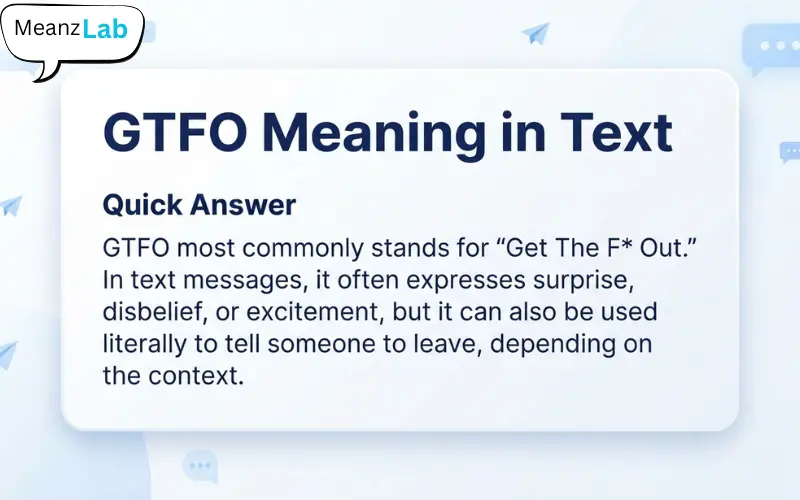
The GTFO meaning in text is “Get The F* Out.”** Although the phrase sounds harsh, it is not always used literally. In many text messages, social media posts, and online chats, people use GTFO to express surprise, disbelief, excitement, or amazement rather than telling someone to leave. The intended meaning depends entirely on the context and the relationship between the people communicating.
Example
Friend: “I just won VIP tickets to the concert.”
You: “GTFO! Seriously?”
Here, GTFO means “No way!” or “I can’t believe it!”, not “Leave.”
The internet has transformed the way people communicate. Instead of typing complete sentences, users often rely on abbreviations to express emotions quickly. Acronyms such as LOL, OMG, IDK, and SMH have become part of everyday online conversations. Another abbreviation that frequently appears in text messages and social media is GTFO.
If you’ve seen someone reply with “GTFO!”, you may have wondered whether they were angry, joking, or simply surprised. That’s because GTFO is one of those internet slang terms whose meaning changes depending on the situation. Sometimes it expresses excitement over unexpected news. Other times it shows disbelief after hearing something shocking. In more serious conversations, however, it can be used literally as an offensive way to tell someone to leave.
Many people search for GTFO meaning in text, what does GTFO mean in text, or what does GTFO mean because the abbreviation isn’t always easy to interpret. Reading only the four letters doesn’t tell you whether the sender is laughing, arguing, or reacting with amazement. Instead, you need to consider the surrounding conversation and the relationship between the people involved.
This guide explains what GTFO stands for, how it is used across different platforms, when it sounds friendly, when it sounds rude, and how to identify its intended meaning with confidence.
What Does GTFO Mean in Text?
The most common answer to “What does GTFO mean in text?” is:
GTFO = Get The F* Out**
Despite its literal wording, this abbreviation often functions as an emotional reaction rather than a command. Among friends, GTFO usually expresses disbelief or excitement after hearing unexpected news.
Imagine a friend tells you they met their favorite actor while shopping. Instead of writing a long response, you might simply reply, “GTFO!” In that context, you’re saying, “No way!” or “You’re kidding!” rather than telling them to go away.
Here are some natural examples:
- “GTFO! You actually won the competition?”
- “GTFO! I thought you were joking.”
- “GTFO, that’s the funniest thing I’ve heard today.”
- “GTFO! You finished the marathon already?”
- “GTFO! I never expected that to happen.”
These examples all share one thing in common: the speaker is reacting with surprise rather than hostility.
What Does GTFO Stand For?
If you’re wondering what does GTFO stand for, the abbreviation expands to:
Get The F* Out**
The phrase includes a swear word, which is why many people avoid using it in professional or formal situations. However, online conversations often soften its meaning, especially between close friends who understand each other’s humor.
Instead of interpreting it literally, many internet users read GTFO as:
- No way!
- Seriously?
- You’re kidding!
- That’s unbelievable!
- I can’t believe it!
This shift in meaning shows how internet slang evolves over time. What began as a direct command has become a common reaction expressing strong emotions.
GTFO at a Glance
| Acronym | Full Form | Most Common Meaning | Typical Tone |
| GTFO | Get The F*** Out | No way! / Seriously? | Informal |
| GTFO | Get The F*** Out | Leave immediately | Aggressive |
| GTFO | Get The F*** Out | I can’t believe it | Surprised |
| GTFO | Get The F*** Out | That’s amazing | Excited |
This table shows why context is essential. The same four letters can communicate completely different emotions.
Why Do People Use GTFO?
People use GTFO because it delivers a strong emotional reaction with very little typing. Internet conversations move quickly, and abbreviations allow users to respond almost instantly.
Instead of writing:
“I can’t believe you actually did that.”
Someone may simply reply:
“GTFO!”
Likewise, instead of typing:
“That’s unbelievable news!”
A friend might respond:
“GTFO!!”
Using GTFO makes the reaction feel more dramatic, energetic, and conversational.
Some of the reasons people use GTFO include:
- To react to shocking news.
- To express excitement.
- To respond to unbelievable stories.
- To exaggerate emotions humorously.
- To keep online conversations short and fast.
Because texting emphasizes speed, abbreviations like GTFO have become part of everyday digital communication.
Different Meanings of GTFO
Although GTFO always expands to the same phrase, its meaning changes depending on how it’s used.
1. Surprise
One of the most common meanings is surprise.
Examples:
- “GTFO! You bought a new house?”
- “GTFO! You really met the singer?”
- “GTFO! That’s incredible.”
- “GTFO! I didn’t expect that.”
- “GTFO! What happened next?”
2. Disbelief
Sometimes GTFO communicates skepticism because something sounds impossible.
Examples:
- “GTFO. You’re making that up.”
- “GTFO! That can’t be real.”
- “GTFO! Nobody would believe that.”
- “GTFO! You’re joking, right?”
- “GTFO! There’s no way.”
3. Excitement
Friends often use GTFO when celebrating good news.
Examples:
- “GTFO! You got the promotion!”
- “GTFO! That’s amazing news.”
- “GTFO! Congratulations!”
- “GTFO! You finally did it.”
- “GTFO! I’m so happy for you.”
4. Literal Command
In arguments, GTFO may actually mean “Leave.”
Examples:
- “GTFO of my room.”
- “GTFO before things get worse.”
- “GTFO now.”
- “Just GTFO.”
- “I said GTFO.”
This is the most offensive usage because the phrase is being interpreted literally.
Meaning by Situation
| Situation | Meaning of GTFO |
| Friend shares exciting news | No way! |
| Someone tells an unbelievable story | Seriously? |
| Funny conversation | You’re kidding! |
| Heated argument | Leave immediately |
| Unexpected achievement | That’s amazing! |
The surrounding conversation almost always tells you which meaning is intended.
Is GTFO Always Rude?
One of the biggest misconceptions about GTFO is that it is always offensive. While the abbreviation contains profanity, its tone depends on how people use it.
Among close friends, GTFO is often playful. Someone may respond with GTFO after hearing that a friend won the lottery, got engaged, or met a celebrity. In these cases, nobody feels insulted because everyone understands that the reaction expresses excitement or disbelief.
However, if GTFO is directed at someone during an argument, the tone changes completely. Instead of expressing surprise, it becomes an aggressive command telling the other person to leave.
Because tone is difficult to judge through text alone, it’s always wise to consider your audience before using GTFO. A close friend may laugh at the abbreviation, while someone you barely know could interpret it as rude or disrespectful.
GTFO on Social Media
GTFO appears regularly on platforms like Instagram, TikTok, Facebook, Reddit, X (formerly Twitter), and YouTube. On these platforms, it is usually used as a reaction rather than a literal command. People often type GTFO in comments when they are shocked, impressed, or amused by something they have just seen.
For example, someone might post a video of an incredible basketball shot or an unexpected magic trick. Instead of writing a long comment, viewers simply reply with GTFO to show their surprise.
Here are some examples:
- “GTFO! That ending was completely unexpected.”
- “GTFO! I watched this three times.”
- “GTFO! You actually made that jump?”
- “GTFO! This recipe looks incredible.”
- “GTFO! I never knew that fact.”
On social media, the abbreviation usually functions as an emotional reaction, much like OMG or No way!
GTFO in Gaming
Online gaming communities have used GTFO for many years. During fast-paced games, players often need to communicate quickly, and short acronyms make teamwork easier.
Unlike social media, GTFO in gaming is often used literally as a warning.
For example:
- “GTFO before the boss attacks.”
- “GTFO of the red zone.”
- “GTFO! The bridge is collapsing.”
- “GTFO, we’re surrounded.”
- “GTFO before the timer runs out.”
Because players only have a few seconds to react, typing four letters is much faster than writing a complete sentence.
GTFO Compared with Similar Internet Slang
GTFO is only one of many internet abbreviations used to express emotions. Learning similar slang makes online conversations much easier to understand.
GTFO vs Similar Acronyms
| Acronym | Full Meaning | Typical Emotion |
| GTFO | Get The F*** Out | Surprise, disbelief, anger |
| OMG | Oh My God | Shock or amazement |
| WTF | What The F*** | Confusion or disbelief |
| SMH | Shaking My Head | Disappointment |
| LOL | Laughing Out Loud | Laughter |
| ROFL | Rolling On the Floor Laughing | Extreme laughter |
Although these abbreviations express different emotions, they all help people communicate quickly without typing long sentences.
Better Alternatives to GTFO
Since GTFO contains profanity, it isn’t always the best choice. If you’re speaking with coworkers, teachers, clients, or people you don’t know well, using a cleaner alternative is usually a better idea.
Some friendly replacements include:
- No way!
- Seriously?
- You’re kidding!
- I can’t believe it!
- That’s unbelievable!
- Incredible!
- Wow!
Here are a few examples:
Instead of:
“GTFO! You won first place?”
You could write:
- “No way! You won first place?”
- “Seriously? That’s amazing!”
- “I can’t believe it!”
- “That’s incredible!”
- “Wow, congratulations!”
These alternatives communicate the same excitement without using offensive language.
When You Should Avoid Using GTFO
Although GTFO is common online, there are situations where using it can create the wrong impression. Because it includes profanity, many people consider it inappropriate in formal settings.
Avoid using GTFO in:
- Business emails.
- Job interviews.
- School assignments.
- Professional presentations.
- Customer service conversations.
- Workplace chat with managers.
- Official documents.
In these situations, complete and respectful language is always the safer choice.
Common Mistakes People Make
Many people misunderstand GTFO because they assume it always has one meaning. The truth is that context changes everything.
One common mistake is believing GTFO always means “Leave immediately.” While that can be true during an argument, it is much more common for friends to use GTFO as an expression of surprise.
Another mistake is using GTFO with someone who may not appreciate strong language. Even if your intention is playful, the profanity may offend readers who are unfamiliar with internet slang.
Finally, some users include GTFO in professional conversations simply because they use it frequently with friends. This should generally be avoided, as the abbreviation may appear disrespectful in formal communication.
Common Mistakes and Corrections
| Mistake | Correct Explanation |
| GTFO always means “Leave.” | It often means “No way!” or “Seriously?” in casual chats. |
| GTFO is appropriate everywhere. | It should be limited to informal conversations. |
| GTFO is always offensive. | Among close friends, it is often playful and humorous. |
| Everyone interprets GTFO the same way. | Context and relationships determine the meaning. |
See Also:
- TTS Meaning in Text
- HYB Meaning in Text
- NC Meaning in Text
- BBW Meaning in Text
- WWA Meaning in Text
- DW Meaning in Text
FAQs
What does GTFO mean in text?
The most common GTFO meaning in text is “Get The F* Out.”** However, many people use it as a reaction to surprising or unbelievable news rather than as a command. Depending on the conversation, it can mean “No way!”, “Seriously?”, or “I can’t believe it!”
Is GTFO always rude?
No. While the phrase contains profanity, friends often use GTFO playfully to express excitement or disbelief. If it is directed at someone during an argument, however, it can sound aggressive and offensive.
What does GTFO mean on social media?
On social media, GTFO is usually a reaction to shocking, funny, or exciting content. People often use it in comments to express amazement or disbelief. In most cases, it is not intended as an insult.
Can I use GTFO in professional communication?
It’s generally best to avoid GTFO in workplaces, business emails, or academic writing. Because it includes profanity, it may appear disrespectful or unprofessional. Safer alternatives such as “That’s unbelievable!” or “Really?” are more appropriate.
How can I tell which GTFO meaning is correct?
The easiest way is to read the surrounding conversation. If someone shares exciting news, GTFO probably means “No way!” If people are arguing, it is more likely to mean “Leave immediately.” Looking at the context almost always reveals the intended meaning.
Conclusion
The GTFO meaning in text is much more flexible than many people realize. Although the abbreviation stands for “Get The F* Out,”** it is often used to express surprise, disbelief, excitement, or amazement rather than telling someone to leave.
The surrounding conversation determines how GTFO should be interpreted. In a friendly chat, it usually means “No way!” or “I can’t believe it!” In an argument, however, it becomes a literal and potentially offensive command.
Whenever you see GTFO in a text message, social media comment, gaming chat, or online discussion, pay attention to the context and the relationship between the people involved. Doing so will help you recognize whether the abbreviation is playful, emotional, or genuinely hostile.