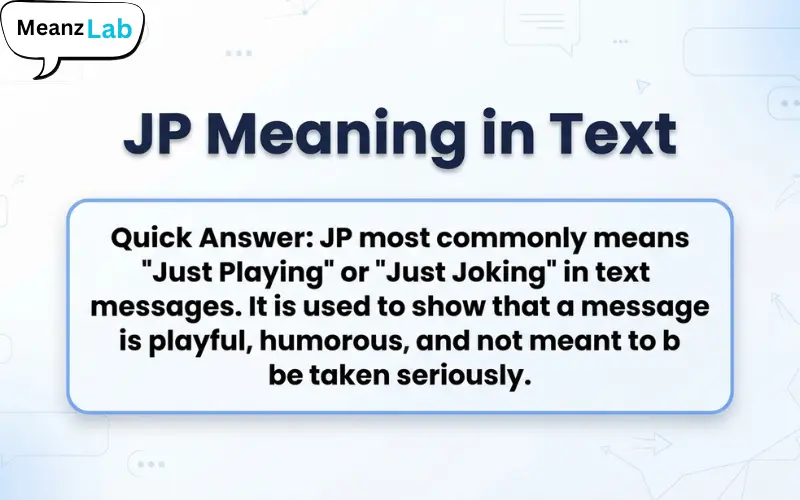
The JP meaning in text most commonly stands for “Just Playing” or “Just Joking.” People use this abbreviation to show that a message is playful, humorous, or not meant to be taken seriously. It helps prevent misunderstandings and keeps conversations light.
Example
Friend: “You’re the worst teammate ever! 😂”
You: “JP bro, you’re actually carrying us.”
Here, JP tells the other person that the comment was made in fun and shouldn’t be taken literally.
Online conversations move much faster than face-to-face communication. Instead of writing long explanations, people often rely on abbreviations that save time while keeping messages easy to understand. Popular shortcuts like LOL, BRB, IDK, TBH, and NGL have become part of everyday digital communication across messaging apps and social media.
Another abbreviation that frequently appears is JP. Although it consists of only two letters, it can have several meanings depending on the conversation. Most of the time, people use JP to indicate that they are joking or teasing someone. In other situations, however, it may refer to a country, a professional title, or another specific term.
Because of these multiple meanings, many people search for JP meaning in text, what does JP mean in text, what does JP stand for, or what does JP mean in slang after seeing it in a message.
Fortunately, the meaning is usually easy to identify once you consider the context. If the conversation involves humor, teasing, or friendly banter, JP almost always means “Just Playing” or “Just Joking.” In more formal discussions, it may have a completely different interpretation.
This guide explains the most common meaning of JP in texting, where it is used, why people like using it, and how to recognize its intended meaning in different situations.
What Does JP Mean in Text?
If you’re wondering what does JP mean in text, the answer depends on the conversation. In casual messaging, the abbreviation usually has one of these meanings:
- Just Playing
- Just Joking
Both expressions serve the same purpose. They tell the other person that a previous statement wasn’t serious and shouldn’t be taken literally.
For example, imagine telling your friend that they owe you a million dollars. Before they start wondering whether you’re serious, you quickly add “JP.” That simple abbreviation immediately changes the tone from serious to playful.
Here are several original examples:
- “JP, I wasn’t serious about deleting your photos.”
- “You’re always late… JP! 😂”
- “JP, I know you did your best.”
- “Don’t quit your job… JP!”
- “JP, I actually liked the movie.”
Each sentence uses JP to soften a statement and avoid misunderstandings.
Quick Comparison of JP Meanings
Although Just Playing and Just Joking are the most common definitions, JP can represent other phrases depending on the situation.
| JP Meaning | Common Context | Example |
| Just Playing | Text messages | “JP, I’m only teasing.” |
| Just Joking | Social media | “JP 😂 I didn’t mean it.” |
| Japan | Gaming and travel | “I’m on the JP server.” |
| Justice of the Peace | Legal discussions | “The document was signed by a JP.” |
| Junior Partner | Business | “She became a JP at the firm.” |
The surrounding conversation almost always reveals which meaning is correct.
Why Do People Use JP?
JP has become popular because it helps people communicate humor without causing confusion. Written messages don’t include facial expressions or tone of voice, so jokes can easily be misunderstood.
Adding JP tells readers that the message is meant as friendly teasing rather than criticism.
People commonly use JP because it:
- Makes jokes easier to recognize.
- Prevents unnecessary arguments.
- Keeps conversations relaxed.
- Saves time while texting.
- Works naturally in gaming and social media chats.
Instead of writing:
- “I’m just joking.”
- “I’m only playing.”
- “Don’t take that seriously.”
- “I didn’t really mean that.”
- “I was only teasing.”
Many users simply type:
JP
Those two letters communicate the same idea much faster.
JP as “Just Playing”
The most common use of JP is “Just Playing.” People say it after making a playful remark so the other person understands they are only teasing.
This expression is especially common among close friends, siblings, classmates, and gaming teammates.
Here are some examples:
- “You’re the slowest driver ever… JP!”
- “JP, I know you’re actually good at basketball.”
- “You forgot my birthday… JP, I know you didn’t.”
- “JP, you’re one of my favorite coworkers.”
- “You’re buying lunch for everyone… JP!”
In each example, JP changes what could sound like criticism into friendly humor.
JP as “Just Joking”
Another very common meaning is “Just Joking.” Although it is nearly identical to Just Playing, some people prefer this version because it directly tells others the previous statement was intended as a joke.
Examples include:
- “I was kidding about quitting. JP.”
- “JP, your cooking is actually delicious.”
- “Don’t block me… JP!”
- “JP, I knew the answer all along.”
- “You’re fired… JP!”
Using JP after these statements immediately removes any serious meaning.
Real Conversation Examples
Seeing JP used in complete conversations makes the abbreviation much easier to understand.
Conversation 1
Friend: “Why didn’t you answer my message?”
You: “JP, I was just teasing earlier.”
Conversation 2
Teammate: “You’re impossible to play with.”
Player: “JP, we’re winning anyway.”
Conversation 3
Friend: “Did you really eat the whole pizza?”
You: “JP 😂 I only had two slices.”
Conversation 4
Brother: “You broke my headphones?”
You: “JP! They’re right on the table.”
Conversation 5
Friend: “You’re deleting the group chat?”
You: “JP, I wouldn’t do that.”
Each of these conversations shows the same purpose: JP reassures the other person that the previous statement was playful and not meant to be taken seriously.
What Does JP Mean in Slang?
When people search what does JP mean in slang, they are usually referring to the same meaning used in casual texting: “Just Playing” or “Just Joking.” Both expressions tell readers that a comment was made for fun and shouldn’t be interpreted literally.
Slang is designed to make conversations feel relaxed and natural. Instead of writing a full sentence to explain that they are joking, people simply add JP at the end of a message. This instantly changes the tone and lets others know there is no bad intention behind the comment.
You’ll often see JP in conversations between friends, classmates, siblings, or gaming teammates because these groups frequently tease one another.
Here are some original examples:
- “JP, I wasn’t really ignoring you.”
- “You’re banned from the group… JP!”
- “JP, I know you’re the smartest one here.”
- “I sold your controller… JP 😂”
- “JP, I would never do that.”
Each example uses JP to remove seriousness and keep the conversation friendly.
JP in Gaming and Online Communities
Gaming communities rely heavily on abbreviations because players need to communicate quickly while focusing on the game. JP has become a useful shorthand for letting teammates know that a teasing remark isn’t meant to offend anyone.
Competitive games often involve playful trash talk between friends. Without abbreviations like JP, those comments could easily be misunderstood.
Examples include:
- “You’re carrying us… JP, we’re all doing great.”
- “JP, nice shot!”
- “You almost lost that fight… JP 😂”
- “JP, you’ll win the next round.”
- “That was the funniest mistake today—JP.”
Outside gaming, JP also appears in Discord servers, Reddit discussions, and online communities where members interact casually and enjoy joking with one another.
JP as Japan
Although Just Playing is the most common meaning in texting, JP can also represent Japan in certain situations. This meaning usually appears in travel discussions, shipping information, gaming servers, and international communities.
For example, many online games organize players by regional servers. Someone saying “I’m playing on the JP server” is talking about the Japanese server, not making a joke.
Examples:
- “The event launches first on the JP server.”
- “I’m ordering this product from JP.”
- “JP has some exclusive game content.”
- “Our flight lands in JP tomorrow morning.”
- “The package shipped from JP yesterday.”
The surrounding topic makes it easy to recognize that JP refers to the country rather than a texting abbreviation.
JP in Professional and Formal Contexts
Outside casual conversations, JP sometimes has formal meanings that are completely unrelated to internet slang.
One common example is Justice of the Peace, a legal official who performs certain legal duties in many countries.
Another meaning is Junior Partner, which refers to a partner with a lower ownership level in a business or law firm.
Examples include:
- “The agreement was signed before a JP.”
- “She recently became a JP at the company.”
- “Our documents require approval from a JP.”
- “The firm’s newest JP joined last month.”
- “The certificate was verified by the local JP.”
Because these meanings appear in professional or legal discussions, they are easy to distinguish from the slang version.
JP vs JK: What’s the Difference?
Many people wonder whether JP and JK mean exactly the same thing. Although they are similar, there is a small difference in how they are commonly used.
| Abbreviation | Meaning | Typical Use |
| JP | Just Playing | Friendly teasing |
| JK | Just Kidding | General jokes |
| LOL | Laughing Out Loud | Showing laughter |
| TBH | To Be Honest | Honest opinions |
| NGL | Not Gonna Lie | Introducing a truthful statement |
JK is slightly more common across the internet because it directly means “Just Kidding.” JP, on the other hand, often sounds more playful and is frequently used after teasing friends.
For example:
- “You’re paying for dinner… JK!”
- “You’re paying for dinner… JP!”
Both sentences communicate the same idea, but JP often feels a little more casual.
Common Mistakes People Make
Because JP has several meanings, people sometimes misunderstand what the abbreviation represents.
One common mistake is assuming JP always means Japan. While that’s true in travel or gaming discussions, most casual text messages use JP to mean Just Playing or Just Joking.
Another mistake is taking JP literally.
For example:
Message: “You’re the worst friend ever. JP.”
Without reading the final abbreviation, the message sounds harsh. Once JP is included, it becomes obvious that the sender is only teasing.
People also occasionally confuse JP with JK. Although both abbreviations communicate humor, they are not identical and may be preferred by different online communities.
When Should You Use JP?
JP works best in informal conversations where everyone understands internet slang. It helps prevent misunderstandings while keeping messages short and friendly.
Good situations include:
- Text messages
- WhatsApp chats
- Snapchat conversations
- Discord servers
- Gaming chats
- Instagram direct messages
- Group conversations with friends
Examples:
- “JP, I knew you’d beat me.”
- “JP, don’t take that seriously.”
- “JP, I’m only teasing.”
- “JP 😂 you’re actually doing great.”
- “JP, I couldn’t resist making that joke.”
Avoid using JP in business emails, academic writing, legal documents, or other professional communication where abbreviations may confuse readers.
See Also:
- STG Meaning in Text
- HN Meaning in Text
- MYB Meaning in Text
- FN Meaning in Text
- WYA Meaning in Text
- NTY Meaning in Text
FAQs
What does JP mean in text?
The most common JP meaning in text is “Just Playing” or “Just Joking.” People use it after making a playful comment so others know they are not being serious. It helps keep conversations friendly and prevents misunderstandings.
What does JP mean in slang?
In slang, JP usually means “Just Playing” or “Just Joking.” It is commonly used between friends during casual conversations, gaming chats, and social media interactions. The abbreviation adds humor and makes teasing sound less serious.
Does JP always mean Just Playing?
No. Although Just Playing is the most common meaning in texting, JP can also refer to Japan, Justice of the Peace, or Junior Partner depending on the topic. Reading the surrounding conversation is the easiest way to determine the correct meaning.
Is JP the same as JK?
JP and JK are very similar because both indicate that someone is joking. However, JK specifically means “Just Kidding,” while JP usually means “Just Playing.” Both abbreviations help soften playful comments.
Can I use JP in professional communication?
JP is best suited for casual conversations rather than formal writing. In business emails, reports, or official documents, it’s usually better to write the complete phrase instead of using abbreviations. This avoids confusion and keeps your communication professional.
Conclusion
The JP meaning in text most commonly stands for “Just Playing” or “Just Joking.” It is a simple abbreviation that helps people show their comments are playful rather than serious. By adding JP to a message, the sender can tease someone without creating unnecessary misunderstandings.
Although JP can also refer to Japan, Justice of the Peace, or Junior Partner, those meanings usually appear in specific professional or geographical contexts. In everyday texting, social media, and gaming conversations, Just Playing and Just Joking remain the most common interpretations.
Whenever you come across JP in a message, look at the surrounding conversation. In most cases, the context will immediately tell you which meaning the sender intended.