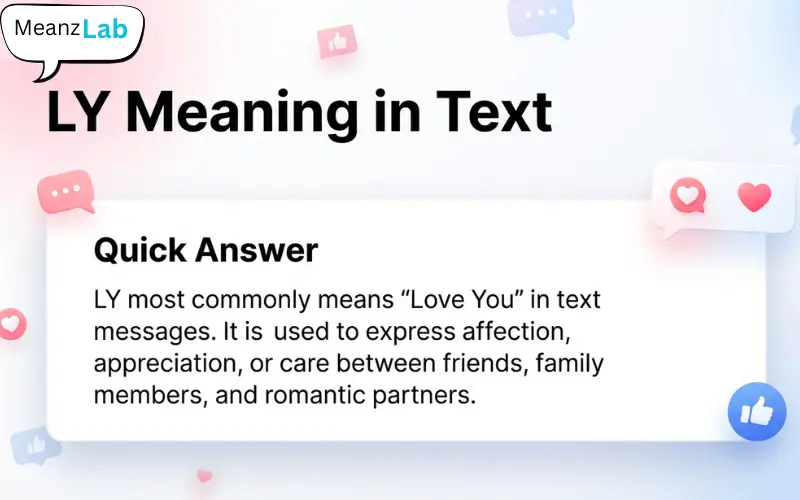
The LY meaning in text is “Love You.” It is a popular texting abbreviation used to express affection, appreciation, or care without typing the full phrase. While it often appears in conversations between romantic partners, LY is also commonly used by family members, close friends, and trusted online friends. The exact tone depends on the relationship and the context of the conversation.
Example:
Friend: “Thanks for always being there for me.”
Reply: “Anytime! LY ❤️”
Here, LY simply means “Love You.”
Text messaging has changed the way people communicate. Instead of writing long sentences, many people now rely on abbreviations to express emotions and ideas quickly. Acronyms such as LOL, BRB, IDK, and TY have become part of everyday conversations, making digital communication faster and more convenient. Another abbreviation you may come across is LY.
If you’ve recently received a message ending with “LY,” you might wonder whether it has a romantic meaning or if friends and family use it too. Since texting abbreviations often have different meanings depending on the situation, it’s natural to search for LY meaning in text or ask what does LY mean in text before responding.
In most cases, LY is a simple way of saying “Love You.” It allows people to express warmth, appreciation, and emotional support in just two letters. However, the feeling behind those letters can vary. A parent sending LY to a child communicates something very different from a partner sending LY at the end of a romantic conversation. Even close friends sometimes use the abbreviation as a sign of appreciation rather than romantic love.
This guide explains the meaning of LY, why people use it, how it appears in different conversations, and how you can tell exactly what it means based on the surrounding context.
What Does LY Mean in Text?
The most common answer to “What does LY mean in text?” is simple:
LY = Love You
People use this abbreviation when they want to express affection without typing the complete phrase. It is especially common in text messages, messaging apps, and social media conversations where short replies are preferred.
Although it contains only two letters, LY often carries genuine emotion. It can show gratitude, encouragement, affection, or emotional closeness depending on who sends it.
Here are some natural examples:
- “Have a great day. LY!”
- “Thanks for helping me yesterday. LY.”
- “Sleep well tonight. LY ❤️”
- “Drive safely and text me when you get there. LY.”
- “I really appreciate everything you’ve done. LY.”
Each example uses LY differently, but the core message remains the same: the sender wants to express care and affection.
LY Meaning at a Glance
| Abbreviation | Meaning | Common Situation | Tone |
| LY | Love You | Text messages | Affectionate |
| LY | Love You | Family chats | Caring |
| LY | Love You | Friend conversations | Warm and supportive |
| LY | Love You | Romantic messages | Loving |
| LY | Love You | Social media | Friendly or affectionate |
The table shows that LY has one primary meaning, but the emotional tone changes depending on the relationship.
Why Do People Use LY Instead of “Love You”?
One of the biggest reasons is convenience. Modern messaging is designed for speed, and abbreviations help people communicate quickly without losing meaning.
Instead of typing “Love You” every time, many people simply write LY. The recipient usually understands the message immediately because the abbreviation has become familiar across texting platforms.
Another reason is that LY feels casual. It allows people to express affection naturally without making the conversation seem overly formal. For many users, it has become part of their everyday texting habits.
Think about these common abbreviations:
- TY = Thank You
- BRB = Be Right Back
- IMO = In My Opinion
- IDK = I Don’t Know
- LY = Love You
Just as people shorten other common expressions, they shorten “Love You” as well.
Here are five more examples:
- “Heading to work now. LY!”
- “Call me when you’re free. LY.”
- “Have fun on your trip. LY.”
- “Thanks for cheering me up. LY ❤️”
- “See you tomorrow. LY.”
These messages feel friendly and natural because LY fits smoothly into everyday conversations.
LY Meaning in Chat Conversations
If you’re searching for LY meaning in chat, you’ll find that the definition remains almost the same.
Whether you’re chatting on WhatsApp, Messenger, Snapchat, Instagram, Discord, or Telegram, LY almost always means “Love You.”
The difference lies in the relationship between the people chatting. In some conversations, LY expresses romantic affection. In others, it simply communicates friendship or family love.
For example:
Person A: “Good luck with your interview.”
Person B: “Thanks! LY.”
In this conversation, LY expresses appreciation and emotional support.
Another example:
Person A: “Goodnight.”
Person B: “Sleep well. LY ❤️”
Here, LY creates a warm and caring ending to the conversation.
More examples include:
- “Don’t forget to eat lunch. LY.”
- “I’m proud of you. LY!”
- “Take care of yourself. LY.”
- “You’ve always been there for me. LY.”
- “Hope everything goes well today. LY.”
These examples show that LY isn’t limited to romantic relationships. It can strengthen many kinds of personal connections.
The Emotional Meaning Behind LY
Although LY is only two letters long, it often carries significant emotional value. Unlike abbreviations that simply save time, LY communicates genuine feelings. That is why many people use it regularly with those who matter most to them.
The emotional meaning depends entirely on the relationship.
A parent may send LY before a child leaves for school to express care and protection. A sibling may use it after offering encouragement before an important exam. Close friends often exchange LY after helping each other through difficult moments. Romantic partners may end nearly every conversation with LY because it has become part of their daily routine.
Here are several examples that show how the emotion changes with context:
- “I’m always here if you need me. LY.”
- “Congratulations on your graduation! LY.”
- “Don’t worry, everything will be okay. LY.”
- “Thanks for making today special. LY ❤️”
- “Can’t wait to see you this weekend. LY.”
Even though every sentence ends with the same abbreviation, the feeling behind it changes according to the situation and the people involved.
LY in Different Relationships
One reason LY is so popular is that it works in many different relationships. Unlike some abbreviations that belong only to internet slang, LY is flexible enough to fit conversations between family members, friends, romantic partners, and even close online acquaintances.
A mother texting “LY” to her daughter before work communicates encouragement. Two lifelong friends may exchange LY after supporting one another through a difficult time. A couple might use LY dozens of times throughout the day simply because it has become part of their routine.
Examples include:
- Parent: “Have a wonderful day at school. LY.”
- Child: “Love you too! See you later.”
- Friend: “Thanks for listening to me yesterday. LY.”
- Sibling: “Drive carefully. LY.”
- Partner: “Counting the hours until I see you. LY ❤️”
These examples show that the abbreviation adapts naturally to different relationships without changing its basic meaning.
LY in Romantic Conversations
One of the most common places you’ll see LY is in conversations between romantic partners. Many couples use it every day because it feels warm, personal, and effortless. Instead of typing the full phrase “Love You” repeatedly, they simply write LY, especially during quick conversations throughout the day.
Although the abbreviation is short, it still communicates affection. Whether it’s sent in the morning, before bed, or during a busy workday, LY reminds the other person that they are loved and appreciated.
Here are some natural examples:
- “Good morning! Hope you have an amazing day. LY ❤️”
- “Drive safely and text me when you get there. LY.”
- “I’m already counting down until our date tonight. LY.”
- “Sweet dreams. LY always.”
- “Thanks for making me smile today. LY.”
In romantic conversations, LY often appears alongside heart emojis, affectionate nicknames, or caring messages. The abbreviation may be brief, but its emotional impact can still be meaningful.
LY Among Friends
Many people assume LY is only used between couples, but that isn’t true. Close friends often use it to show appreciation, gratitude, or emotional support without implying romance.
Long-term friendships are built on trust and care. For some friends, saying “Love You” feels completely natural, and using LY makes the expression quick and casual.
Examples include:
- “Thanks for helping me prepare for my interview. LY!”
- “You’re honestly the best friend I could ask for. LY.”
- “Have fun on your vacation and stay safe. LY!”
- “I appreciate everything you’ve done for me this year. LY.”
- “Call me if you need anything. LY.”
These messages show that friendship can involve genuine affection without being romantic. The relationship itself determines how LY is interpreted.
LY in Family Text Messages
Family members probably use LY more often than anyone else. Parents, children, siblings, grandparents, and other relatives frequently include it in everyday conversations because it communicates love in a simple and natural way.
Since families often exchange multiple messages each day, abbreviations like LY make texting quicker while still expressing genuine care.
Consider these examples:
- “Don’t forget your doctor’s appointment. LY.”
- “Have a safe flight. LY ❤️”
- “Dinner will be ready at seven. LY.”
- “Good luck on your exam today. LY!”
- “Call me when you get home safely. LY.”
These examples show that LY often carries feelings of protection, encouragement, and family support rather than romance.
LY on Social Media
The popularity of social media has helped abbreviations like LY become even more common. People often include it in captions, comments, replies, and direct messages to express appreciation publicly or privately.
Unlike private texting, social media conversations are sometimes visible to a wider audience. Even so, LY usually keeps the same meaning.
You might see it on:
- Instagram captions
- Facebook comments
- Snapchat messages
- TikTok replies
- X (formerly Twitter) posts
Examples include:
- “Happy birthday! Hope you have the best day ever. LY ❤️”
- “Thanks for always supporting me. LY.”
- “Missing you already. LY.”
- “Couldn’t have done it without you. LY!”
- “You’re amazing. LY forever.”
Whether posted publicly or sent privately, LY continues to communicate affection and appreciation.
LY vs Similar Texting Abbreviations
| Abbreviation | Full Meaning | Typical Tone | Common Usage |
| LY | Love You | Warm and affectionate | Friends, family, partners |
| ILY | I Love You | More direct and emotional | Romantic and family conversations |
| Love Ya | Love You | Casual and playful | Close friends and relatives |
| TY | Thank You | Appreciative | Everyday texting |
| XOXO | Hugs and Kisses | Affectionate | Letters, texts, social media |
Although all these expressions can communicate positive feelings, LY is one of the quickest ways to express care without writing a full sentence.
LY vs ILY: What’s the Difference?
People often compare LY with ILY, and while both express affection, they are not always identical in tone.
ILY stands for “I Love You.” Because it includes the subject “I,” it feels more direct and personal. Many people use ILY during emotional conversations or when they want to make their feelings especially clear.
LY, on the other hand, feels slightly lighter and more conversational. It still means “Love You,” but it often fits naturally into everyday messages.
Here are a few examples:
- “Have a great day. LY!”
- “I just wanted to remind you that ILY.”
- “Thanks again for everything. LY.”
- “No matter what happens, ILY.”
- “Talk to you tomorrow. LY ❤️”
Neither abbreviation is better than the other. The choice depends on the relationship and the tone of the conversation.
Common Mistakes People Make About LY
One common misunderstanding is believing that LY always has a romantic meaning. In reality, millions of people use it with parents, siblings, children, and close friends.
Another mistake is assuming that LY is only used by teenagers. While younger people may use abbreviations more frequently, adults also use LY in family chats and everyday messaging.
Some people also confuse LY with other internet abbreviations or assume it has multiple unrelated meanings. Unlike many texting shortcuts, LY almost always stands for Love You, making it one of the easier abbreviations to recognize.
To avoid misunderstandings, always consider:
- Who sent the message.
- What the conversation is about.
- The relationship between the people involved.
Those three clues usually make the intended meaning obvious.
How Should You Respond to LY?
Your reply should match both the relationship and the tone of the conversation. There’s no single correct response because different situations call for different levels of affection.
If a family member sends LY, replying with “Love you too” or “LY ❤️” is perfectly natural. If a close friend sends it after thanking you for something, responding warmly helps maintain the positive tone.
Examples of appropriate replies include:
- “LY too! Have a wonderful day.”
- “Love you too ❤️”
- “Aww, thank you! LY.”
- “Take care. LY!”
- “You’re the best. LY too.”
Choosing a response that feels genuine is more important than using any specific abbreviation.
See Also:
- BTS Meaning in Text
- UT Meaning in Text
- PP Meaning in Text
- PRN Meaning in Text
- GPI Meaning
- GL Meaning
FAQs
What does LY mean in text?
The most common LY meaning in text is “Love You.” People use it to express affection in text messages, chat apps, and social media conversations. While the wording is brief, it often carries genuine emotion and warmth.
What does LY mean in chat?
In chat conversations, LY almost always stands for “Love You.” It can be used between romantic partners, family members, or close friends. The relationship between the people chatting helps determine the emotional tone.
Is LY always romantic?
No. Although romantic partners frequently use LY, it is also common among parents, children, siblings, and close friends. Context is the key to deciding whether the message is romantic, friendly, or simply caring.
What is the difference between LY and ILY?
LY means “Love You,” while ILY means “I Love You.” ILY usually sounds more direct because it includes the word “I.” LY feels slightly more casual, making it popular in everyday conversations.
Can I use LY with friends?
Yes. Many close friends use LY to express appreciation, gratitude, and emotional support. As long as both people understand the nature of the friendship, the abbreviation feels completely natural and friendly.
Conclusion
The LY meaning in text is simple yet meaningful. In almost every texting or chat conversation, LY stands for “Love You.” People use it to express affection, appreciation, encouragement, and emotional support without typing the complete phrase.
Although many associate LY with romantic relationships, it is equally common among family members, close friends, and trusted online companions. The relationship between the sender and the recipient determines the emotional tone, but the core meaning remains the same.
The next time someone sends you LY, you’ll know they’re expressing care in a quick, modern, and heartfelt way. By paying attention to the surrounding conversation, you can easily recognize the intended meaning and respond naturally.