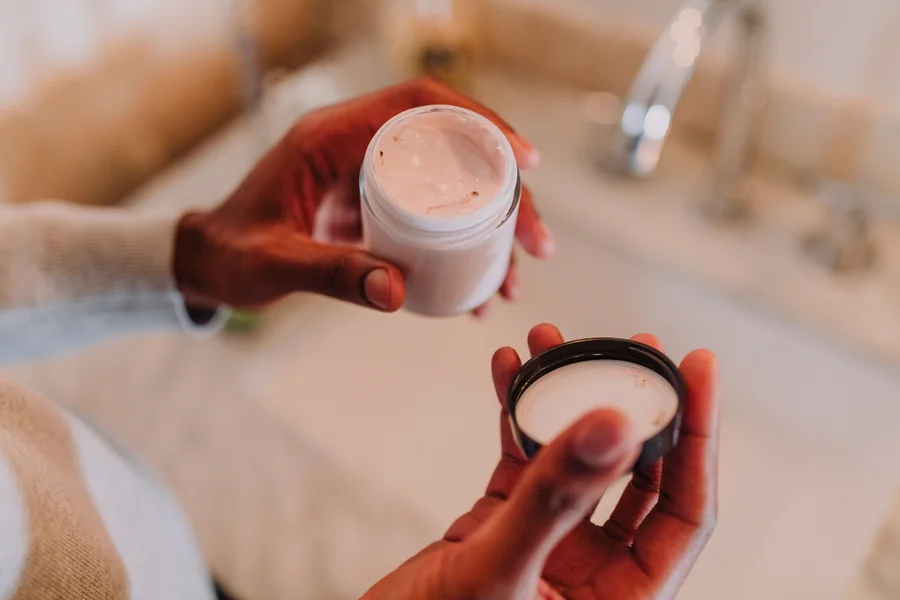
Moisturizer labels can read like a chemistry exam. Three ingredients come up on almost every one, though: hyaluronic acid, ceramides, and niacinamide. You don’t need a science degree to understand them. You just need to know what each one does, so you can tell whether the jar in your hand is worth buying.
Hyaluronic acid: the water magnet
Hyaluronic acid is a humectant, which is a fancy word for smething that holds onto water. It can bind a lot of it, so it gives skin that soft, plump, bouncy feel. It’s also very light, which is why it shows up in gels and watery creams that don’t feel greasy.
One thing worth knowing: it works best on slightly damp skin. Dermatologists keep saying to apply moisturizer while your skin’s still a bit wet after washing. Skip that, and you’ve given the ingredient nothing to hold onto. And it doesn’t seal anything in by itself, so it’s usually paired with something heavier on top.
Ceramides: the seal
Think of your skin barrier as a brick wall. The skin cells are the bricks, and ceramides are part of the mortar holding them together. They’re fats your skin makes naturally, and they help stop water from escaping and irritants from getting in. A dermatologist at Cleveland Clinic describes ceramides as the grout of the skin, which is a pretty good way to picture it.
When that barrier gets weak, skin can feel tight, flaky, or easily irritated. A moisturizer with ceramides helps top up what’s missing. They’re a good pick for dry skin, for winter, and for anyone whose face stings when they try something new. Creams and thicker textures usually carry them best.
Niacinamide: the multitasker
Niacinamide is vitamin B3, and it’s one of the most popular skincare ingredients for good reason. It supports the skin barrier, calms redness, helps balance oil, and can fade the look of dark spots over time. Some research suggests formulas with around 5% niacinamide can help with that last one, though you won’t see changes overnight.
It plays nicely with others. It’s often paired with ceramides and hyaluronic acid, which is why so many moisturizers contain all three. If you’ve got oily or combination skin, it’s a particularly handy one to look for.
Start slowly, though. A small number of people find higher strengths irritating, so patch test on your inner arm first and don’t pile it on with a bunch of other actives in the same week.
Do you need all three?
Not necessarily. They do different jobs. Hyaluronic acid brings water in, ceramides help keep it there, and niacinamide supports the barrier and evens things out. Together they make a very sensible combination, and that’s why you see them so often side by side.
But a good moisturizer doesn’t need a long ingredient list. If your skin’s happy with a simple formula, you’re fine.
Matching it to your skin
If your skin runs dry, look for a richer cream with ceramides. If it’s oily or gets shiny by midday, a lightweight gel or lotion with hyaluronic acid and niacinamide usually feels better. Combination skin can go either way, or use a lighter formula in the morning and a richer one at night.
The climate matters too. Constant air conditioning dries skin out, even in a hot country. Dermatologists’ dry skin tips are worth a read if you find your face feels tight indoors, and they include the trick about applying moisturizer to damp skin.
Reading the label without losing your mind
Ingredients are listed from highest to lowest amount, so the first few are the main event. Don’t worry if something you want sits near the bottom. Many active ingredients work at small percentages. If you have sensitive skin, a fragrance-free formula is usually the safer choice.
And sunscreen is separate. A moisturizer with hydration ingredients doesn’t replace it unless it clearly states SPF and protection on the label.
Give any new product a few weeks before you decide, using it every day. Skin doesn’t change in three days.
So the short version: hyaluronic acid brings the water, ceramides keep it in, and niacinamide helps everything run smoothly. Pick the texture you actually enjoy using, and it’ll earn its place on your shelf.