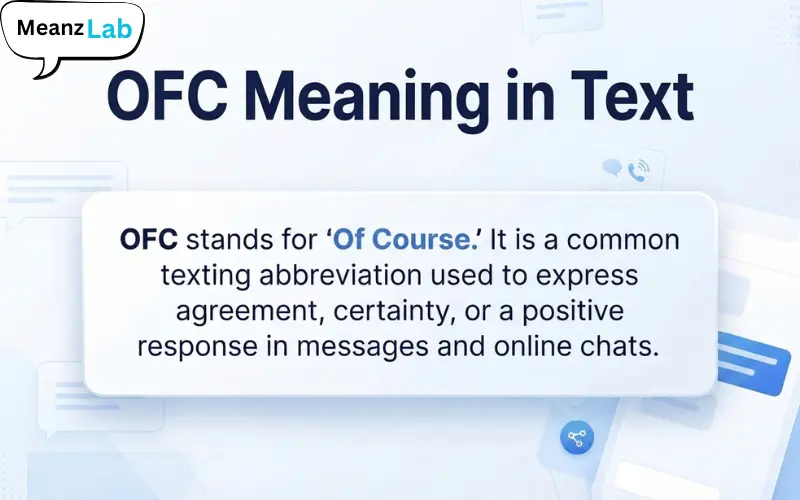
The OFC meaning in text is “Of Course.” People use this abbreviation to show agreement, certainty, willingness, or a positive response in text messages, social media conversations, gaming chats, and online discussions.
Example
Friend: “Can you send me the notes after class?”
You: “OFC!”
In this conversation, OFC simply means “Of course,” showing that you’re happy to help.
Online conversations move quickly, and people often look for ways to type faster without changing the meaning of their messages. That’s why abbreviations have become an important part of digital communication. Instead of writing complete phrases every time, users shorten common expressions into a few letters that are easy to recognize.
One abbreviation you may come across is OFC. Although it’s only three letters long, it appears in thousands of conversations every day across messaging apps and social media platforms. Whether someone is accepting an invitation, agreeing with a friend, or confirming a plan, OFC provides a quick and friendly response.
Many people search for OFC meaning in text, what does OFC mean in text, what does OFC stand for, or what does OFC mean in slang after receiving it in a message. Fortunately, this abbreviation is one of the easiest internet terms to learn because it almost always carries the same positive meaning.
This guide explains how OFC is used, why it became popular, where you’ll commonly see it, and how context affects its tone. You’ll also find plenty of natural examples that make the abbreviation easy to recognize in everyday conversations.
What Does OFC Mean in Text?
If you’re wondering what does OFC mean in text, the answer is simple.
OFC stands for “Of Course.”
People use it when they want to answer “yes” with confidence or reassure someone that they are willing to do something. Rather than typing the full phrase, they shorten it to three letters to save time.
OFC can express several ideas, including:
- Agreement
- Confirmation
- Willingness to help
- Confidence
- Enthusiasm
- Reassurance
Although it is short, the abbreviation sounds warm and positive in most conversations.
Here are some original examples:
- “Can you pick me up after work?” — “OFC!”
- “Are you coming to the movie?” — “OFC.”
- “Will you join our study group?” — “OFC, I’d love to.”
- “Do you still want pizza?” — “OFC 😂”
- “Can I count on you tomorrow?” — “OFC.”
In each example, OFC replaces the full phrase “Of course” without changing the meaning.
Quick Comparison
| Abbreviation | Full Meaning | Common Purpose |
| OFC | Of Course | Agreement or confirmation |
| LOL | Laugh Out Loud | Express laughter |
| TBH | To Be Honest | Give an honest opinion |
| IDK | I Don’t Know | Show uncertainty |
| BRB | Be Right Back | Indicate a short absence |
OFC stands out because it almost always carries a positive and cooperative tone.
Why Do People Use OFC?
People choose OFC because it makes conversations faster while still sounding friendly.
Typing “Of course” takes more time than simply writing “OFC.” While the difference is small, those saved seconds add up during frequent texting or fast-moving group chats.
Another reason OFC remains popular is that it’s easy to understand. Unlike some abbreviations with several possible meanings, OFC usually represents the same phrase regardless of the platform.
Some of the biggest reasons people use OFC include:
- It saves typing time.
- It keeps replies short.
- It sounds friendly.
- It expresses confidence.
- It works across different apps.
Because it is both simple and positive, OFC has become a natural part of everyday online communication.
Common Situations Where OFC Is Used
OFC fits naturally into many different conversations.
Accepting Invitations
Friends often use OFC when agreeing to plans.
Examples:
- “Want to grab coffee later?” — “OFC.”
- “Coming to the birthday party?” — “OFC!”
- “Can you join us tonight?” — “OFC, I’ll be there.”
- “Movie night tomorrow?” — “OFC.”
- “Let’s meet after work.” — “OFC.”
Offering Help
OFC is commonly used when someone asks for assistance.
Examples:
- “Can you explain this question?” — “OFC.”
- “Would you help me move?” — “OFC.”
- “Can I borrow your calculator?” — “OFC.”
- “Could you proofread my essay?” — “OFC.”
- “Will you show me how it works?” — “OFC.”
The abbreviation makes the reply feel quick while remaining polite.
Confirming Information
People also use OFC to confirm facts or reassure someone.
Examples:
- “Did you finish the project?” — “OFC.”
- “Are you ready?” — “OFC.”
- “You remembered the tickets, right?” — “OFC.”
- “Did you lock the door?” — “OFC.”
- “Is everything packed?” — “OFC.”
This type of response communicates confidence and certainty.
OFC Meaning in Slang
When people search what does OFC mean in slang, the answer is still “Of Course.”
The difference is not the meaning but the tone. In slang, OFC sounds more relaxed and conversational than writing the full phrase.
It is especially common among friends, classmates, gamers, and social media users who prefer quick replies.
Here are some examples:
- “You’re coming with us, right?” — “OFC 😎”
- “That game was amazing!” — “OFC it was!”
- “Would you recommend this show?” — “OFC.”
- “Do you like pizza?” — “OFC 😂”
- “You’re watching the final tonight?” — “OFC!”
Adding emojis or punctuation can make the abbreviation sound more enthusiastic without changing its meaning.
Real Conversation Examples
Seeing OFC used naturally makes it much easier to recognize.
Conversation 1
Friend: “Can you help me study tonight?”
You: “OFC.”
Conversation 2
Sibling: “Want to order burgers?”
You: “OFC!”
Conversation 3
Coworker: “Can you join the meeting at 2 PM?”
You: “OFC, I’ll be there.”
Conversation 4
Friend: “Did you watch the match?”
You: “OFC. It was incredible.”
Conversation 5
Classmate: “Can I copy your notes?”
You: “OFC, no problem.”
These examples show why OFC has become one of the simplest and most useful abbreviations in modern texting. It communicates agreement, positivity, and willingness in just three letters while keeping conversations fast and friendly.
OFC on Social Media
Because social media conversations move quickly, abbreviations like OFC have become a natural part of everyday communication. Instead of typing long replies, users often respond with three simple letters that immediately show agreement or enthusiasm.
You’ll regularly find OFC on platforms such as:
- Snapchat
- TikTok
- Discord
- Telegram
- X (formerly Twitter)
Although the abbreviation looks the same everywhere, its tone changes slightly depending on the conversation.
Here are some examples:
- “Should I watch this series?” — “OFC!”
- “That outfit looks amazing.” — “OFC it does.”
- “Are you joining the live stream?” — “OFC.”
- “Would you recommend this restaurant?” — “OFC, the food is great.”
- “Do you still play this game?” — “OFC.”
Because OFC sounds friendly and positive, it fits naturally into almost every casual online conversation.
Different Ways OFC Can Be Used
Even though OFC always means “Of Course,” the emotion behind it can change depending on punctuation, emojis, or the surrounding message.
Here are a few common styles.
Simple Agreement
A plain “OFC” gives a straightforward yes.
Example:
Friend: “Can you send me the photos?”
You: “OFC.”
Excitement
Adding exclamation marks shows enthusiasm.
Examples:
- “OFC!!”
- “OFC!!!”
- “OFC 😊”
- “OFC 🎉”
- “OFC! Can’t wait.”
Humor
People sometimes combine OFC with laughing emojis.
Examples:
- “OFC 😂”
- “OFC lol.”
- “OFC 🤣”
- “OFC, that’s hilarious.”
- “OFC 😆”
Encouragement
OFC can also reassure someone.
Examples:
- “Can I ask another question?” — “OFC.”
- “Will you support me?” — “OFC.”
- “Can I count on you?” — “OFC.”
- “Would you help me practice?” — “OFC.”
- “Can we do this together?” — “OFC.”
These examples show how flexible the abbreviation can be while keeping the same basic meaning.
Alternative Meanings of OFC
Although Of Course is by far the most common meaning in texting, the abbreviation occasionally represents different terms in specialized industries.
| Meaning | Common Context |
| Of Course | Texting and social media |
| Operations Finance Center | Business |
| Official Fan Club | Entertainment |
| Oregon Fish Commission | Historical reference |
| Office Facilities Coordinator | Workplace titles |
If you’re chatting with friends, however, Of Course is almost always the intended meaning.
OFC vs Similar Abbreviations
Several internet abbreviations express agreement, but each has a slightly different tone.
| Abbreviation | Meaning | Tone |
| OFC | Of Course | Friendly and confident |
| YEP | Yes | Casual |
| YUP | Yes | Informal |
| DEF | Definitely | Enthusiastic |
| OK | Okay | Neutral |
| SURE | Sure | Flexible |
Among these options, OFC usually sounds the warmest because it reassures the other person.
Common Mistakes About OFC
Many people misunderstand OFC when they first encounter it.
One mistake is assuming it has a hidden slang meaning. In reality, it almost always means Of Course.
Another mistake is believing OFC sounds rude because it’s short. Most people interpret it as friendly, especially when used with emojis or polite wording.
Some users also write OFC in formal emails or professional reports. Although people will usually understand it, writing “Of course” in full looks much more professional.
Finally, some beginners confuse OFC with similar abbreviations like OMW, OMG, or IDC. Each abbreviation has a completely different meaning, so context remains important.
When Should You Use OFC?
OFC works best in informal conversations where short responses are expected.
Good situations include:
- Text messages
- Family chats
- Friends’ group chats
- Gaming communities
- Social media comments
- Online forums
Examples:
- “Can you join the game?” — “OFC.”
- “Want to grab lunch?” — “OFC!”
- “Can I call you later?” — “OFC.”
- “Ready for practice?” — “OFC.”
- “Will you be there tomorrow?” — “OFC.”
These conversations feel natural because OFC matches the casual tone.
When Should You Avoid OFC?
Although OFC is common online, there are situations where writing the complete phrase is a better choice.
Avoid using OFC in:
- Business emails
- Academic essays
- Legal documents
- Official reports
- Professional presentations
For example, instead of writing:
“OFC I can attend the meeting.”
Write:
“Of course, I can attend the meeting.”
Using the complete phrase creates a more polished and professional impression.
See Also:
- PH Meaning in Text
- GIF Meaning in Text
- GPI Meaning in Text
- HWY Meaning in Text
- ELO Meaning in Text
- BDE Meaning in Text
FAQs
What does OFC mean in text?
The OFC meaning in text is “Of Course.” People use it to agree with someone, confirm information, or respond positively to a request. It is one of the easiest texting abbreviations to recognize because its meaning rarely changes in casual conversations.
What does OFC mean in slang?
In slang, OFC still means “Of Course.” The abbreviation simply makes conversations feel faster and more relaxed than typing the full phrase. It often appears with emojis or exclamation marks to show excitement.
Is OFC polite?
Yes. OFC is generally considered polite and friendly when used in casual conversations. It shows that you’re willing to help, agree, or participate without sounding formal or distant.
Where is OFC commonly used?
You’ll find OFC on WhatsApp, Instagram, Snapchat, TikTok, Discord, Facebook, Telegram, and many other messaging platforms. It also appears in gaming chats and online communities where people prefer quick responses. Because it is short and easy to understand, it has become a standard part of internet communication.
Should I use OFC in professional communication?
It’s better to avoid OFC in formal emails, business reports, or academic writing. Although most people understand its meaning, writing “Of course” in full looks more professional and avoids any possibility of confusion. Save the abbreviation for casual conversations with friends, family, or online communities.
Conclusion
The OFC meaning in text is “Of Course,” a popular abbreviation used to express agreement, certainty, willingness, or enthusiasm. Whether someone is accepting an invitation, confirming plans, or offering help, OFC provides a quick and friendly response that feels natural in digital conversations.
You’ll commonly see OFC in text messages, WhatsApp chats, Instagram comments, Snapchat conversations, Discord servers, and many other online communities. While the abbreviation occasionally has specialized meanings in business or organizations, “Of Course” is almost always the correct interpretation in everyday texting.
The next time someone replies with OFC, you’ll know they’re simply saying “Of course” in a faster and more convenient way.