
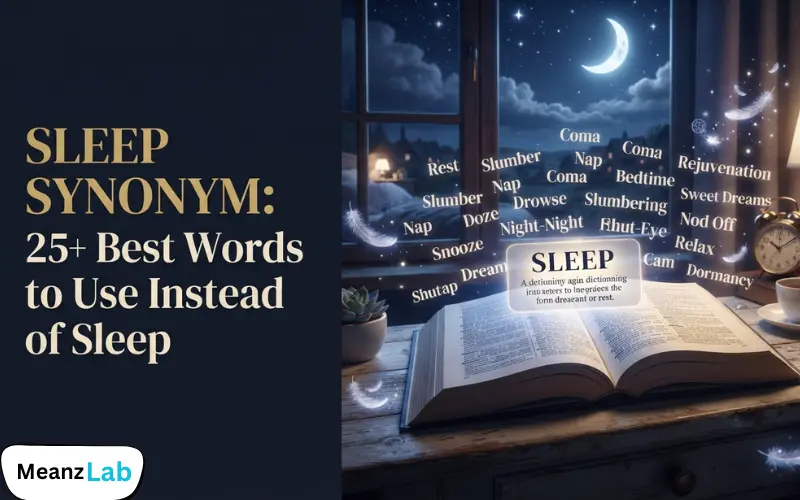
A sleep synonym is a word or phrase that has the same or a similar meaning as sleep. Depending on the situation, you can use words like rest, slumber, nap, doze, snooze, repose, catnap, drift off, nod off, or shut-eye. Some are suitable for formal writing, while others are better for casual conversations or creative writing.
The word sleep is simple, clear, and used every day. Whether you’re talking about getting eight hours of rest, taking a quick afternoon nap, or writing a novel, it’s a word that appears frequently in English.
However, using the same word repeatedly can make your writing sound repetitive. That’s why learning synonyms is valuable. A well-chosen alternative can make a sentence more descriptive, improve its tone, and help you communicate more precisely.
For example, there’s a difference between someone who takes a nap, drifts off, slumbers peacefully, or crashes after a long day. Each expression refers to sleep, but each creates a different image and feeling.
Writers often choose slumber to create a peaceful atmosphere, while friends might casually say they’re going to hit the sack. In medical writing, the word rest is often more appropriate than sleep.
This guide explores the best synonyms for sleep, explains when to use each one, and provides practical examples to help you expand your vocabulary.
What Is a Synonym for Sleep?
A synonym is a word that has the same or nearly the same meaning as another word.
When we talk about sleep, synonyms describe resting, falling asleep, or being asleep. Although these words are closely related, they are not always interchangeable. Some refer to short periods of sleep, while others describe deep rest or are used only in specific situations.
For example:
- Nap refers to a short sleep during the day.
- Doze suggests light or accidental sleep.
- Slumber describes peaceful or deep sleep.
- Snooze usually means sleeping for a few extra minutes.
- Rest focuses on relaxation rather than sleeping itself.
Understanding these differences helps you choose the most accurate word for your writing.
The Most Common Synonyms for Sleep
The following words are among the best alternatives to sleep. Each has a slightly different meaning and works best in specific contexts.
| Synonym | Best Used For | Example |
| Rest | General relaxation | You should rest after work. |
| Slumber | Peaceful or literary writing | The baby slumbered quietly. |
| Nap | Short daytime sleep | I took a nap after lunch. |
| Doze | Light sleep | He dozed during the movie. |
| Snooze | Casual conversations | She snoozed for ten more minutes. |
| Repose | Formal writing | The travelers found repose. |
| Catnap | Very brief sleep | A quick catnap improved his mood. |
| Drift Off | Gradually falling asleep | I drifted off while reading. |
| Nod Off | Accidentally falling asleep | He nodded off in class. |
| Shut-Eye | Informal expression | I need some shut-eye tonight. |
Although all these words relate to sleep, choosing the right one depends on the situation.
Detailed Look at the Best Sleep Synonyms
Rest
Rest is one of the closest synonyms to sleep. However, it doesn’t always mean sleeping. It can also mean relaxing your body or mind.
Example Sentences
- You should get some rest before tomorrow’s interview.
- After exercising, she rested for an hour.
- Doctors recommended complete rest after the surgery.
Best for: Everyday conversations, healthcare, and formal writing.
Slumber
Slumber is a more elegant and literary alternative to sleep. It often suggests peaceful, uninterrupted sleep.
Example Sentences
- The child slumbered peacefully throughout the night.
- Snow covered the village while everyone remained in slumber.
- She fell into a deep slumber after the long journey.
Best for: Stories, novels, poems, and descriptive writing.
Nap
A nap is a short period of sleep, usually taken during the day.
Example Sentences
- I always take a twenty-minute nap after lunch.
- A short nap improved his concentration.
- Children often need an afternoon nap.
Best for: Daily conversations and lifestyle writing.
Doze
To doze means to sleep lightly, often without intending to.
Example Sentences
- Grandpa dozed in his chair while watching television.
- She dozed on the train during her commute.
- I accidentally dozed off while reading.
Best for: Informal and descriptive writing.
Snooze
Snooze usually refers to sleeping for a few extra minutes or taking a brief sleep.
Example Sentences
- I snoozed my alarm twice this morning.
- He enjoyed a quick snooze after work.
- Don’t snooze through your entire weekend.
Best for: Casual conversations.
Repose
Repose is a formal word that emphasizes peaceful rest.
Example Sentences
- The quiet garden offered perfect repose.
- Travelers found repose after a difficult journey.
- The old cabin became a place of complete repose.
Best for: Formal writing and literature.
Catnap
A catnap is an extremely short sleep that helps restore energy.
Example Sentences
- A fifteen-minute catnap made me feel refreshed.
- She squeezed in a catnap between meetings.
- Even a quick catnap can improve productivity.
Best for: Everyday conversations.
Drift Off
This phrase describes falling asleep slowly and naturally.
Example Sentences
- I drifted off while listening to soft music.
- The sound of rain helped her drift off quickly.
- He drifted off before finishing the movie.
Best for: Descriptive and conversational writing.
Nod Off
To nod off means to fall asleep unintentionally, usually for a short time.
Example Sentences
- He nodded off during the lecture.
- I almost nodded off on the bus.
- She nodded off while waiting at the airport.
Best for: Informal English.
Shut-Eye
Shut-eye is an informal expression meaning sleep or rest.
Example Sentences
- I need some shut-eye before tomorrow’s flight.
- Try getting more shut-eye every night.
- A little shut-eye can make a big difference.
Best for: Casual speech and blogs.
Sleep Synonyms by Context
Choosing the right synonym becomes much easier when you consider the context.
Formal Writing
- Rest
- Repose
- Recuperation
- Relaxation
Everyday Conversations
- Sleep
- Nap
- Snooze
- Doze
- Shut-eye
Creative Writing
- Slumber
- Drift off
- Dreamland
- Peaceful sleep
Medical Context
- Rest
- Recovery
- Sedation
- Sleep cycle
Using the appropriate synonym makes your writing sound more natural and helps readers understand your intended meaning without confusion.
Sleep Synonym vs. Related Words
Many words are associated with sleep, but they don’t all mean exactly the same thing. Knowing the differences will help you choose the most accurate word in your writing.
| Word | Meaning | Best Used When |
| Sleep | Natural state of rest | General situations |
| Rest | Relaxing the body or mind | Recovery or relaxation |
| Nap | Short daytime sleep | Afternoon or brief sleep |
| Doze | Light or accidental sleep | Brief, unplanned sleep |
| Slumber | Peaceful or deep sleep | Literature and storytelling |
| Snooze | Short extra sleep | Casual conversations |
| Catnap | Very short sleep | Quick energy boost |
| Drift Off | Fall asleep gradually | Descriptive writing |
| Nod Off | Fall asleep unintentionally | Informal English |
| Hibernate | Long seasonal sleep (animals) | Scientific contexts |
Although these words are related, using the right one makes your writing more precise and engaging.
How to Choose the Right Sleep Synonym
Not every synonym works in every situation. The best choice depends on your audience, tone, and purpose.
For Everyday Conversations
Simple words are usually the best option.
Examples include:
- Sleep
- Nap
- Snooze
- Doze
- Shut-eye
These sound natural in daily speech.
Example:
“I’m going to get some shut-eye before tomorrow’s meeting.”
For Creative Writing
Stories and novels often benefit from more descriptive vocabulary.
Good choices include:
- Slumber
- Drift off
- Peaceful sleep
- Dreamland
- Repose
These words create stronger imagery.
Example:
“The child drifted into a peaceful slumber as the rain tapped gently against the window.”
For Formal or Academic Writing
Professional writing usually requires straightforward language.
Suitable words include:
- Rest
- Recovery
- Relaxation
- Repose
These alternatives sound more formal without being overly dramatic.
Common Phrases Related to Sleep
English includes many expressions that use the idea of sleep in a figurative way.
Hit the Sack
Meaning: Go to bed.
Example:
“I’m exhausted. I’m going to hit the sack.”
Hit the Hay
Another informal way to say go to sleep.
Example:
“It’s getting late. Let’s hit the hay.”
Catch Some Z’s
A casual expression meaning to sleep.
Example:
“I need to catch some Z’s before work.”
Sleep Like a Baby
Means sleeping very peacefully.
Example:
“After the long hike, everyone slept like a baby.”
Burn the Midnight Oil
This phrase actually means staying awake late to work or study.
Example:
“She burned the midnight oil preparing for her exams.”
Although it mentions nighttime, it is the opposite of sleeping.
Words That Are Often Confused with Sleep Synonyms
Some words are related to sleep but are not true synonyms.
Dream
Dreams happen during sleep, but dreaming and sleeping are not the same thing.
Relax
You can relax without falling asleep.
Someone reading a book in a chair may be relaxed but fully awake.
Hibernate
Hibernate specifically describes certain animals entering a long period of inactivity during winter.
It should not normally be used for people.
Pass Out
This phrase often means becoming unconscious rather than falling asleep naturally.
Because of that, it should be used carefully.
Common Mistakes to Avoid
Choosing the wrong synonym can change the meaning of your sentence.
Using “Nap” for a Full Night’s Sleep
A nap is always a short period of sleep.
Incorrect:
“I took an eight-hour nap.”
Better:
“I slept for eight hours.”
Confusing “Rest” with “Sleep”
Rest does not always involve sleeping.
Someone resting on a couch may still be awake.
Overusing Literary Words
Words like slumber sound beautiful, but using them in everyday conversation may sound unnatural.
Instead of saying:
“I’m going to slumber now.”
Most native speakers would simply say:
“I’m going to sleep.”
Using Informal Expressions in Professional Writing
Expressions such as hit the sack or catch some Z’s work well in conversations but are usually inappropriate in academic or business writing.
See Also:
Metaphors for Happiness: 50+ Beautiful Examples & Meanings
FAQs
What is the best synonym for sleep?
The best synonym depends on the context. Rest is the closest general alternative, while slumber works well in creative writing, nap refers to a short daytime sleep, and doze describes light sleep.
Is “slumber” the same as “sleep”?
Not exactly. Slumber usually suggests deep, peaceful, or poetic sleep, whereas sleep is the general term used in everyday English.
What’s the difference between a nap and sleep?
A nap is a short period of sleep, usually during the day. Sleep can refer to any length of natural rest, including a full night’s sleep.
Can I use “rest” instead of “sleep”?
Sometimes. Rest often means relaxing rather than sleeping. In many situations, it can replace sleep, but not always.
For example:
- You need more rest. ✅
- I rested for eight hours last night. (Possible, but slept is more natural.)
Which sleep synonym is best for creative writing?
Words such as slumber, drift off, repose, dreamland, and peaceful sleep create vivid imagery and are excellent choices for novels, poetry, and descriptive writing.
Conclusion
Finding the right sleep synonym can make your writing clearer, more engaging, and more expressive. While sleep remains the most common and versatile word, alternatives such as rest, slumber, nap, doze, snooze, and repose each bring their own nuance and work best in different situations.
The key is to choose a word that matches the tone and context. Casual conversations often call for simple expressions like nap or catch some shut-eye, while formal or literary writing may benefit from words like slumber or repose. Understanding these subtle differences not only improves your vocabulary but also helps you communicate more naturally and effectively.
Whether you’re writing a story, an essay, a blog post, or simply trying to expand your English vocabulary, using the right synonym at the right time will make your language more precise and impactful.