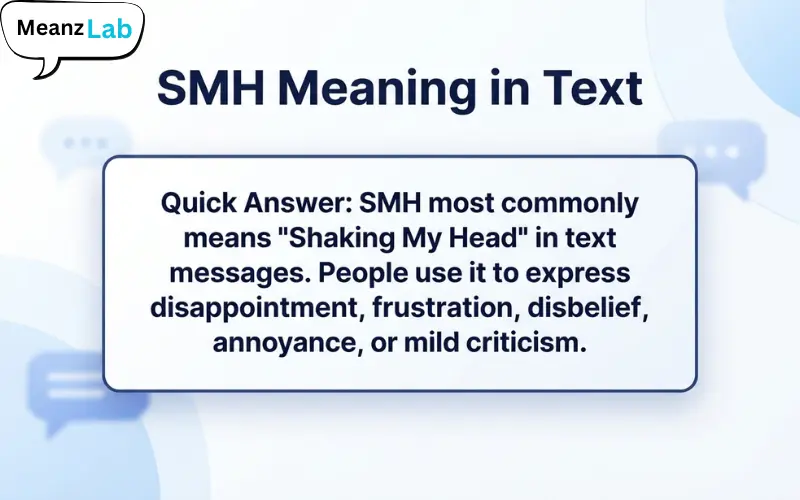
The SMH meaning in text is “Shaking My Head.” People use this abbreviation to express disappointment, frustration, disbelief, annoyance, or mild criticism. Instead of explaining their reaction in a full sentence, they simply type SMH to show that something seems foolish, surprising, or frustrating.
Example
Friend: “I forgot my wallet at home again.”
You: “SMH.”
In this conversation, SMH means you’re reacting by shaking your head because the situation is frustrating or avoidable.
Online conversations move quickly, and most people prefer typing short messages instead of long explanations. That’s why internet abbreviations have become a regular part of texting. Popular shortcuts like LOL, OMG, IDK, TBH, and BRB appear every day across messaging apps and social media platforms.
Another abbreviation you’ll frequently encounter is SMH. It has been part of internet culture for years and continues to appear in text messages, memes, comments, and online discussions. Although it only contains three letters, it communicates a strong emotional reaction without requiring a lengthy explanation.
Many people search for SMH meaning in text, what does SMH mean in text, what does SMH mean, or SMH meaning in chat after seeing it in a message. Unlike abbreviations that simply replace common words, SMH represents a physical gesture. It describes the action of shaking your head when you witness something disappointing, ridiculous, or difficult to believe.
The expression works because nearly everyone recognizes that gesture in real life. Instead of physically shaking your head during an online conversation, you simply type SMH, and the other person immediately understands your reaction.
This guide explains the meaning of SMH, when people use it, how it appears in everyday conversations, and why it has remained one of the most recognizable abbreviations on the internet.
What Does SMH Mean in Text?
If you’re wondering what does SMH mean in text, the answer is simple.
SMH stands for “Shaking My Head.”
People use it to react when something seems:
- Disappointing
- Frustrating
- Foolish
- Hard to believe
- Slightly embarrassing
Instead of writing a long sentence describing their feelings, they simply type SMH.
Imagine a friend tells you they forgot their passport before arriving at the airport. Rather than typing, “I can’t believe that happened,” many people would simply reply:
SMH
The abbreviation immediately communicates disappointment and disbelief.
Here are several original examples:
- “SMH, I can’t believe I missed the bus again.”
- “SMH, someone left the refrigerator door open all night.”
- “SMH, the internet stopped working during my meeting.”
- “SMH, he forgot our appointment for the third time.”
- “SMH, they started the movie without us.”
Every example expresses a reaction rather than providing new information.
SMH Meaning at a Glance
Although SMH always stands for Shaking My Head, the emotion behind it changes depending on the conversation.
| Abbreviation | Meaning | Common Emotion | Example Situation |
| SMH | Shaking My Head | Disappointment | Missing an important event |
| SMH | Shaking My Head | Frustration | Repeating the same mistake |
| SMH | Shaking My Head | Disbelief | Hearing unbelievable news |
| SMH | Shaking My Head | Annoyance | Someone ignoring simple instructions |
| SMH | Shaking My Head | Mild Criticism | Watching an avoidable mistake |
The surrounding conversation tells readers exactly which emotion the sender intends.
Why Do People Use SMH?
The popularity of SMH comes from its ability to communicate emotion instantly. Rather than typing several sentences explaining disappointment or frustration, users can express the same feeling with just three letters.
For example, compare these responses:
- “I can’t believe you forgot again.”
- “That was a poor decision.”
- “I’m disappointed.”
- “Seriously?”
- “SMH”
Each communicates a similar reaction, but SMH is much shorter.
People also like SMH because it works across many situations. Whether someone makes a small mistake or shares unbelievable news, the abbreviation still feels natural.
Consider these examples:
- A friend forgets their homework.
- Someone loses their phone for the second time.
- A teammate misses an easy goal.
- A sibling leaves the lights on all day.
- A coworker accidentally deletes an important file.
In every situation, SMH quickly communicates disbelief or disappointment without requiring a detailed explanation.
When Do People Commonly Use SMH?
SMH appears in many different types of conversations. While the exact emotion changes, the abbreviation almost always reacts to something that seems unnecessary, surprising, or frustrating.
Reacting to Silly Mistakes
People frequently use SMH after hearing about an avoidable mistake.
Examples:
- “SMH, I left my keys inside the house.”
- “SMH, I studied the wrong chapter.”
- “SMH, I forgot my umbrella again.”
- “SMH, I sent the email to the wrong person.”
- “SMH, I bought the wrong size.”
These examples express mild disappointment rather than serious anger.
Responding to Bad Decisions
SMH also appears when someone makes a choice that others consider unwise.
Examples:
- “SMH, he spent all his savings in one day.”
- “SMH, she skipped the interview.”
- “SMH, they ignored every warning.”
- “SMH, he never reads the instructions.”
- “SMH, they forgot to back up the files.”
In these conversations, SMH communicates criticism without needing a lengthy explanation.
Showing Disbelief
Sometimes people use SMH simply because they find something difficult to believe.
Examples:
- “SMH, that actually happened?”
- “SMH, I can’t believe the game ended like that.”
- “SMH, the package arrived at the wrong address.”
- “SMH, they canceled the event at the last minute.”
- “SMH, another delay already?”
The abbreviation reflects surprise mixed with disappointment.
Reacting to Frustrating Situations
Many everyday frustrations also lead people to use SMH.
Examples:
- “SMH, traffic was terrible again.”
- “SMH, my laptop froze during the presentation.”
- “SMH, the website crashed before checkout.”
- “SMH, my phone battery died at the worst time.”
- “SMH, the printer stopped working again.”
Because these situations are relatable, SMH has become one of the internet’s most recognizable reactions.
Real Conversation Examples
Seeing SMH in complete conversations makes its meaning much easier to recognize.
Conversation 1
Friend: “I forgot my homework at home.”
You: “SMH.”
Conversation 2
Brother: “I locked my keys in the car.”
You: “SMH 😂”
Conversation 3
Coworker: “The meeting started an hour ago.”
You: “SMH, I completely lost track of time.”
Conversation 4
Friend: “I accidentally deleted all my vacation photos.”
You: “SMH. That’s painful.”
Conversation 5
Teammate: “I forgot to save the project.”
You: “SMH, hopefully there’s a backup.”
Each conversation shows how SMH replaces a much longer emotional response. Instead of writing several sentences explaining disappointment or disbelief, users simply type SMH, making conversations faster while still expressing exactly how they feel.
SMH Meaning in Chat
If you’re searching for SMH meaning in chat, the definition is almost always the same as in text messages. SMH stands for “Shaking My Head,” and people use it to react to something they find disappointing, unbelievable, frustrating, or simply unnecessary.
In chat conversations, SMH usually appears as a response rather than a complete sentence. It allows people to express their feelings without typing a long explanation.
For example, if someone tells you they forgot their laptop before an important meeting, replying with SMH immediately shows your reaction. The abbreviation acts like the real-life gesture of shaking your head after hearing surprising or foolish news.
Here are some natural examples:
- “SMH, you forgot your birthday again?”
- “SMH, that’s the third time this week.”
- “SMH, I can’t believe that actually happened.”
- “SMH, you should have checked first.”
- “SMH, maybe next time you’ll remember.”
Although the abbreviation is brief, the emotion behind it is usually easy to recognize because the surrounding conversation provides enough context.
SMH on Social Media
Social media is one of the most common places where you’ll see SMH. Users often react to posts, videos, comments, or news stories by typing the abbreviation instead of writing a full opinion.
Whether someone shares a funny mistake or a disappointing event, SMH provides an instant reaction.
You’ll commonly find SMH on:
- TikTok
- Snapchat
- X (formerly Twitter)
- Discord
- YouTube comments
Examples include:
- “SMH, why would someone do that?”
- “SMH, this happens every year.”
- “SMH, people never learn.”
- “SMH, that’s unbelievable.”
- “SMH 😂 I would’ve done the same thing.”
The meaning remains the same, but the tone may range from serious criticism to playful humor depending on the situation.
Can SMH Be Funny?
Although SMH often expresses disappointment, it isn’t always negative. Many people use it jokingly when reacting to harmless mistakes or funny situations.
In these cases, SMH becomes part of friendly teasing rather than criticism. Friends frequently combine it with laughing emojis to show they aren’t genuinely upset.
Examples:
- “SMH 😂 You seriously wore two different shoes?”
- “SMH, you ate the whole pizza yourself?”
- “SMH 😂 You locked yourself out again?”
- “SMH, that’s the funniest excuse I’ve heard.”
- “SMH 😂 I would’ve made the same mistake.”
Adding laughter changes the tone completely. Instead of sounding harsh, the abbreviation feels playful and lighthearted.
SMH in Memes and Internet Culture
Memes often rely on quick emotional reactions, making SMH a perfect fit. Instead of explaining why a situation is ridiculous, creators simply place SMH alongside an image or caption.
Because internet humor often focuses on awkward moments, poor decisions, or relatable mistakes, SMH naturally complements meme culture.
For example, you might see:
- Someone trying to unlock their phone with a TV remote.
- A person searching for glasses that are already on their face.
- Someone complaining about being tired after staying awake until 3 a.m.
- A driver parking across several parking spaces.
- A student remembering homework after arriving at school.
In each case, SMH communicates the viewer’s reaction without needing additional explanation.
When Should You Avoid Using SMH?
Although SMH works well in casual conversations, it isn’t appropriate everywhere.
Professional communication usually requires clear, complete language instead of internet abbreviations. Using SMH in formal situations may confuse readers or appear unprofessional.
Avoid using SMH in:
- Business emails
- Job applications
- Academic assignments
- Official reports
- Professional presentations
Instead of writing:
“SMH, the report contains mistakes.”
Write:
“The report contains several errors that should be corrected.”
Choosing full sentences creates a more professional impression.
SMH Compared With Similar Abbreviations
Many internet abbreviations express emotions, but each one serves a different purpose. Comparing them makes it easier to know when SMH is the best choice.
| Abbreviation | Meaning | Typical Emotion |
| SMH | Shaking My Head | Disappointment or disbelief |
| LOL | Laughing Out Loud | Amusement |
| OMG | Oh My God | Surprise |
| IDK | I Don’t Know | Uncertainty |
| TBH | To Be Honest | Honesty |
| NVM | Never Mind | Ending a topic |
| BRB | Be Right Back | Temporary absence |
Unlike LOL or OMG, SMH doesn’t celebrate something exciting. Instead, it reacts to situations that seem foolish, frustrating, or difficult to believe.
Common Mistakes People Make
Because SMH appears in many different conversations, beginners sometimes misunderstand its purpose.
One common mistake is thinking SMH always expresses anger. While it can indicate frustration, it often communicates mild disappointment or playful teasing instead.
Another mistake is using SMH in serious professional communication. Since many workplaces prefer clear language, writing the full response is usually more appropriate.
Some users also overuse SMH. If every message contains the abbreviation, it can make conversations sound overly negative. Using it only when it genuinely fits keeps your reactions natural.
See Also:
- TB Meaning in Text
- RQ Meaning in Text
- CM Meaning in Text
- TMP Meaning in Text
- TW Meaning in Text
- HG Meaning in Text
FAQs
What does SMH mean in text?
The most common SMH meaning in text is “Shaking My Head.” People use it to express disappointment, frustration, disbelief, or mild criticism after reading or hearing something surprising. It is one of the most recognizable abbreviations in modern texting.
What does SMH mean in chat?
In chat conversations, SMH usually carries the same meaning as in text messages. It acts as a quick reaction to something foolish, frustrating, or difficult to believe. Instead of typing a full sentence, users simply write SMH to show their feelings.
Is SMH considered internet slang?
Yes. SMH is a popular piece of internet slang that has been widely used for many years. It appears across messaging apps, gaming communities, forums, and social media platforms because it communicates emotion quickly and clearly.
Can SMH be used jokingly?
Absolutely. Many people pair SMH with laughing emojis or humorous comments when reacting to harmless mistakes made by friends or family. In these situations, the abbreviation sounds playful rather than critical.
Should I use SMH in professional communication?
It’s usually better to avoid SMH in business emails, official documents, or academic writing. Some readers may not recognize the abbreviation, while others may consider it too informal. Writing your reaction in complete sentences is the safer and more professional choice.
Conclusion
The SMH meaning in text is “Shaking My Head.” It represents the familiar real-life gesture people make when reacting to something disappointing, frustrating, surprising, or unnecessary. Instead of typing a long explanation, users simply write SMH to communicate their feelings quickly.
Whether you’re searching for what does SMH mean in text, what does SMH mean, or SMH meaning in chat, the definition remains the same. The exact emotion depends on the conversation, but it usually expresses disbelief, annoyance, mild criticism, or humorous frustration.
Because SMH appears in text messages, social media posts, memes, gaming chats, and online discussions, recognizing its meaning will help you understand modern digital conversations more naturally.