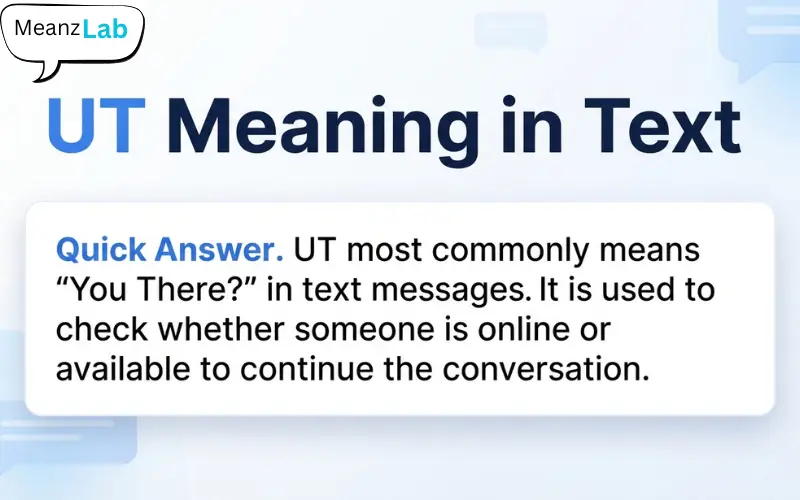
The UT meaning in text is most commonly “You There?” People use it to check whether someone is online, active, or paying attention during a conversation. Although this is the most frequent meaning in texting, UT can also stand for University of Texas, Universal Time, Ultimate Team, or User Testing, depending on the context.
Example
Friend: UT?
You: Yeah, I’m here. What’s up?
In this conversation, UT simply means “Are you there?”
Text messaging has changed the way people communicate. Instead of writing complete sentences, many people now rely on abbreviations to reply quickly. Acronyms like LOL, BRB, IDK, and TBH have become part of everyday conversations. Another abbreviation you may come across is UT. While it isn’t as common as some popular internet slang, it still appears in text messages, social media chats, gaming conversations, and online communities.
If you’ve received a message that simply says “UT?”, you might wonder whether it’s asking a question, referring to a university, or meaning something entirely different. That’s because UT has more than one definition. The correct meaning depends on who sent the message and what the conversation is about.
For example, if your friend suddenly texts “UT?” after you stop replying, they’re probably checking whether you’re still available. However, if someone says, “I’m starting at UT this fall,” the abbreviation almost certainly refers to the University of Texas. Likewise, discussions about international schedules may use UT to mean Universal Time, while gamers often use it to refer to Ultimate Team.
Knowing what does UT mean in text helps you avoid confusion and respond appropriately. This guide explains the most common meanings of UT, where each one is used, and how to recognize the correct definition based on context. You’ll also find practical examples, comparison tables, and helpful tips that make this abbreviation easy to remember.
What Does UT Mean in Text?
When people search for the UT meaning in text, they are usually asking about conversations on messaging apps like WhatsApp, Messenger, Snapchat, or iMessage.
In these situations, UT most commonly means “You There?” It is a short way of asking whether another person is still online or paying attention.
Instead of typing “Are you there?”, someone simply writes “UT?” because it saves time and keeps the conversation moving.
Here are several examples:
- UT? I need your advice.
- Hey, UT?
- UT? I’ve been waiting for your reply.
- UT? Can you help me with something?
- UT? Let me know when you’re free.
In every example above, the sender isn’t starting a new topic. They’re simply checking whether the other person is available before continuing the conversation.
Why Do People Use UT?
Texting is designed for speed. Most people want to send short messages that communicate their thoughts without typing unnecessary words. That’s one reason abbreviations like UT have become popular.
Imagine waiting several minutes for a reply. Instead of writing “Are you still there?”, it’s much quicker to send “UT?”. The message is short, clear, and easy to understand if both people are familiar with the abbreviation.
People also use UT because it feels casual. Friends, classmates, family members, and gaming teammates often prefer quick abbreviations instead of full sentences.
Here are some natural examples:
- UT? Everyone is waiting for you.
- UT? The meeting starts in five minutes.
- UT? I found something funny to show you.
- UT? Answer when you get a chance.
- UT? Don’t leave me hanging!
Notice that each example checks someone’s availability rather than introducing new information.
Common Meanings of UT
| UT Meaning | Where It’s Used | Example |
| You There? | Texting and chats | “UT? Can we talk?” |
| University of Texas | Education | “She was accepted into UT.” |
| Universal Time | Science and aviation | “The launch begins at 14:00 UT.” |
| Ultimate Team | Sports video games | “I upgraded my UT squad.” |
| User Testing | Software development | “The app is entering UT next week.” |
This table shows why context matters. The same abbreviation can mean something completely different depending on the conversation.
UT in Everyday Text Conversations
The most frequent use of UT happens in casual conversations between friends. It usually appears when one person stops replying, and the other wants to know if they’re still available.
Unlike greetings such as “Hi” or “Hello,” UT is generally sent after a conversation has already started.
For example:
Friend: I have some exciting news.
(Five minutes pass with no reply.)
Friend: UT?
The sender isn’t asking a new question. They’re simply checking whether the other person is still present.
Here are more examples:
- UT? I wanted your opinion before I decide.
- UT? I think I solved the problem.
- UT? I’ve almost finished the assignment.
- UT? Call me when you’re free.
- UT? There’s something important we need to discuss.
Because texting often includes pauses, abbreviations like UT help restart the conversation naturally.
UT Meaning in Social Media Chats
UT also appears on platforms where people exchange direct messages. Although it isn’t used as often as abbreviations like LOL or OMG, you’ll still see it in conversations on apps such as Instagram, Snapchat, Facebook Messenger, Discord, Telegram, and WhatsApp.
On these platforms, the meaning remains the same. UT is usually a quick way to ask whether someone is active before sending another message.
Examples include:
- UT? I just sent you a photo.
- UT? Check your notifications.
- UT? I need your opinion on something.
- UT? Did you see my last message?
- UT? Let’s join the group call.
Because social media conversations often happen in real time, people use abbreviations like UT to keep the exchange fast and informal.
UT in Online Gaming
Gaming communities rely heavily on abbreviations because players need to communicate quickly during matches. Every second counts, so typing long sentences isn’t practical.
In multiplayer games, UT commonly means “You There?” Players use it to check whether teammates are connected, ready, or paying attention before starting a match or completing an objective.
Examples include:
- UT? We’re ready to begin.
- UT? Everyone else has joined.
- UT? Pick your character quickly.
- UT? The next round starts in ten seconds.
- UT? Don’t go AFK now.
Using short messages like these helps teams coordinate more efficiently without interrupting gameplay.
UT in Group Chats
Group chats often move quickly, especially when several people are replying at once. Messages can easily be missed, and someone may suddenly stop responding. In these situations, UT is a simple way to check whether a specific person—or even the whole group—is still following the conversation.
Unlike a direct question, UT acts as a gentle prompt. It reminds people to rejoin the discussion without sounding demanding.
Here are some natural examples:
- UT everyone? We need to choose a meeting time.
- Sarah, UT? We haven’t heard from you yet.
- UT? Let’s decide before tonight.
- UT? We can’t book the tickets until everyone replies.
- UT? The group call is starting now.
In each example, the abbreviation encourages participation rather than introducing a new topic.
Other Meanings of UT
Although “You There?” is the most common UT meaning in text, it isn’t the only definition you’ll encounter. The same abbreviation is used in education, technology, science, and gaming. Knowing these alternative meanings prevents misunderstandings when you see UT outside of casual conversations.
UT as University of Texas
In educational discussions, UT often refers to the University of Texas. Students, teachers, and university staff frequently use this abbreviation because the institution’s name is long.
Examples:
- My sister was accepted into UT this year.
- He’s applying to UT after high school.
- UT has a strong engineering program.
- We’re visiting the UT campus next weekend.
- Several of my friends graduated from UT.
When education is the topic, this meaning is much more logical than “You There?”
UT as Universal Time
In science, aviation, astronomy, and international scheduling, UT stands for Universal Time. It provides a standard time reference that people around the world can use.
Examples:
- The satellite launch begins at 16:00 UT.
- Please join the meeting at 09:00 UT.
- Weather reports are recorded using UT.
- The telescope observations start at 22:30 UT.
- Pilots often use UT for international coordination.
This meaning rarely appears in everyday texting unless the conversation involves global events or scientific topics.
UT as Ultimate Team
Sports video games, especially football titles, frequently use UT to mean Ultimate Team. Players use the abbreviation while discussing squads, player cards, competitions, and online matches.
Examples:
- I finally completed my UT squad.
- My UT team needs a better goalkeeper.
- The new UT event starts tomorrow.
- I packed an amazing player for my UT lineup.
- Let’s compare our UT teams tonight.
Because gaming conversations have their own vocabulary, this meaning is immediately recognizable to regular players.
UT as User Testing
In software development and technology, UT may refer to User Testing. Developers perform user testing before releasing software to identify problems and improve the user experience.
Examples:
- The app enters UT next week.
- We’re collecting feedback during UT.
- Several bugs appeared in the first UT session.
- Our designers attended today’s UT meeting.
- UT helped improve the navigation menu.
Here, the abbreviation belongs to a professional environment rather than casual messaging.
How Context Helps You Choose the Right Meaning
The easiest way to identify the correct meaning of UT is to read the surrounding conversation. The words before and after the abbreviation almost always provide enough clues.
Consider these examples:
Example 1
Message: “UT? I haven’t heard from you.”
Meaning: You There?
Example 2
Message: “I’ll be studying at UT next semester.”
Meaning: University of Texas
Example 3
Message: “The event begins at 18:00 UT.”
Meaning: Universal Time
Example 4
Message: “My UT squad finally reached the finals.”
Meaning: Ultimate Team
Example 5
Message: “We’re starting UT before the public release.”
Meaning: User Testing
Instead of memorizing every possible definition, focus on the topic of the conversation. That’s usually enough to identify the correct meaning.
Should You Use UT?
Using UT depends on your audience. Among close friends, classmates, or gaming teammates, it feels natural because everyone understands the casual style of texting.
However, professional communication is different. In emails, business messages, or academic writing, spelling out your question is much clearer.
Instead of writing:
UT?
A professional message might say:
- Are you available?
- Do you have a moment?
- Are you online right now?
- Can we discuss this when you’re free?
- Please let me know when you’re available.
Complete sentences leave less room for confusion, especially when communicating with people who may not recognize internet abbreviations.
Common Mistakes People Make
Many people assume UT always has the same meaning. This is the biggest source of confusion.
For example:
Sentence: “I’m going to UT this fall.”
❌ Incorrect: You There?
✔ Correct: University of Texas
Another example:
Sentence: “The launch begins at 12:00 UT.”
❌ Incorrect: You There?
✔ Correct: Universal Time
One more example:
Sentence: “UT? Are you still awake?”
✔ Correct: You There?
The lesson is simple: never interpret UT without reading the surrounding conversation.
Comparison: UT vs Other Popular Texting Acronyms
| Acronym | Meaning | Typical Use |
| UT | You There? | Checking if someone is online |
| LOL | Laughing Out Loud | Showing amusement |
| BRB | Be Right Back | Leaving briefly |
| IDK | I Don’t Know | Expressing uncertainty |
| TBH | To Be Honest | Giving an honest opinion |
| BTW | By The Way | Introducing new information |
| DM | Direct Message | Private conversations |
Although UT is less common than LOL or BRB, it serves a unique purpose by checking another person’s availability.
See Also:
- PP Meaning in Text
- IDC Meaning in Text
- HMMM Meaning in Text
- BTS Meaning in Text
- LY Meaning in Text
- PRN Meaning in Text
FAQs
What does UT mean in text?
The most common UT meaning in text is “You There?” People use it to check whether someone is online or still following the conversation. It is mostly found in casual chats between friends, family members, and online communities.
What does UT mean in chat?
In chat conversations, UT usually asks if another person is available to continue talking. It often appears after someone stops replying for a while. Depending on the topic, it may also have other meanings, so context is important.
Is UT considered internet slang?
UT is better described as an internet abbreviation rather than traditional slang. It shortens the phrase “You There?” to make texting faster and more convenient. While many people use it casually, it isn’t as universally recognized as abbreviations like LOL or BRB.
Does UT always mean “You There?”
No. Although “You There?” is the most common meaning in texting, UT also stands for University of Texas, Universal Time, Ultimate Team, and User Testing. The intended meaning depends entirely on the conversation.
Should I use UT in professional communication?
Generally, no. Professional emails and workplace messages are clearer when you write complete sentences such as “Are you available?” or “Do you have a moment?” Using full phrases reduces confusion and creates a more professional tone.
Conclusion
The UT meaning in text is most commonly “You There?” It is a quick way to ask whether someone is still online, paying attention, or available to continue a conversation. Friends, family members, classmates, and gamers often use it because it saves time and keeps chats moving naturally.
However, UT doesn’t always carry the same meaning. In education, it may refer to the University of Texas. In science and aviation, it often stands for Universal Time. Gamers may use it for Ultimate Team, while technology professionals sometimes use it to mean User Testing.
Whenever you see UT in a message, don’t rely on the abbreviation alone. Read the surrounding conversation and identify the topic. Doing so will help you interpret the message correctly and avoid unnecessary confusion.