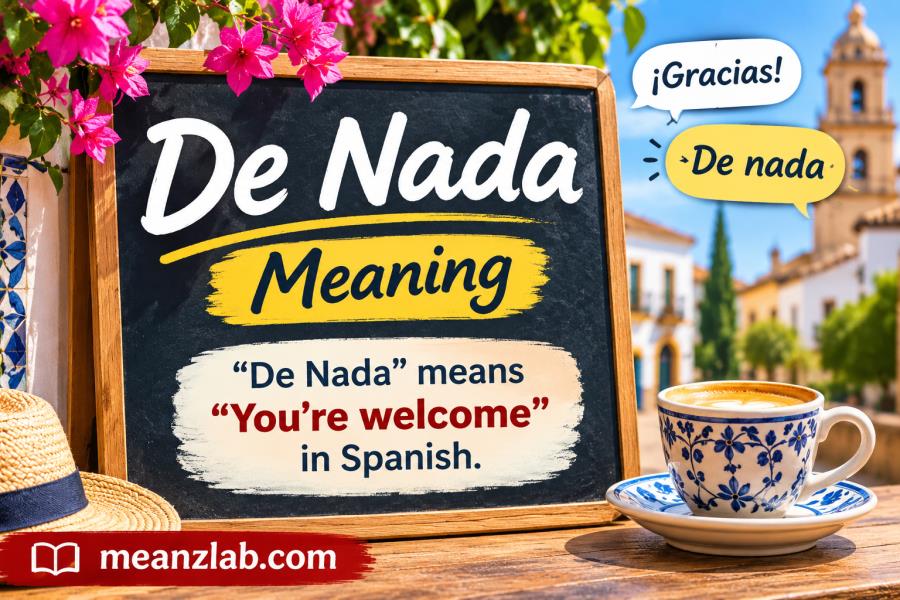
The word “ de nada meaning ” is one of the most common Spanish phrases. “you’re welcome” is its literal translation and it is used as a polite reply to someone saying “gracias” (thank you). You will see this word often when you travel, when you are learning Spanish, when watching Spanish films and when talking to Spanish speakers.
Students of Spanish are aware that “gracias” means “thank you” but don’t know what to say back. The straightforward reply is de nada, which indicates graciousness and also tells someone that assisting him or her was no trouble.
The term is short but if the students understand the meaning of the term de nada, they will be better able to communicate with their audience. There are a number of Spanish expressions of “you’re welcome,” but de nada is the most popular and common.
Quick Answer: What Is the De Nada Meaning?
In English, de nada is the same as “you’re welcome”. After someone says “gracias” it is used in a polite manner to indicate that the support or favor was received, but that there was no problem.
| Fact | Details |
| Phrase | De nada |
| Language | Spanish |
| English meaning | You’re welcome |
| Used after | Gracias (Thank you) |
| Pronunciation | Deh NAH-dah |
| Common use | Daily conversations |
| Tone | Friendly and polite |
De Nada Meaning in Spanish
Literally, the phrase de nada means “of nothing” or “from nothing.” But the literal translation does not reveal the actual meaning. In Spanish, it is used as a casual way of saying “you’re welcome”, “no problem” or “it was nothing”.
When someone says:
Gracias por tu ayuda.
(Thank you for your help.)
A natural reply is:
De nada.
(You’re welcome.)
It implies there is no burden in the action for the person helping. It is like saying “don’t mention it” or “no worries”” in English.
The de nada meaning is straightforward, but it does have an important social message. It demonstrates respect, friendliness and willingness to assist.
Read Also: LCR Meaning in Text: What Does LCR Mean in Chats?
Why Do Spanish Speakers Say De Nada?
Spanish speakers use de nada as a polite and easy way to thank someone for their appreciation. It can be used in everyday situations, at work, and in conversation.
For example:
- Your food is brought by a waiter.
- Help with homework from a friend.
- A co-worker communicates.
- You find an opening at a door.
The other person can say de nada after saying gracias.
It is considered normal and respectful in most Spanish-speaking countries.
De Nada Meaning With Examples
Learning de nada meaning phrases becomes easier when you see them in real situations. Here are some examples showing how de nada is used.
| Spanish Conversation | English Meaning |
| Gracias por venir. — De nada. | Thank you for coming. — You’re welcome. |
| Gracias por tu tiempo. — De nada. | Thank you for your time. — You’re welcome. |
| Muchas gracias por ayudarme. — De nada. | Thank you very much for helping me. — You’re welcome. |
| Gracias por el regalo. — De nada. | Thank you for the gift. — You’re welcome. |
| Gracias por explicar esto. — De nada. | Thank you for explaining this. — You’re welcome. |
These examples show that the phrase fits many situations. It does not require a formal setting or special grammar.
How to Pronounce De Nada Correctly
The pronunciation of de nada is easy for English speakers.
It sounds like:
Deh NAH-dah
Break it into two parts:
- De = sounds like “deh”
- Nada = sounds like “nah-dah”
The stress falls on the first syllable of nada.
A common mistake is pronouncing it too strongly like an English phrase. Spanish pronunciation is smoother, with each vowel clearly spoken.
De Nada Meaning Compared With Similar Spanish Phrases
While de nada is the most common response to gracias, Spanish speakers also use other expressions. Some are more casual, while others sound more formal.
| Spanish Phrase | English Meaning | Usage |
| De nada | You’re welcome | Most common response |
| No hay de qué | Don’t mention it | Polite and common |
| Por nada | It was nothing | Casual response |
| Con gusto | With pleasure | Friendly and warm |
| No te preocupes | Don’t worry | Casual |
| Encantado/a | Glad to help | More personal |
The de nada meaning stays the same across most Spanish-speaking regions, but these alternatives add variety to conversations.
De Nada Meaning in Different Spanish-Speaking Countries
Spanish is spoken in many countries, and small differences exist in everyday expressions. However, de nada is understood almost everywhere.
In countries like:
- Spain
- Mexico
- Colombia
- Argentina
- Chile
- Peru
people commonly use de nada after gracias.
Some regions may prefer alternatives. For example, people in Mexico often use “no hay de qué,” while others may say “con gusto.” Still, de nada remains a safe choice for Spanish learners.
When Should You Use De Nada?
You can use de nada whenever someone thanks you. It works in both simple and important situations.
Casual Situations
Example:
Friend: Gracias por traer mi book.
You: De nada.
Professional Situations
Example:
Client: Gracias por your assistance.
You: De nada. It was my pleasure.
Travel Situations
Example:
Tourist: Gracias por showing me the way.
Local: De nada.
The phrase is flexible, which is why it is one of the first Spanish expressions many learners remember.
Common Mistakes When Using De Nada
Although de nada is easy, beginners sometimes make small mistakes.
Mistake 1: Using It Before Someone Says Gracias
De nada is a response. It normally comes after someone expresses thanks.
Correct:
Gracias.
De nada.
Incorrect:
De nada.
(Without any previous thanks, it sounds incomplete.)
Mistake 2: Thinking It Means “Nothing”
The literal translation may confuse learners. The real meaning is not “nothing” in a negative way. It is a polite phrase that means the favor was small or appreciated.
Mistake 3: Overthinking Formality
Many learners worry about whether de nada is too casual. It is generally acceptable in both casual and polite conversations.
De Nada vs You’re Welcome: Are They Exactly the Same?
The de nada meaning is close to “you’re welcome,” but the cultural feeling can be slightly different.
“You’re welcome” in English can sometimes sound like a formal response. De nada often feels lighter and more natural. It tells the other person that helping them was easy.
For example:
English: Thank you for your help.
Response: You’re welcome.
Spanish: Gracias por tu ayuda.
Response: De nada.
Both phrases serve the same purpose, but the social tone depends on the language and culture.
Alternative Ways to Say De Nada
Spanish offers many expressions that can replace de nada.
| Alternative | Meaning | Example |
| No hay de qué | Don’t mention it | Gracias por todo. No hay de qué. |
| Con gusto | Gladly | Gracias por ayudar. Con gusto. |
| A la orden | At your service | Gracias. A la orden. |
| Cuando quieras | Whenever you want | Gracias. Cuando quieras. |
| No pasa nada | No problem | Gracias. No pasa nada. |
These phrases help learners sound more natural and understand real conversations.
Why Learning De Nada Is Important for Spanish Learners
Small phrases often create the biggest improvement in communication. Knowing the de nada meaning allows beginners to complete basic conversations confidently.
A simple exchange like:
Hola (Hello)
Gracias (Thank you)
De nada (You’re welcome)
can help you connect with Spanish speakers immediately.
Language learning is not only about vocabulary. It is also about understanding social habits. De nada is a perfect example of a phrase that carries both meaning and culture.
Read Also: ATP Meaning in Text: What Does ATP Mean in Chats?
Final Thoughts
De nada meaning is a simple, but important, meaning. The Spanish equivalent of “you’re welcome.” One of the most frequently used words for common conversation.
De nada is used in certain circumstances, and if you employ it to join it to your Spanish sentences, it will sound more natural, whether you’re in a Spanish-speaking country or learning Spanish or speaking Spanish to native speakers.
A little word that has a lot of meaning when it comes to manners. By de nada you have just mastered one of the key elements of conversation with Spanish friends.
FAQs
What does de nada meaning?
De nada means “you’re welcome” in Spanish. It is used after someone says gracias.
Is de nada formal or informal?
De nada works in both formal and informal conversations. It is a standard polite response.
How do you pronounce de nada?
De nada is pronounced as “deh NAH-dah.”
Can I say de nada after gracias?
Yes. De nada is the most common response after someone says gracias.
What is another way to say de nada?
Other options include no hay de qué, con gusto, and no pasa nada.
Does de nada mean no problem?
Yes. In many situations, de nada can have the same feeling as “no problem” or “don’t mention it.”
Is de nada used in Mexico?
Yes. De nada is commonly used in Mexico and other Spanish-speaking countries.