

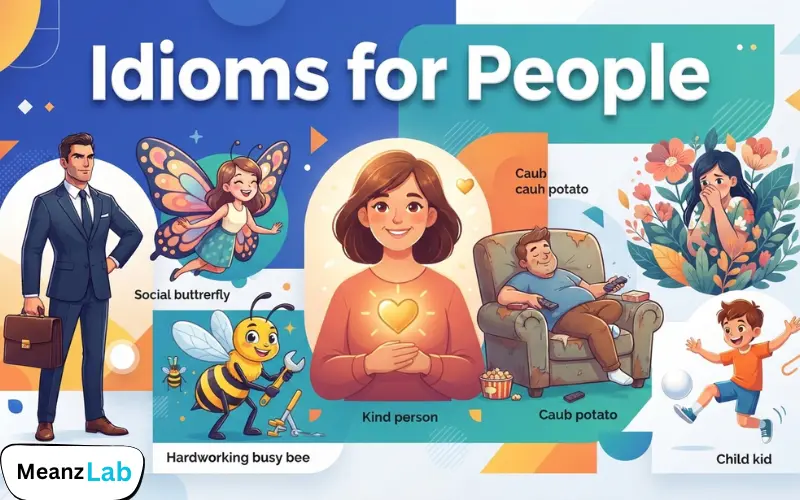
Idioms for people are expressions used to describe a person’s personality, appearance, behavior, intelligence, emotions, or habits without using literal language. For example, calling someone “a social butterfly” means they enjoy meeting new people, while “a couch potato” describes someone who spends a lot of time sitting and watching TV.
Learning these idioms helps you speak and write English more naturally because native speakers use them in everyday conversations, books, movies, and workplaces.
English is full of colorful expressions that make conversations more interesting. Instead of describing someone with ordinary adjectives like friendly, lazy, or clever, native speakers often use idioms that create vivid mental images.
For example, saying “Sarah is very friendly” is perfectly correct. However, saying “Sarah is a social butterfly” sounds more natural and expressive. Likewise, calling someone “a night owl” immediately tells people that the person enjoys staying awake late at night.
Idioms are an important part of English because they communicate ideas quickly while adding personality to conversations. They appear in everyday speech, novels, newspapers, television shows, business meetings, and even job interviews.
Understanding these expressions also improves listening skills because many native speakers use idioms without realizing it. If you only know the literal meanings of the words, expressions like “cold fish” or “big cheese” can seem confusing.
In this guide, you’ll learn some of the most common idioms used to describe people, grouped by personality and behavior, along with clear meanings and practical examples.
What Are Idioms for People?
Idioms for people are fixed expressions that describe someone’s character, habits, appearance, or behavior in a figurative way.
Unlike ordinary adjectives, idioms cannot usually be understood by translating each individual word.
For example:
- Bookworm doesn’t describe a worm inside a book.
- Couch potato has nothing to do with vegetables.
- Big cheese doesn’t refer to food.
Instead, each expression has its own established meaning.
Learning these idioms allows you to understand native English more easily and communicate in a more natural way.
Idioms for Friendly and Social People
Some idioms describe people who enjoy meeting others and building relationships.
Social Butterfly
Meaning: Someone who enjoys meeting people and attending social events.
Example:
“Emma is a real social butterfly. She knows almost everyone in town.”
Life of the Party
Meaning: A person who makes social gatherings more exciting.
Example:
“Jake is always the life of the party because of his great sense of humor.”
People Person
Meaning: Someone who enjoys interacting with others.
Example:
“She’s definitely a people person and loves working with customers.”
Open Book
Meaning: Someone who freely shares their thoughts and emotions.
Example:
“You never have to guess what David thinks because he’s an open book.”
Good Egg
Meaning: A kind, honest, and dependable person.
Example:
“Everyone likes Mr. Wilson because he’s such a good egg.”
Idioms for Intelligent People
English includes many expressions for describing intelligence.
Bright Spark
Meaning: A very intelligent or creative person.
Example:
“Sophia is a bright spark who always finds clever solutions.”
Walking Encyclopedia
Meaning: Someone who knows a great deal about many subjects.
Example:
“Ask Michael if you have a history question—he’s a walking encyclopedia.”
Sharp as a Tack
Meaning: Extremely intelligent and quick to understand things.
Example:
“Even at eighty years old, she’s still as sharp as a tack.”
Brainiac
Meaning: A very smart person.
Example:
“Our class brainiac solved the puzzle within minutes.”
Know-It-All
Meaning: Someone who behaves as if they know everything.
Example:
“Nobody enjoys working with a know-it-all.”
Idioms for Hardworking People
These idioms describe determination and dedication.
Busy Bee
Meaning: Someone who is always working.
Example:
“Maria has been a busy bee all week preparing for the conference.”
Go-Getter
Meaning: An ambitious and energetic person.
Example:
“The company loves hiring go-getters.”
Workhorse
Meaning: Someone who works very hard and reliably.
Example:
“James is the workhorse of our department.”
High Flyer
Meaning: Someone expected to achieve great success.
Example:
“Everyone believes she’s a high flyer in her career.”
Self-Starter
Meaning: Someone who begins tasks without being told.
Example:
“Employers value self-starters who work independently.”
Idioms for Lazy People
Some expressions describe people who avoid work or physical activity.
Couch Potato
Meaning: Someone who spends too much time sitting and watching television.
Example:
“During the holidays, I turned into a couch potato.”
Lazy Bones
Meaning: A lazy person.
Example:
“Get out of bed, you lazy bones!”
Slow Coach
Meaning: Someone who does things very slowly.
Example:
“Come on, slow coach—we’re going to be late.”
Slack Off
Meaning: To avoid work or effort.
Example:
“Some students slack off before exams.”
Goldbrick
Meaning: A person who avoids work whenever possible.
Example:
“Nobody wanted to partner with the office goldbrick.”
Idioms for Honest and Kind People
Kindness and honesty are often described through memorable idioms.
Heart of Gold
Meaning: A very kind and generous person.
Example:
“Grandmother has a heart of gold.”
Idioms for Shy and Quiet People
Not everyone enjoys being the center of attention. These idioms describe people who are quiet, reserved, or timid.
Wallflower
Meaning: A shy person who avoids social attention, especially at parties or gatherings.
Example:
“Instead of dancing, Mia remained a wallflower throughout the evening.”
Quiet as a Mouse
Meaning: Extremely quiet and rarely noticeable.
Example:
“The children were as quiet as mice during the movie.”
Keep to Yourself
Meaning: To avoid socializing and prefer spending time alone.
Example:
“Although friendly, Daniel usually keeps to himself at work.”
Shrinking Violet
Meaning: A very shy and modest person.
Example:
“She’s no shrinking violet when it comes to defending her ideas.”
Lone Wolf
Meaning: Someone who prefers working or living independently.
Example:
“He’s a lone wolf who enjoys solving problems on his own.”
Idioms for Talkative People
Some people enjoy conversations so much that English has many idioms to describe them.
Chatterbox
Meaning: A person who talks constantly.
Example:
“Everyone knows Lucy is the chatterbox of the family.”
Motor Mouth
Meaning: Someone who talks very quickly and continuously.
Example:
“Our guide was a real motor mouth during the tour.”
Gift of the Gab
Meaning: The natural ability to speak confidently and persuasively.
Example:
“He’s successful in sales because he has the gift of the gab.”
Big Mouth
Meaning: A person who cannot keep secrets.
Example:
“Don’t tell him your surprise plans—he’s a big mouth.”
Talk Your Head Off
Meaning: To talk for a very long time.
Example:
“She talked my head off about her vacation.”
Idioms for Difficult or Unpleasant People
Some idioms describe challenging personalities.
Cold Fish
Meaning: Someone who shows very little emotion.
Example:
“He appears to be a cold fish, but he’s actually quite kind.”
Pain in the Neck
Meaning: Someone who is annoying or difficult.
Example:
“The noisy neighbor is a real pain in the neck.”
Tough Cookie
Meaning: A strong and determined person who handles challenges well.
Example:
“After everything she’s been through, she’s one tough cookie.”
Bad Apple
Meaning: A dishonest or troublesome person who negatively influences others.
Example:
“One bad apple can damage a team’s reputation.”
Snake in the Grass
Meaning: Someone who appears friendly but cannot be trusted.
Example:
“Be careful around him—he’s a snake in the grass.”
Idioms for Energetic and Positive People
Positive personalities often inspire colorful expressions.
Full of Beans
Meaning: Full of energy and excitement.
Example:
“The kids were full of beans after the birthday party.”
Bundle of Energy
Meaning: Someone who is always active.
Example:
“Even at seventy, she’s still a bundle of energy.”
Ray of Sunshine
Meaning: A cheerful person who brightens the lives of others.
Example:
“Her smile makes her the ray of sunshine in the office.”
Happy Camper
Meaning: Someone who is satisfied and content.
Example:
“Now that the project is finished, I’m a happy camper.”
Breath of Fresh Air
Meaning: A refreshing and positive person.
Example:
“Our new manager has been a breath of fresh air for the whole team.”
Quick Comparison of Popular Idioms for People
| Idiom | Meaning | Common Situation |
| Social Butterfly | Friendly and outgoing | Social events |
| Couch Potato | Lazy | Casual conversations |
| Heart of Gold | Kind and generous | Compliments |
| Busy Bee | Hardworking | Workplace |
| Sharp as a Tack | Intelligent | Education or work |
| Wallflower | Shy | Parties and gatherings |
| Chatterbox | Talks a lot | Everyday speech |
| Cold Fish | Emotionally reserved | Describing personality |
| Tough Cookie | Strong and resilient | Challenges |
| Ray of Sunshine | Cheerful and positive | Compliments |
Tips for Using Idioms Naturally
Learning idioms is only the first step. Knowing when to use them is equally important.
Match the Situation
Informal idioms like couch potato or big mouth are perfect for conversations with friends but may not be appropriate in professional settings.
Consider the Tone
Some idioms are compliments, while others can sound rude.
For example:
- Heart of gold is positive.
- Bad apple is negative.
Choose expressions that fit your intended message.
Don’t Translate Literally
Idioms are figurative expressions. Translating them word for word into another language often changes or loses their meaning.
Practice with Real Examples
Reading books, watching English movies, and listening to podcasts are excellent ways to see idioms used naturally.
Common Mistakes to Avoid
Using Idioms Literally
A social butterfly is not an actual butterfly, and a couch potato isn’t a vegetable. Remember that idioms have figurative meanings.
Mixing Different Idioms
Combining unrelated idioms in one sentence can confuse readers.
Incorrect:
“He’s a social butterfly with a heart of beans.”
Correct:
“He’s a social butterfly with a heart of gold.”
Using Informal Idioms in Formal Writing
Expressions like big mouth or pain in the neck work well in casual conversations but should generally be avoided in academic or professional writing.
See Also:
Sleep Synonym: 25+ Best Words to Use Instead of Sleep
FAQs
What are idioms for people?
Idioms for people are figurative expressions used to describe a person’s personality, behavior, emotions, or habits. Instead of using literal adjectives, they create vivid images that make communication more natural and engaging.
Why are idioms important in English?
Idioms are common in everyday conversations, books, movies, and media. Learning them helps you understand native speakers more easily and improves your speaking and writing skills.
What is the most common idiom for a friendly person?
One of the most common idioms is social butterfly, which describes someone who enjoys meeting people and attending social events. Another popular expression is people person.
Can idioms be used in professional writing?
Some idioms are appropriate in business communication, but many are best reserved for informal situations. Always consider your audience and the level of formality before using an idiom.
How can I learn English idioms faster?
The best way is to read regularly, listen to native speakers, and practice using idioms in your own sentences. Learning idioms by category—such as personality, emotions, or work—also makes them easier to remember.
Conclusion
Idioms for people add color, personality, and depth to the English language. Rather than relying on ordinary adjectives, these expressions allow you to describe someone’s character, habits, or behavior in a way that is both vivid and memorable. Whether you’re talking about a social butterfly, a heart of gold, a couch potato, or a tough cookie, each idiom paints a clear picture that readers and listeners instantly recognize.
By learning when and how to use these expressions, you’ll improve your vocabulary, sound more natural in conversations, and better understand English books, movies, and everyday speech. Start by practicing a few idioms at a time, and you’ll soon find yourself using them with confidence in both speaking and writing.