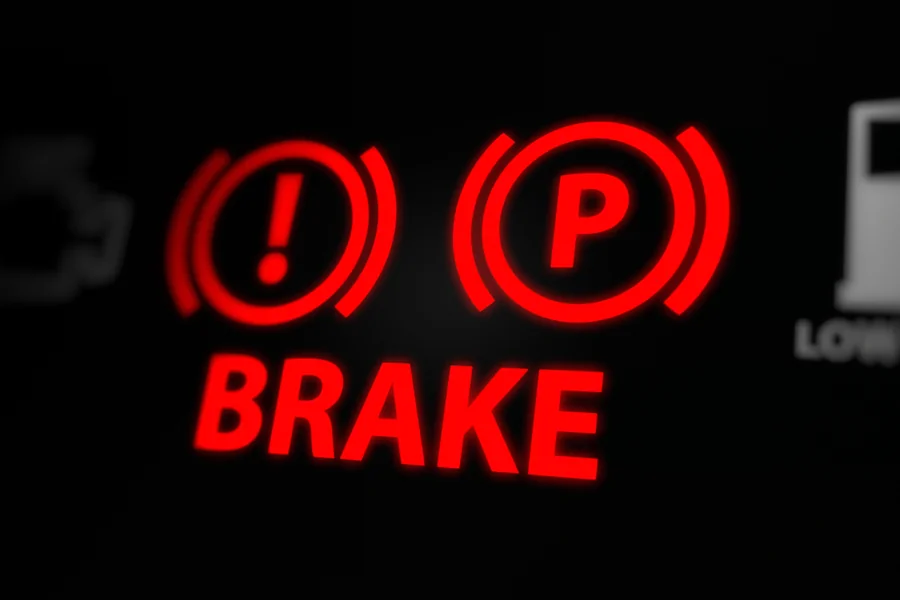
Brake warning light meaning is typically because your vehicle has identified a condition related to your brakes that requires attention. It could just be that the parking brake is on. It can also indicate that the brake fluid is low or that there is a problem with the brake system. A brake warning light that remains illuminated even when the parking brake has been released is a serious safety issue and cannot be ignored.
The warning is typically a red circle with an exclamation mark, or the warning word “BRAKE.” This may differ depending on the vehicle. Please refer to the owner’s manual for your model.
Quick Answer: What Does the Brake Warning Light Mean?
A brake warning light meaning can be an indication of the parking brake being applied, running low on brake fluid, or a brake system malfunction.
When the parking brake is released and the light stays on keep the car where it is and check the owner’s manual. Some manufacturers recommend to stop right away if you have a red brake-system warning. Toyota, for instance, lists as potential causes the low brake fluid or a problem with the brake system, and urges drivers to stop safely.
Brake Warning Light at a Glance
| Dashboard Warning | Common Meaning | What to Do |
| Red BRAKE light | Parking brake or brake-system problem | Release parking brake and recheck |
| Red circle with ! | Brake-system warning | Stop safely if it remains on |
| Parking brake symbol | Parking brake is engaged | Fully release parking brake |
| ABS light | Anti-lock braking system fault | Arrange inspection |
| Brake + ABS lights | More serious braking-system issue may exist | Stop safely and seek assistance |
| Brake pad warning | Brake pads may be worn | Schedule brake inspection |
| Brake fluid warning | Fluid may be below the required level | Have the brake system checked |
Brake Warning Light Meaning Explained
The first step in knowing the brake warning light meaning is to know that there are different types of dashboard warning lights.To understand the brake warning light meaning, it’s important to know that there are various types of dashboard warning lights.
The brake warning may be linked to the parking brake, hydraulic braking system, brake fluid level, electronic parking brake, ABS or other systems depending on the vehicle.
Colour is important, too.
A red brake warning light typically should be addressed immediately. Red alert signs are usually signs of more serious issues. If a yellow or amber brake related light appears, it is an indicator that there is a fault and the brake needs to be inspected but is not of the same urgency. The documentation from the NHTSA shows that red and yellow are employed by manufacturers to differentiate between more serious and less serious warnings for the braking system.
Your owner’s manual is the best guide to deciphering the exact meaning of your vehicle’s symbol.
What Does the Red Brake Light on the Dashboard Mean?
A red brake light commonly means one of three things:
- The parking brake is still engaged.
- The brake fluid level may be low.
- The braking system has detected a malfunction.
Start with the simplest possibility. Make sure the parking brake is completely released.
Modern vehicles are designed to provide an indicator when the parking brake is applied. U.S. brake-system requirements include a parking-brake indicator under specified conditions.
If the parking brake is fully released but the red light remains on, treat the warning seriously.
Do not assume the sensor is faulty simply because the car still seems to stop normally.
Common Reasons the Brake Warning Light Comes On
There are a number of things that could cause a warning message to pop up on the dashboard in regards to the brakes.
This is when the parking brake is applied.This is where the parking brake is activated.
1.This is one of the most frequently and mildly used.
Brake warning can still be on if started driving with parking brake on. Others vehicles make a warning noise as well.
Press down the parking brake and once again read the dashboard.
If the light switches off, the issue may be resolved.
If it is still lit, there is a need for further investigation.
- Low Brake Fluid
The purpose of brake fluid is to transmit the pressure of the brake pedal to the brakes at the wheels.
Some vehicles detect the level of fluid in the reservoir and illuminate the brake warning light when the fluid level gets too low.
For instance, Toyota includes “Low brake fluid” among the potential causes of its brake-system warning light.
Low fluid shouldn’t be viewed just as a reminder to increase fluid intake. A review of the cause of the low level should be conducted as well.
- Brake-System Malfunction
If a brake warning is always on, the braking system is likely to be malfunctioning.
Brake warning systems have also been used in the past to warn the driver to problems involving hydraulic pressure. NHTSA records include information about brake warning indicators that may be triggered in the event of a significant loss of pressure in part of a hydraulic brake system.
This varies by vehicle and is used for a variety of diagnostic purposes.
If the braking operation feels different or the warning message is not expected when driving, come to a safe stop.
- Worn Brake Pads
Electronic sensors for brake pads are fitted in some cars.
At some time, as the pads wear, a separate dashboard indicator might show up.
This symbol may not always appear as the primary red brake system warning.
Other signs that can be caused by worn brake pads are:
Squealing
Grinding
Reduced braking response
Longer stopping distance
Brake pedal vibration
Replaced worn brakes rather than just because the light has come on.
- ABS System Problem
The ABS warning light is different from the standard brake warning light.
Anti-lock braking system (ABS) is a safety device that prevents wheels from locking up during braking.
It is designed to assist in avoiding wheel lock during rapid braking on some occasions.
In some vehicles, if the ABS warning light is on, the anti-lock braking system will not function, but the vehicle can still be stopped conventionally. Toyota records this on some cars, for instance.
Designs will vary, please refer to the owner’s manual and schedule service.
- Electronic Parking Brake Fault
Many newer vehicles do not have a hand lever for the parking brake, but instead have an electronic parking brake.
These systems can give individual alerts if they detect issues with:
A major benefit of this system is that the electronic parking brake is now included.
Parking brake control
Brake hold
An electronic actuator
The warning could be a letter P, a brake icon or a message on the instrument display.
Meanings Across Platforms: Brake Warning Symbols Explained
The appearance and wording of brake warnings differ between manufacturers and dashboard systems.
Meanings Across Vehicle Dashboard Systems
| Symbol or Message | Typical Meaning | Example Situation |
| BRAKE | General brake or parking brake warning | Parking brake remains engaged |
| (!) inside circle | Brake-system warning | Low brake fluid or system fault |
| (P) inside circle | Parking brake status | Parking brake is applied |
| ABS | Anti-lock brake fault | ABS function needs inspection |
| Brake pad symbol | Brake-pad wear | Pads approaching replacement |
| “Brake System” | Electronic brake-system message | System detects a malfunction |
| “Parking Brake Fault” | Electronic parking brake issue | Parking brake control problem |
These descriptions are general. Dashboard symbols are not completely standardized across every make and model.
Brake Warning Light vs ABS Light
It is easy to confuse these two warnings.
| Feature | Brake Warning Light | ABS Warning Light |
| Typical color | Red | Yellow or amber |
| Main system | Basic braking system/parking brake | Anti-lock braking system |
| Common trigger | Parking brake, fluid level, system fault | ABS-related fault |
| Urgency | Often high | Requires inspection |
| Can you ignore it? | No | No |
| Best action | Check parking brake and manual | Check manual and arrange diagnosis |
A red brake warning deserves particular attention because it may relate directly to normal braking capability.
What If the Brake and ABS Lights Are Both On?
A brake warning light with ABS light on could be a more severe braking-system issue than with ABS light on alone.
Don’t keep driving if the brake pedal does not feel as it should.
Get to a safe area, if possible. Refer to the owner’s manual and manufacturer’s directions.
Certain combinations of braking warnings require immediate action, as per some of the manufacturer documentation.
Can You Drive With the Brake Warning Light On?
It’s based on the purpose for which the light is on.
When the parking brake is set and the parking brake release button is pressed, if the light is off, this may not mean that there is no operation signal.
When the parking brake is released and the brake warning light is still illuminated, it could be a safety hazard to continue driving.
Ford advises, for instance, checking the parking brake for release and checking the braking system when the warning is on.
If you see the following in addition to the above, do not drive:
- A spongy or soft brake pedal
- A foot that extends out of the ordinary towards the ground.
- Poor braking response
- Grinding noises
- Any fluid leak around one of the wheels or under the vehicle.
- If your pedals suddenly feel different, then it’s time to replace them.
- Multiple brake warnings
- Difficulty stopping normally
Arrange professional assistance instead.
What Should You Do When the Brake Warning Light Comes On?
Use a simple process.
Step 1: Stay Calm and Reduce Speed Safely
Avoid sudden acceleration.
Pay attention to how the brake pedal feels.
Step 2: Move Somewhere Safe
If the warning appears while driving, find a safe place to stop.
Step 3: Check the Parking Brake
Make sure the parking brake is fully released.
A partially engaged parking brake may keep the warning illuminated.
Step 4: Check for Other Warning Lights
Look for:
- ABS
- Traction control
- Electronic parking brake warning
- Stability-control warning
- Additional dashboard messages
Multiple warnings can provide useful diagnostic information.
Step 5: Read the Owner’s Manual
Manufacturers use different warning symbols and procedures.
The owner’s manual can tell you exactly what your particular dashboard light means.
Step 6: Arrange an Inspection When Necessary
If the brake warning stays on after the parking brake is released, have the vehicle inspected.
Brake warnings are not something to postpone simply because the vehicle appears to drive normally.
Why Does My Brake Light Come On and Off?
An intermittent brake warning can have several possible explanations.
It might be related to:
- Parking brake switch behavior
- Fluid level near the sensor threshold
- An electrical connection
- A brake-system sensor
- An electronic parking brake issue
Do not assume an intermittent warning is harmless.
Record when it happens. Note whether it occurs during turns, braking, startup, or after using the parking brake. That information may help a technician diagnose the problem.
Why Is My Brake Warning Light On but the Brakes Feel Fine?
A warning light can appear before you notice an obvious change in braking.
For example, a sensor may detect a low fluid level or electrical fault while pedal feel still seems normal.
That does not mean the warning should be ignored.
Dashboard warnings exist to alert you before or during a potential problem. A vehicle that stops normally today may still need inspection.
Brake Warning Light After Replacing Brake Pads
If a warning remains after brake-pad replacement, several possibilities may need checking.
These can include:
- Brake-pad wear sensor not reset
- Sensor damaged during replacement
- Brake fluid level issue
- Electronic parking brake service procedure
- Unrelated brake-system fault
Some cars require a dashboard reset or scan-tool procedure after brake service.
The correct method depends on the make and model.
Similar Terms & Alternatives
People use several phrases when searching for the brake warning light meaning.
| Similar Term | Meaning | Example |
| Brake system warning light | General braking-system alert | “My brake system warning light stays on.” |
| Brake dashboard light | General term for brake warning | “Why is my brake dashboard light red?” |
| Red brake light | Usually a higher-priority brake warning | “The red brake light appeared while driving.” |
| Parking brake light | Indicator showing parking brake status | “The parking brake light won’t turn off.” |
| ABS warning light | Anti-lock braking system warning | “My ABS warning came on today.” |
| Brake fluid warning | Possible low-fluid indicator | “The brake fluid warning appeared.” |
| Brake pad warning | Brake wear indicator | “My car says the brake pads need service.” |
Brake Warning Light Colors: Red vs Yellow
Dashboard colors help drivers judge the general importance of warnings, but the exact meaning varies.
Red Brake Warning Light
A red brake warning commonly relates to a condition requiring prompt attention.
It may indicate:
- Parking brake engaged
- Low brake fluid
- Brake-system malfunction
If it remains on after releasing the parking brake, stop safely and consult the owner’s manual.
Yellow or Amber Brake Warning
A yellow or amber brake-related symbol may indicate a secondary system fault, wear condition, or electronic brake issue.
It still deserves diagnosis.
Yellow does not mean the issue should be ignored indefinitely.
Google PAA: People Also Ask About Brake Warning Lights
| Question | Short Answer |
| What does the brake warning light mean? | It can indicate an engaged parking brake, low brake fluid, or a problem within the vehicle’s braking system. |
| Can I drive with my brake warning light on? | Avoid driving if the light stays on after releasing the parking brake or if braking performance feels abnormal. |
| Why is my brake light on when the parking brake is off? | The vehicle may have low brake fluid, a faulty sensor, or another braking-system problem requiring inspection. |
| What does a red brake warning light mean? | A red brake light often signals the parking brake, low fluid, or a potentially serious braking-system fault. |
| What does the ABS warning light mean? | It indicates the anti-lock braking system has detected a problem and may not operate normally until repaired. |
| Why are my ABS and brake lights on together? | Both lights can indicate a broader braking-system problem that should be checked promptly by a qualified technician. |
| Can low brake fluid turn the brake light on? | Yes. Some vehicles illuminate the brake-system warning when brake fluid falls below the specified operating level. |
| Will worn brake pads trigger a warning light? | Some vehicles have brake-pad wear sensors that activate a separate warning when the pads approach their replacement limit. |
How Do You Reset a Brake Warning Light?
You should not reset a brake warning simply to make the symbol disappear.
First identify and correct the cause.
If the parking brake caused the warning, releasing it properly should normally clear the indicator.
A service-related brake warning may require:
- Repairing the underlying issue
- Replacing a wear sensor
- Completing an electronic parking brake procedure
- Using a diagnostic scan tool
- Following a manufacturer-specific reset process
Never use a reset as a substitute for diagnosis.
When Should You Get the Brakes Inspected?
Arrange an inspection if the brake warning stays on or you notice changes in braking performance.
You should also pay attention to physical symptoms.
These include:
- Grinding
- Squealing
- Pulling during braking
- Steering-wheel vibration
- Brake pedal vibration
- Soft pedal feel
- Reduced stopping response
- Visible fluid leakage
- Burning smell near a wheel
Ford also lists the brake-system warning light among signs that should prompt brake inspection.
Is the Brake Warning Light Always Serious?
No. Sometimes the explanation is simply an engaged parking brake.
But you cannot safely assume that is the cause without checking.
A brake warning that remains on after the parking brake is fully released may represent a genuine system problem.
That distinction is important.
The sensible approach is simple: check the parking brake first. If the warning remains, follow the owner’s manual and have the system inspected.
How to Prevent Brake Warning Problems
Routine brake maintenance can reduce the chance of unexpected issues.
Useful habits include:
- Follow the manufacturer’s service schedule.
- Have brake pads inspected when recommended.
- Pay attention to changes in pedal feel.
- Do not ignore grinding or squealing.
- Check unexplained fluid leaks.
- Use the correct brake fluid specification.
- Investigate dashboard warnings promptly.
- Have brake work performed correctly.
Brake components wear gradually, so early attention can often identify problems before they become more serious.
Final Thoughts
The brake warning light meaning may be something as trivial as the parking brake being engaged or could be a problem with the brake fluid or a malfunction in the brake system.
Firstly, release the parking brake completely. If the light turns off and the car operates normally, then it is likely that the parking brake is to blame.
Don’t ignore the warning if it remains, if it is accompanied by other warnings for the brakes, or if it is seen with unusual pedal behavior. Stop safely and adhere to instructions in your vehicle’s owner’s manual.
Brake warning symbols vary from manufacturer to manufacturer, but there is a common guideline: If the brake system warning is on, it means it should be taken seriously—even if it is a persistent problem.
FAQs
What does the brake warning light meaning?
The brake warning light can indicate an engaged parking brake, low brake fluid, worn components, or a braking-system fault.
Can I drive with the brake warning light on?
Avoid driving if the warning stays on after releasing the parking brake, especially if braking feels weak, soft, or unusual.
Why is my brake warning light on when the parking brake is off?
It may be caused by low brake fluid, a faulty sensor, worn brake parts, or another issue in the braking system.
What does a red brake warning light mean?
A red brake warning light usually signals a brake-system condition that needs prompt attention, including low fluid or a system malfunction.
Why are my ABS and brake warning lights on together?
Both lights can indicate a wider braking-system problem. Stop safely, check your owner’s manual, and arrange a professional inspection.